Skip to content










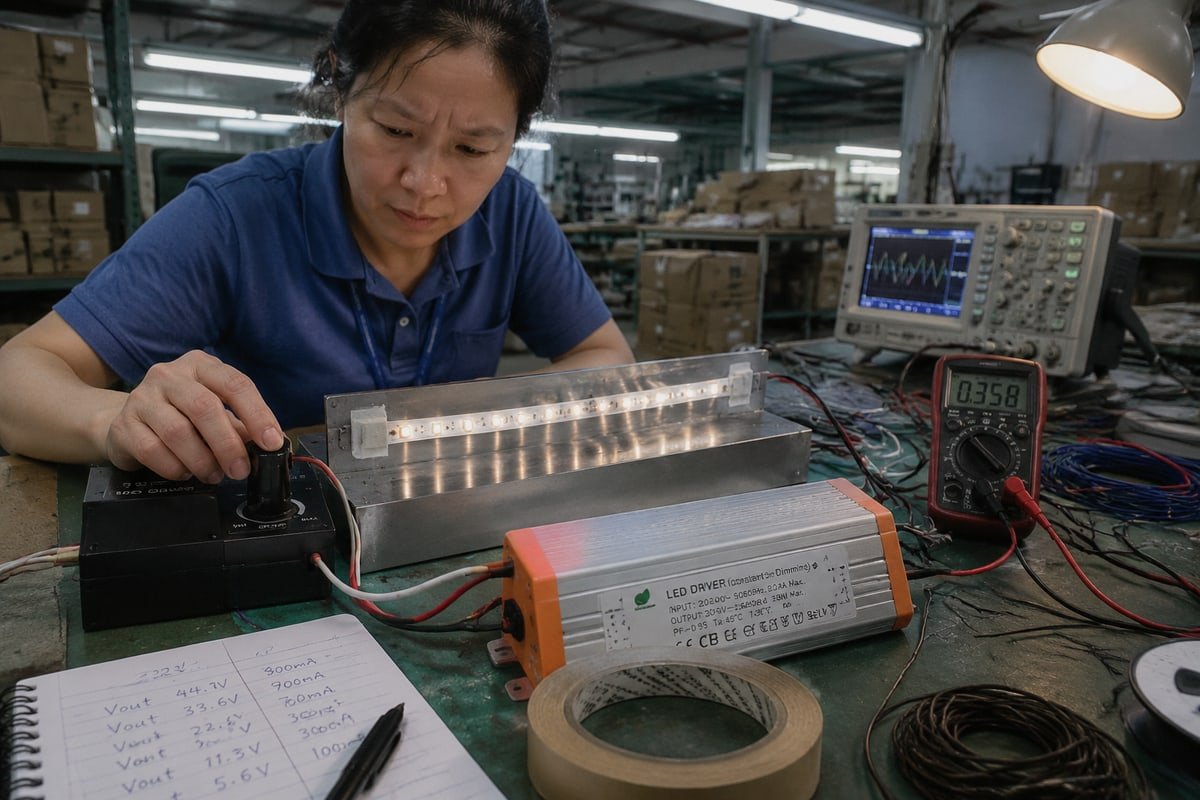
LED strips flicker with CV TRIAC drivers more often than any other complaint we log at our driver factory. It frustrates installers, kills project confidence, and stalls repeat orders.
LED strips flicker with CV TRIAC drivers when the dimmer, driver input circuit, and LED load are not properly matched. The TRIAC cuts the AC waveform, and an incompatible driver fails to keep stable DC regulation—especially at low dimming levels, low loads, or with the wrong leading-edge/trailing-edge pairing.
That answer sounds simple. But the details matter. Below, I break down the real causes, the fixes that work, and how to qualify products before you buy in bulk.
What causes my LED strips to flicker when I use CV TRIAC drivers?
Last year our QC team traced a Singapore client’s flicker complaint to one root cause: the driver’s input stage 1 could not hold the TRIAC latched. That case shaped this whole section.
Flicker happens when the phase-cut waveform, the driver’s input stage, its DC regulation loop, and the LED load fall out of sync. Common triggers include holding-current dropout, excessive input capacitance, leading-edge/trailing-edge mismatch, hiccup protection cycling, and loads below the driver’s minimum load requirement.

Most people frame this as “TRIAC incompatibility.” That framing is too vague to fix anything. The real chain is this: phase-cut waveform → driver input stage → DC regulation and control loop → LED load. Flicker appears when any link in that chain breaks down.
The most overlooked cause: holding current
A TRIAC needs enough current flowing through it to stay latched during each AC half-cycle. A driver with a small or highly nonlinear input current can make the TRIAC turn off early or fire inconsistently. This gets worse near the bottom of the dimming range, because the conduction window 2 is already short. That is why flicker often appears only below roughly 20% brightness. The system works fine at full power, then flashes, pops, or shimmers when you dim down.
The full list of flicker mechanisms
In our lab, we sort flicker complaints into the mechanisms below. Each one has a different fix, so identifying the right one saves weeks.
| Mechanism | What actually happens | Typical symptom |
|---|---|---|
| Holding-current dropout | Driver draws too little current to keep the TRIAC latched | Flashing or popping at low dim levels |
| Leading/trailing edge mismatch | Driver cannot decode the dimmer’s phase-cut style | Flicker across the whole range |
| EMI filter inrush ringing | Input capacitors ring at each TRIAC trigger | Shimmer or buzz near mid-range |
| Zero-cross detection jitter | Driver misreads the chopped waveform timing | Random, irregular flicker |
| Hiccup protection cycling | Overload protection restarts the driver repeatedly | Slow, rhythmic on-off blinking |
| Ripple vs PWM beat patterns | Rectified AC ripple interferes with the internal PWM dimming frequency | Slow rolling or strobing effect |
| Thermal drift | Latching thresholds shift as components heat up | Flicker that starts after warm-up |
| Harmonic pollution | Other nonlinear loads notch the AC waveform on the branch | Flicker only when other equipment runs |
| Voltage drop on DC runs | Undersized wire or long runs cause sag oscillations | Flicker at the far end of the strip |
| Reflected impedance mismatch | Strip’s parasitic inductance upsets the output regulation loop | Instability with very long strips |
Notice that only some of these are dimmer problems. Several are power-delivery problems that just become visible when dimming removes the system’s margin.
How can I fix flickering in my TRIAC dimmable LED strip lighting projects?
A client in Vietnam once returned three “faulty” drivers to our workshop. All three passed our bench tests. His real problem was voltage drop on a long strip run at the job site.
Fix flicker by testing in order: bypass the dimmer, verify driver voltage and wattage match the strip, confirm the dimmer’s minimum load is met, tighten every connection, measure voltage drop along the run, and finally replace the driver with a phase-cut-rated CV unit.
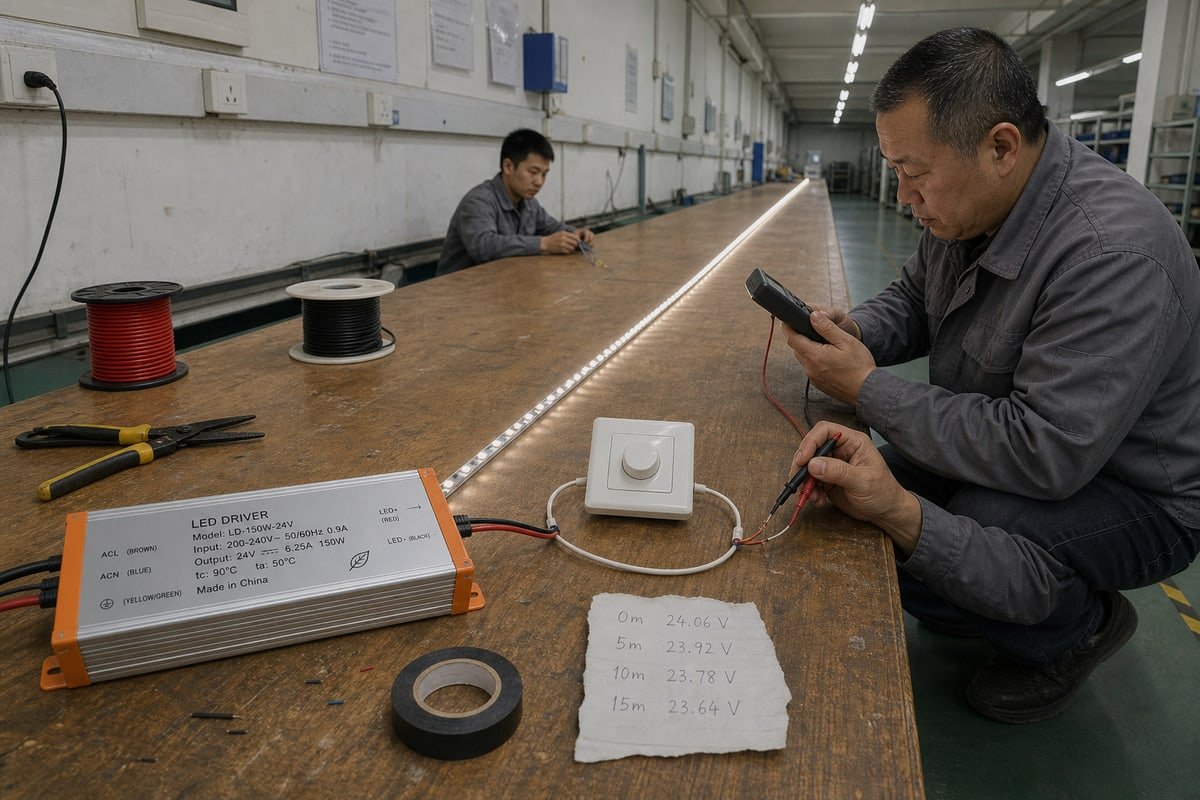
The fastest way to fix flicker is to stop guessing and start eliminating. The key distinction is between dimmer-induced flicker and power-delivery flicker. They look identical to the eye, but they need opposite fixes. Here is the elimination sequence we recommend to our engineering clients.
- Bypass the dimmer. Wire the driver directly to mains. If the flicker disappears, the problem lives in the dimming chain 3. If it stays, look at power delivery instead.
- Verify the electrical match. Confirm the low voltage LED transformer outputs the correct 12V or 24V, and that its wattage covers the strip with headroom. A driver running at its ceiling can slip into hiccup protection, which looks like rhythmic blinking.
- Check the dimmer’s minimum load. Many wall dimmers need a minimum wattage to operate. A short strip at low brightness may sit under that floor, so the dimmer cycles on and off.
- Inspect every connection. Loose terminals, corroded splices, and cheap clip connectors create intermittent contact that mimics dimmer trouble perfectly.
- Measure voltage at both ends of the strip. If you see more than about 0.5V of drop from start to finish, sag is contributing to the flicker. Shorten the run, upsize the wire, or feed power from both ends.
- Swap the driver last. If steps one through five pass and flicker remains, replace the driver with a unit explicitly rated for phase-cut dimming and confirmed against your dimmer model.
Following this order matters. In our after-sales records, a large share of “driver failures” turn out to be wiring, load sizing, or dimmer minimum-load issues that a new driver would never have fixed.
Which TRIAC dimmer switches are truly compatible with my CV LED drivers?
Choosing between a forward phase dimmer and a trailing-edge model is a trade-off our engineers weigh constantly: raw latching reliability versus smooth low-end performance.
Compatible TRIAC dimmers match the driver’s declared dimming method—leading edge, trailing edge, or both—meet the driver’s input current profile, and carry a minimum load rating the connected strip can satisfy. Always confirm the pairing against the driver manufacturer’s tested dimmer compatibility list.
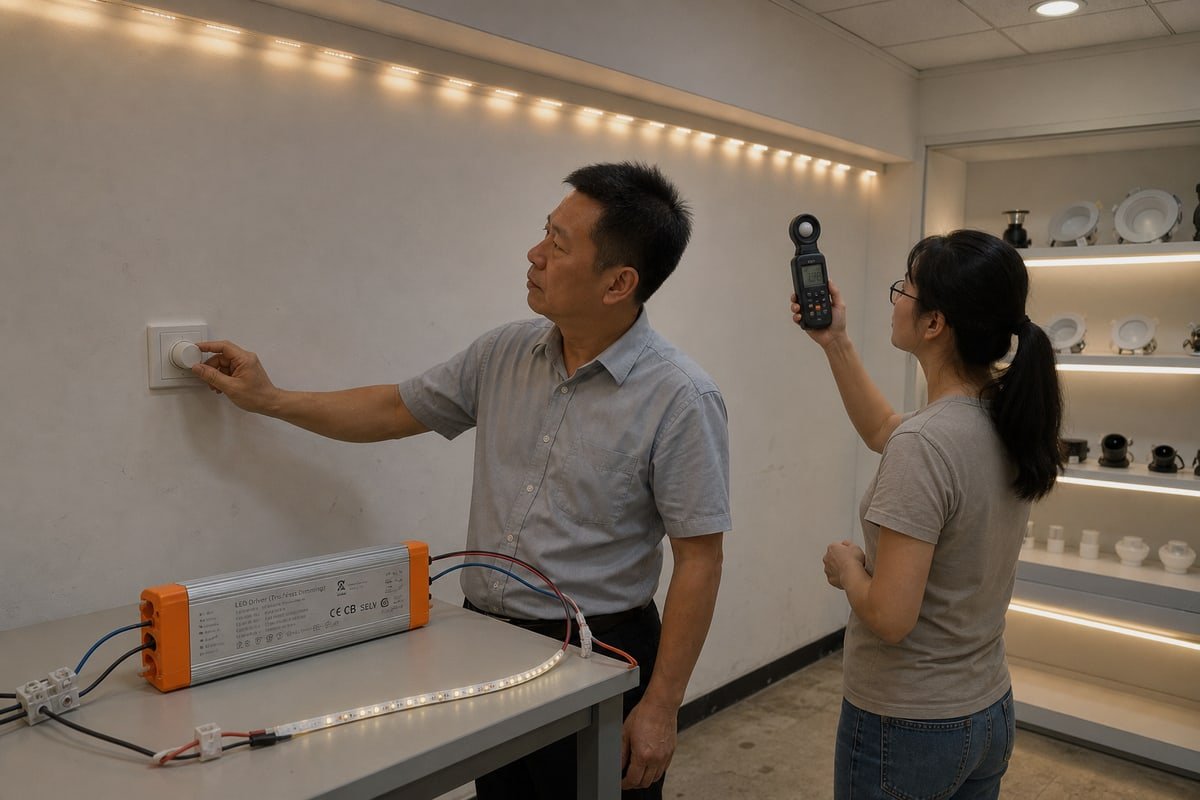
Dimmer switch compatibility is where most projects go wrong, so start with the leading edge vs trailing edge comparison. The two technologies cut the AC waveform differently, and a driver designed for one may misbehave on the other.
| Factor | Leading edge (forward phase) | Trailing edge (ELV type) |
|---|---|---|
| How it cuts the waveform | Chops the front of each half-cycle | Chops the back of each half-cycle |
| Original design target | Incandescent and magnetic loads | Electronic low-voltage loads |
| Holding current sensitivity | High—needs steady current to stay latched | Low—uses transistors, not a latching TRIAC |
| Minimum load requirement | Often 25W or more | Usually much lower |
| Low-end dimming behavior | Prone to dropout and flash | Typically smoother and quieter |
| Best pairing | Drivers explicitly rated for leading edge | ELV dimmable driver designs |
Now let me address a common buyer objection. Some engineers tell me TRIAC dimming is inherently wrong for LED strips, and that only a MOSFET or trailing-edge solution can be flicker-free. I understand where that view comes from—legacy incandescent dimmers on generic constant voltage power supply 4 units flicker badly. But the conclusion is outdated. A driver whose input stage is engineered to decode phase-cut input, present a stable current to the TRIAC, and regulate cleanly at deep dimming levels can perform very well on leading-edge hardware 5. The real spectrum runs from “old generic setups that flicker” to “engineered TRIAC-compatible systems that do not.”
The practical rule we give distributors: never qualify a dimmer alone. Qualify the dimmer, driver, and strip as one system, and ask your supplier for their tested compatibility list before specifying anything.
How do I choose a reliable CV TRIAC driver to prevent flicker in bulk orders?
One lesson from years of exporting drivers to Europe and Southeast Asia stands out for me: a datasheet line reading 24V constant-voltage tells you nothing about dimming.
Choose a driver explicitly labeled 24V constant-voltage, TRIAC/phase-cut dimmable—not merely constant-voltage. Verify leading-edge and trailing-edge support, minimum and maximum load, low-end dimming stability, input current behavior, safety marks like CE, CB, and SELV, then sample-test the full dimmer-driver-strip combination before committing.
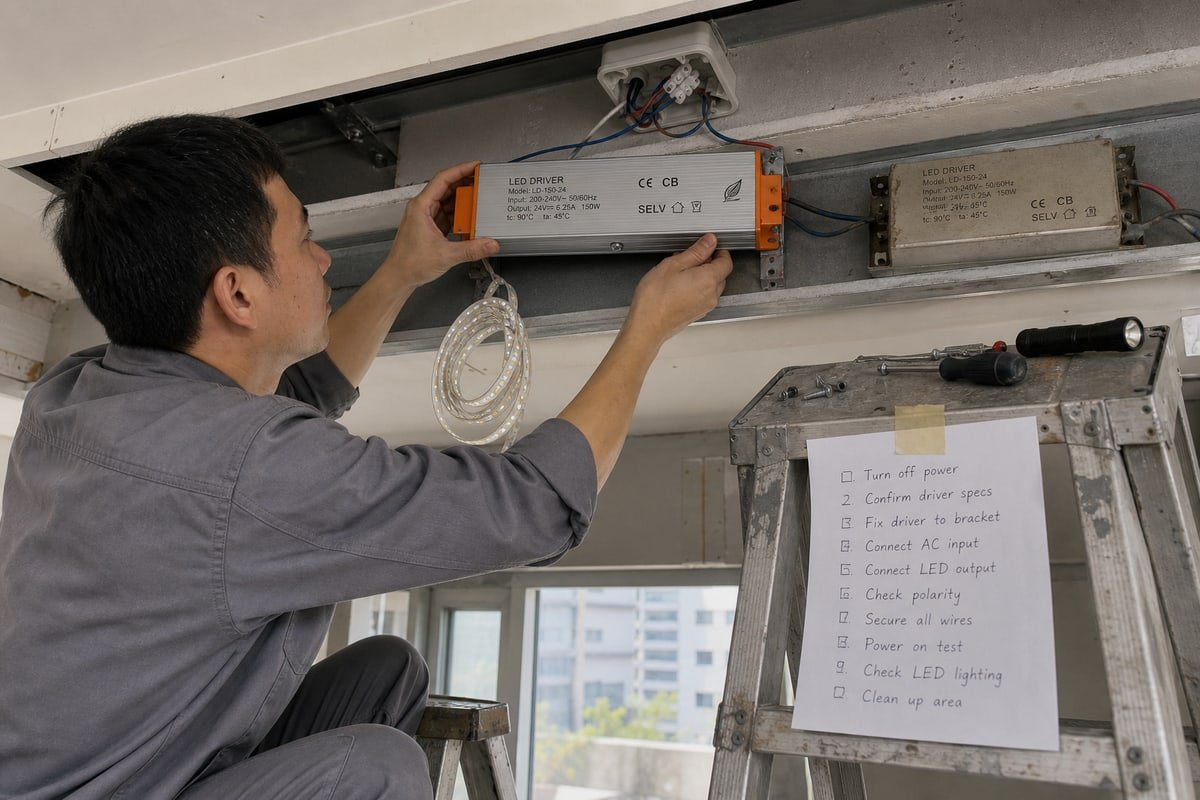
Here is the hidden problem that costs buyers the most money. A 24V LED strip can be perfectly compatible with a 24V CV driver electrically and still flicker when dimmed. Voltage compatibility and dimming compatibility are two different things. A conventional constant voltage power supply may produce excellent 24V DC in normal operation, yet its input circuit may be completely unsuited to a phase-cut waveform. Wiring it behind a TRIAC dimmer does not magically make it a TRIAC-dimmable driver. The specification must say something like “24V constant-voltage, TRIAC/phase-cut dimmable”—not simply “24V constant-voltage power supply.”
The six questions to ask every supplier
Before any bulk order, we tell buyers to go beyond “is it TRIAC dimmable?” and ask these six questions instead:
- Is it designed for leading-edge, trailing-edge, or both?
- What is the driver’s minimum and maximum load?
- What is the input current waveform of the driver?
- Does it maintain stable regulation at your intended minimum dimming level?
- Is the LED strip actually drawing enough power for the driver’s operating range?
- Does the dimmer have a minimum-load requirement of its own?
The bulk-order qualification checklist
| Checkpoint | What to verify | Red flag |
|---|---|---|
| Dimming label | States TRIAC/phase-cut dimmable explicitly | Only says constant-voltage |
| Safety marks | CE, CB, and SELV printed on the housing | Missing or unverifiable certificates |
| Thermal design | Aluminum casing with heat-dissipation grooves | Sealed plastic with no thermal path |
| Flicker-free claims | Ask if 0–100% dimming applies to your dimmer and load | Claim given with no tested dimmer list |
| Low-end test | Sample tested at your real minimum brightness | Only tested at full output |
| Warranty terms | Written warranty honored on dimming faults | Warranty excludes dimming behavior |
On the hardware side, physical build quality tells you a lot. Our own units use a brushed aluminum housing with ribbed heat-dissipation grooves, because thermal drift in a hot driver can shift latching behavior and create flicker that only appears after warm-up. Also treat “0–100% flicker-free” marketing as a compatibility claim, not a universal guarantee—it holds only with tested dimmers across the stated load range. My strongest B2B takeaway: do not qualify a CV driver as TRIAC dimmable just because it accepts a TRIAC dimmer. The real test is whether the complete dimmer, driver, and LED-strip combination stays stable across your entire required dimming range.
Conclusion
Flicker is a system mismatch, not a mystery. Match the dimmer, driver, and strip; test the complete chain; and only buy from suppliers who qualify full combinations.
Footnotes
- Explains the function of the input stage in TRIAC-based power control. ↩︎
- Technical explanation of phase-fired control and conduction timing. ↩︎
- The original Department of Energy URL is 404; this is the updated authoritative page explaining LED flicker fundamentals and system components. ↩︎
- EU Low Voltage Directive standards for constant voltage electrical equipment. ↩︎
- NEMA standard regarding dimming compatibility for solid-state lighting. ↩︎