Skip to content










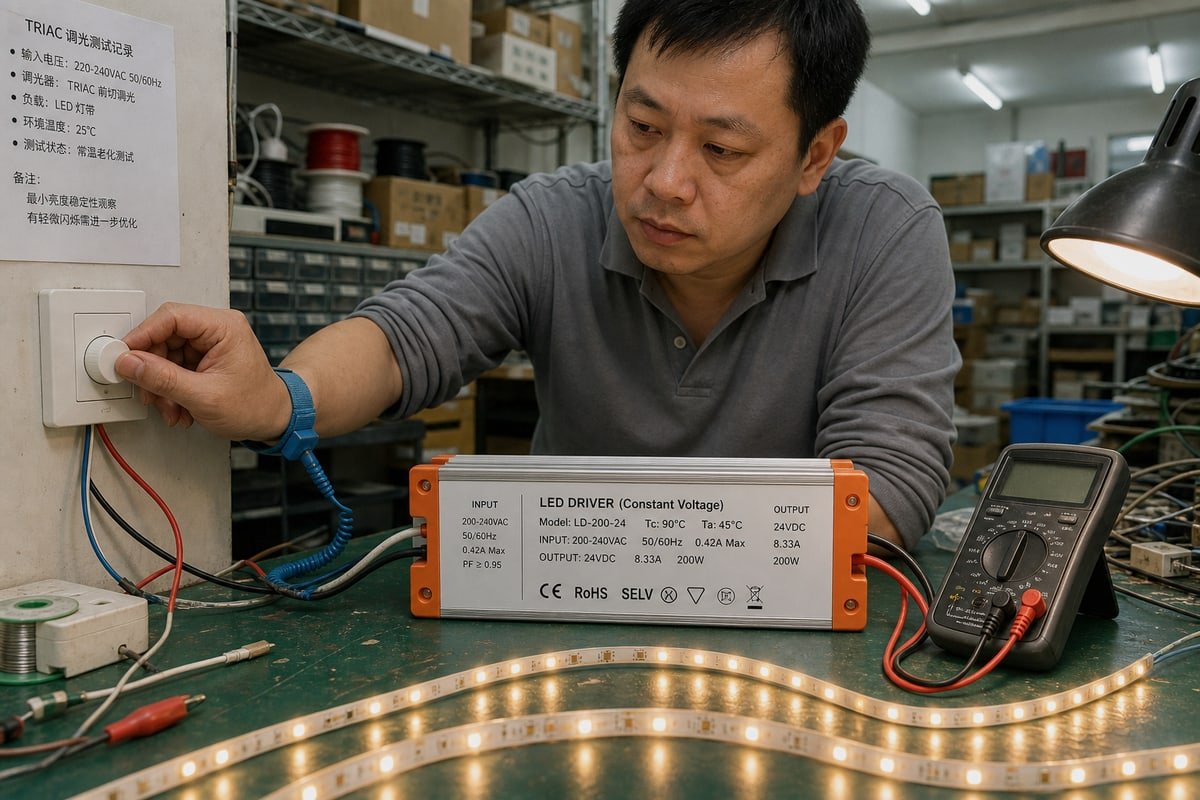
A client’s LED strips flickered badly on a hotel project last year. Our Shenzhen lab traced it to minimum load requirements for TRIAC CV drivers — a spec most buyers overlook.
A TRIAC-dimmable constant-voltage (CV) LED driver may need a minimum connected load for stable operation with a TRIAC phase-cut dimmer. If the total LED load falls below the dimmer’s specified minimum, the system can flicker, buzz, drop out, or switch unreliably. Always verify both dimmer and driver load ratings.
One quick note on terminology before we go deeper. The TRIAC normally sits inside the dimmer, not inside the constant-voltage output stage 1 of the LED driver. So when people say “TRIAC CV driver,” they usually mean a CV driver designed to accept TRIAC phase-cut input. That distinction shapes everything in this article. Let’s break it down piece by piece.
What is the minimum load requirement for TRIAC CV drivers and why does it matter for my project?
Last month, a lighting distributor in Singapore sent me a WhatsApp message: her 6W TRIAC-dimmable drivers flickered on one dimmer but ran perfectly on another. Terminology was the culprit.
The minimum load requirement is the lowest connected wattage a TRIAC phase-cut dimmer needs to keep its internal TRIAC latched and conducting. It matters because loads below this threshold can cause flickering, dropout, or unreliable switching — even when the CV driver itself is fully functional.

Here is the point I make very prominent with every buyer: the dimmer’s minimum load and the LED driver’s minimum load are two different specifications. Confusing them causes most field failures I see.
Two Specs, Two Meanings
A dimmer might state a minimum LED load of 10W. A driver might state a minimum output load of 2W. These numbers describe completely different things. The first concerns whether the dimmer can operate correctly with the connected electrical load. The second concerns whether the driver can regulate its LED output correctly at a particular load. Both must be satisfied.
| Specification | Belongs To | What It Governs | Typical Example |
|---|---|---|---|
| Minimum LED load | The wall dimmer | Whether the TRIAC stays latched through the AC cycle | 10W minimum |
| Minimum output load | The LED driver | Whether the driver regulates its DC output cleanly | 2W minimum |
| Holding current | The TRIAC inside the dimmer | Current needed to remain conducting | 10–50mA |
| Latching current | The TRIAC inside the dimmer | Current needed to start conducting each half-cycle | Varies by device |
Why Watts Alone Don’t Tell the Story
Here is the expert insight I always share. Minimum load is not simply a wattage problem. It is an electrical-behavior problem. A traditional TRIAC dimmer was designed around a resistive load 2, like an incandescent lamp, which draws predictable current across the whole AC waveform. A CV LED driver behaves very differently. Its input stage may contain rectifier circuitry, EMI filtering, capacitors, switching electronics, active power-factor correction 3, and inrush-current limiting. So a 6W LED driver doesn’t necessarily “look like” a 6W resistive load to the TRIAC. That’s why two different 6W drivers can behave completely differently on the same dimmer.
This also explains why a leading-edge dimmer 4 struggles more with small electronic loads than a trailing-edge dimmer. Trailing-edge designs use MOSFETs and don’t need a holding current, so they tolerate low-power phase-cut dimming far better.
How do I calculate the minimum load needed for my TRIAC CV driver setup?
When we spec drivers for a multi-fixture project, we always weigh one trade-off: adding wattage headroom raises component cost, but running at the dimmer’s edge risks callbacks.
Add up the actual input wattage of every driver on the circuit, then compare the total against the dimmer’s minimum and maximum LED load ratings. Also verify the driver’s own minimum output load, the maximum driver count, and aggregate inrush current before finalizing the design.

The math itself is simple. The judgment behind it is not. Follow this process, and you will avoid the mistakes I see in project inquiries every week.
- Find the dimmer’s published minimum LED load. Legacy leading-edge dimmers often specify 20W–40W. Modern LED-optimized phase-cut controls can work down to 1W–3W. Never assume; read the datasheet.
- Find the driver’s minimum output load. Some drivers advertise no minimum load. Others define a real operating window — one 24V TRIAC-dimmable CV driver datasheet we benchmarked shows a 33–100W load range with under 1W no-load consumption. That is a defined window, not a no-load guarantee.
- Use actual measured wattage, not nominal fixture ratings. LED tape often draws less than its label suggests.
- Check totals against both minimum and maximum ratings.
- Leave headroom. Running exactly at the minimum invites instability as components age and temperatures shift.
Worked Example — Qualified Correctly
If the dimmer specifies a 10W minimum LED load and the actual connected load is 6W, the combination is outside the dimmer’s specified operating range and may be unstable. Notice I said “may,” not “will.” Some dimmers tolerate loads below their published minimum; others don’t. Operating outside the spec simply means the manufacturer no longer guarantees dimming stability.
The Multi-Driver Trap
This one matters for commercial lighting. Compare one 6W driver against twenty 6W drivers. The nominal load changes from 6W to 120W, but so do other electrical characteristics — especially aggregate inrush current 5 and the interaction of twenty input circuits on one dimmer. So the correct calculation is never just 6W × 20 = 120W.
| Check | Single 6W Driver | Twenty 6W Drivers |
|---|---|---|
| Steady-state load | 6W | 120W |
| Dimmer minimum load | Likely below it | Comfortably above it |
| Aggregate inrush current | Negligible | Potentially critical |
| Maximum driver count per dimmer | Not a concern | Must verify with manufacturer |
| Compatibility testing needed | Yes | Yes, at full quantity |
What problems will I face if my lighting load falls below the minimum requirement?
Our QC team once burned three days chasing a flicker that only appeared after twenty minutes of runtime. The cause taught us how sneaky under-loaded circuits can be.
Loads below the minimum requirement can cause LED flickering, audible buzzing, pop-on behavior, dead zones at the top of the dimming range, ghosting when switched off, and dropout at low brightness. Some symptoms appear only after the dimmer warms up and its holding current rises.

That warm-up detail deserves emphasis. A TRIAC’s holding current requirement is temperature-sensitive and typically increases as the device heats up. So a system that looks stable at startup can begin flickering twenty minutes later. If your installer reports “it worked fine at first,” suspect this mechanism.
Symptom-to-Cause Map
| Symptom | Possible cause |
|---|---|
| Flicker at low level | Insufficient load or driver/dimmer incompatibility |
| Flicker throughout range | Phase-cut incompatibility or unstable driver input |
| Buzzing | Electrical or mechanical interaction between dimmer and driver |
| Drops out while dimming | TRIAC holding-current and input-current interaction |
| Won’t turn fully OFF | Leakage current or driver input behavior |
| Works with several fixtures but not one | Load below minimum |
| Works with one fixture but fails with many | Inrush current or maximum driver count |
A few of these need extra explanation. Pop-on behavior means the LEDs stay dark at low dimmer settings and snap on abruptly higher up the slider. A dead zone means the light sits at 100% output across the top portion of the dimmer’s travel. Ghosting — faint glowing or periodic flashing in the OFF state — often appears with no-neutral smart dimmers, which draw their standby power through the load itself. And audible buzzing can come from drivers using secondary-side PWM, which reflects high-frequency current pulses back to the primary side and disturbs the TRIAC’s zero-crossing detection.
Should You Add a Dummy Load?
A common field fix is adding a resistive dummy load or a flicker-fixer to lift the circuit above the dimmer’s minimum rating. That can work, but I give every buyer this warning: adding a dummy load may solve minimum-load instability, but it also increases energy consumption and heat, and it does not necessarily solve driver/dimmer incompatibility. Use it only when both manufacturers permit it. Remember — a minimum-load problem is not a universal compatibility problem. If the driver’s input stage is incompatible with the dimmer’s waveform, more watts won’t cure the flicker. Also note that flicker-free drivers with internal active bleeder circuits concentrate heat at low dimming levels, so thermal management matters even when the LEDs draw almost nothing.
How can I find a TRIAC CV driver supplier that meets my project’s minimum load and customization needs?
On our Shenzhen production line, every TRIAC-dimmable driver batch gets tested against a wall of real dimmers before shipping. That habit came from hard lessons with export projects across Europe and Southeast Asia.
Choose a supplier that publishes minimum and maximum load specifications, provides dimmer compatibility lists, offers OEM/ODM customization of load ranges and bleeder circuits, and tests drivers against real phase-cut dimmers. Ask for samples, test reports, and technical support before committing to volume orders.

At boqi, we work exclusively with brand owners, wholesalers, and lighting manufacturers, so I evaluate supplier questions from the buyer’s chair every day. Procurement managers like Olivia — one of our long-term clients in Singapore — care about three things: total project cost, tight deadlines, and access to current design technology. Minimum load requirements for TRIAC CV drivers touch all three. A driver that fails compatibility testing after installation blows both the budget and the schedule.
Questions That Separate Good Suppliers from Risky Ones
Don’t ask only, “How many watts can this TRIAC dimmer handle?” Ask both “What’s the minimum LED load?” and “How does the LED driver’s input behave with this dimmer?” That second question is the one most suppliers cannot answer. A capable partner should tell you whether their driver supports forward-phase dimming, whether it works with a trailing-edge dimmer as well, how its bleeder circuit handles low-load conditions, and which specific dimmer models they have validated. When we develop an OEM driver for a European client, we test dimming stability against the leading-edge dimmer brands common in that market — because a driver that passes in one country’s electrical environment can behave differently in another.
Supplier Evaluation Checklist
| What to Verify | Why It Matters | Red Flag |
|---|---|---|
| Published min/max load specs | Lets you design circuits with confidence | Vague or missing datasheets |
| Dimmer compatibility list | Confirms real-world phase-cut dimming tests | “Works with all TRIAC dimmers” claims |
| OEM/ODM capability | Load range and bleeder tuning for your market | One-size-fits-all catalog only |
| Certifications (CE, CB) | Required for EU and export markets | Unverifiable certificates |
| Sample and test support | Validates your exact dimmer-driver-load chain | Refusal to send pre-production samples |
| After-sales technical support | Fast troubleshooting protects your schedule | Slow or scripted responses |
The market itself is genuinely confusing here. Some vendor guides insist TRIAC dimming still needs 25W–40W of load, while some driver makers advertise no minimum load at all. Both statements can be true, because they describe different products and different parts of the system. Minimum-load performance is a design-specific specification, not a universal TRIAC rule. A supplier who explains that honestly is a supplier you can trust with your brand.
Conclusion
Under-loaded TRIAC circuits flicker, buzz, and drop out — and the fix starts with one habit: check the dimmer’s minimum load, the driver’s minimum load, and their real compatibility together.
Footnotes
- Wikipedia overview of LED circuit configurations and output stage characteristics. ↩︎
- Technical documentation from a leading semiconductor manufacturer regarding TRIAC electrical characteristics and loads. ↩︎
- Authoritative Wikipedia entry explaining active power factor correction for electronic loads. ↩︎
- Wikipedia entry explaining the operation and technical differences between phase-cut dimmer types. ↩︎
- NEMA standard defining inrush current characteristics and requirements for LED lighting equipment. ↩︎