Skip to content











A returned batch of dead LED modules taught our Shenzhen team a hard truth: without constant current control 1, LED modules quietly cook themselves. Here is why that happens.
Constant current is preferred for LED modules designed as constant-current loads because an LED’s forward voltage shifts with temperature and current. A constant-current driver regulates current instead of letting it climb, maintaining predictable light output, limiting thermal stress, and extending LED lifespan. Match current first, then verify voltage compliance.
One clarification matters before we go further. Constant current is not preferred for every LED product on earth. It is preferred for LED loads that were designed as constant-current loads: bare modules, COB arrays, and series strings. LED strips with built-in current limiting are a different story. This article walks through the physics, the reliability gains, the cost math, and a practical selection method. Let’s start with the core question.
Why should I choose constant current drivers over constant voltage for my LED modules?
A procurement manager in Singapore once asked me why her supplier insisted on constant current drivers for bare COB modules. Our answer came down to one word: physics.
Choose constant current drivers for LED modules designed as constant-current loads because bare LEDs cannot regulate their own current. A small voltage rise creates a large current spike. Constant voltage drivers suit LED strips with built-in current limiting; bare modules, COBs, and series strings need regulated current.

The most important concept here is the LED’s negative differential resistance behavior. An LED does not naturally regulate its own current. Once its forward voltage 2 is reached, a relatively small increase in voltage can produce a disproportionately large increase in current. The chain looks like this: higher current raises LED temperature, higher temperature changes the forward voltage, the operating point shifts, and the current can climb even further. That is exactly why connecting a bare LED module directly to a voltage source is dangerous.
A properly designed constant current driver breaks that chain. It controls the current, while the LED voltage settles at whatever value the load requires within the driver’s operating range. Let me kill a common misconception right away: a constant-current driver does not force a fixed voltage into the LED. The LED determines its operating voltage; the driver regulates the current.
Where does each driver type belong?
| Feature | Constant Current (CC) | Constant Voltage (CV) |
|---|---|---|
| Regulated output | Current | Voltage |
| Typical specification | 350 mA, 500 mA, 700 mA | 12V, 24V |
| Typical application | Bare LED modules, COBs, many downlights | LED strips, CV modules |
| Primary selection parameter | LED current | LED voltage |
| Secondary parameter | Forward-voltage/compliance range | Maximum load current/power |
| Current limiting | Built into driver | Usually required within the LED load |
So a constant voltage driver is not wrong. It is simply the right tool for a different architecture. CC drivers also pair naturally with a series circuit, because the same current flows through every LED in the string while the driver adjusts its output voltage to cover the combined forward voltage.
How does constant current improve the reliability and lifespan of my LED lighting projects?
Every driver batch on our line goes through a full burn-in test before shipping. That habit started after we studied why field failures cluster around heat, not brightness.
Constant current improves reliability by preventing thermal runaway, holding LEDs within their absolute maximum current rating, and stabilizing junction temperature. Steady current keeps luminous flux and color consistency predictable, reduces electrical stress on the chip, and typically extends LED lifespan across the fixture’s operating temperature range.
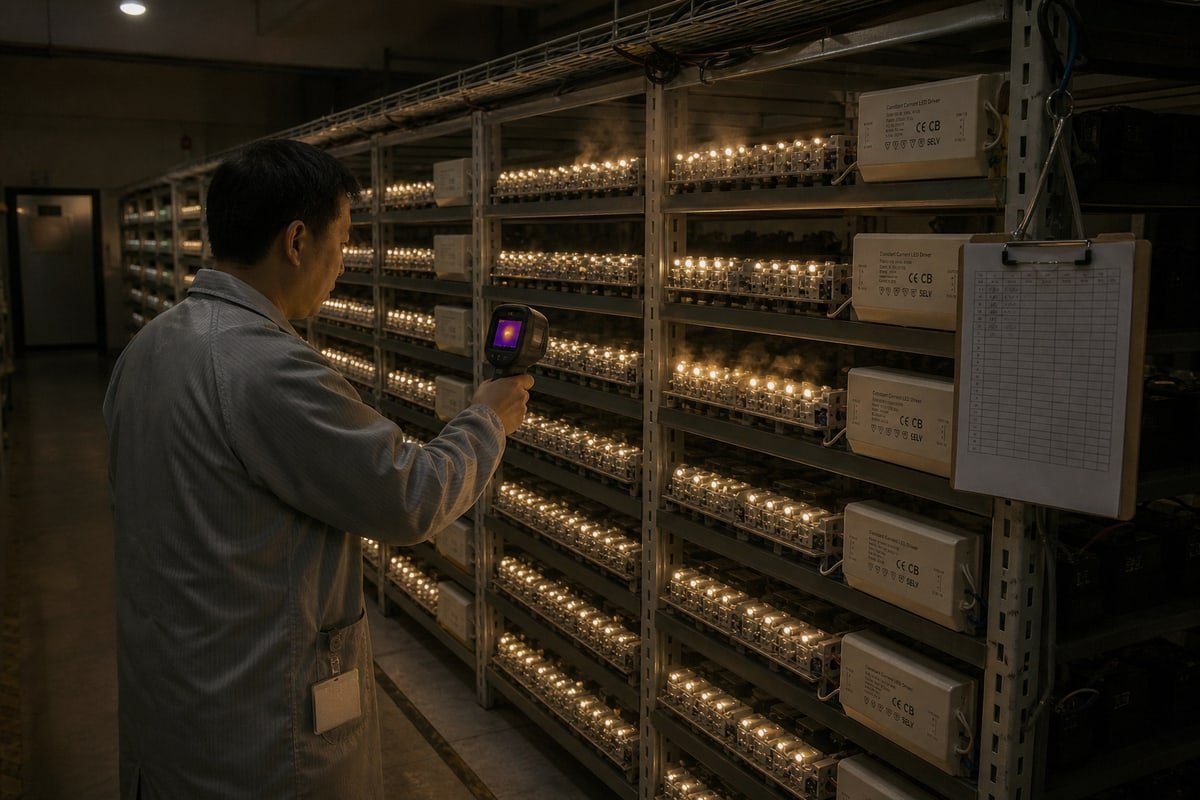
LEDs have a negative temperature coefficient. As the junction heats up, resistance effectively falls and the diode pulls more current at the same voltage. On an unregulated supply, that loop feeds itself until the chip fails. Engineers call this thermal runaway, and it is the single biggest killer of overdriven modules. A CC driver compensates automatically: as the LED warms and its forward voltage drifts, the driver adjusts its output voltage and holds the current at the setpoint. That is built-in overdrive protection, keeping the chip inside the manufacturer’s Absolute Maximum Current Rating regardless of input fluctuations.
Light quality benefits you can measure
Reliability is not only about survival. LED chips are binned at a calibrated current. When current wanders away from that binning point, the color temperature 3 shifts, and a wall of downlights stops matching. Regulated current prevents that CCT drift and keeps luminous flux 4 uniform across every module in a series string. Well-designed CC drivers also reduce the flicker index and mitigate the stroboscopic effect, which matters in factories with rotating machinery or studios using high-speed cameras.
| Failure or quality risk | How constant current helps |
|---|---|
| Thermal runaway | Holds current fixed as temperature rises |
| Chip burnout | Respects the absolute maximum current rating |
| CCT drift | Keeps LEDs at their calibrated binning current |
| Uneven brightness | Same current through every LED in the string |
| Flicker | Lower flicker index with proper output filtering |
A hidden diagnostic bonus
There is one benefit most articles skip. Because the driver holds current constant, you can monitor the forward voltage needed to maintain it. A long-term shift in that voltage signals LED aging or interconnect degradation before the fixture actually fails. Several of our engineering clients in Germany and Japan use exactly this method for predictive maintenance in enclosed fixtures, where heat dissipation is hardest.
What cost advantages can I expect from switching to constant current LED drivers?
Price-per-watt is the first number most buyers quote to us at trade shows. Yet the drivers that look cheapest on a quotation are rarely cheapest across a project’s life.
Constant current LED drivers cut costs by removing current-limiting resistors that waste roughly 20–40% of power as heat, lowering energy bills, reducing warranty returns from overcurrent failures, and compensating for voltage drop on long runs. Better power factor and lower THD also ease utility compliance costs.
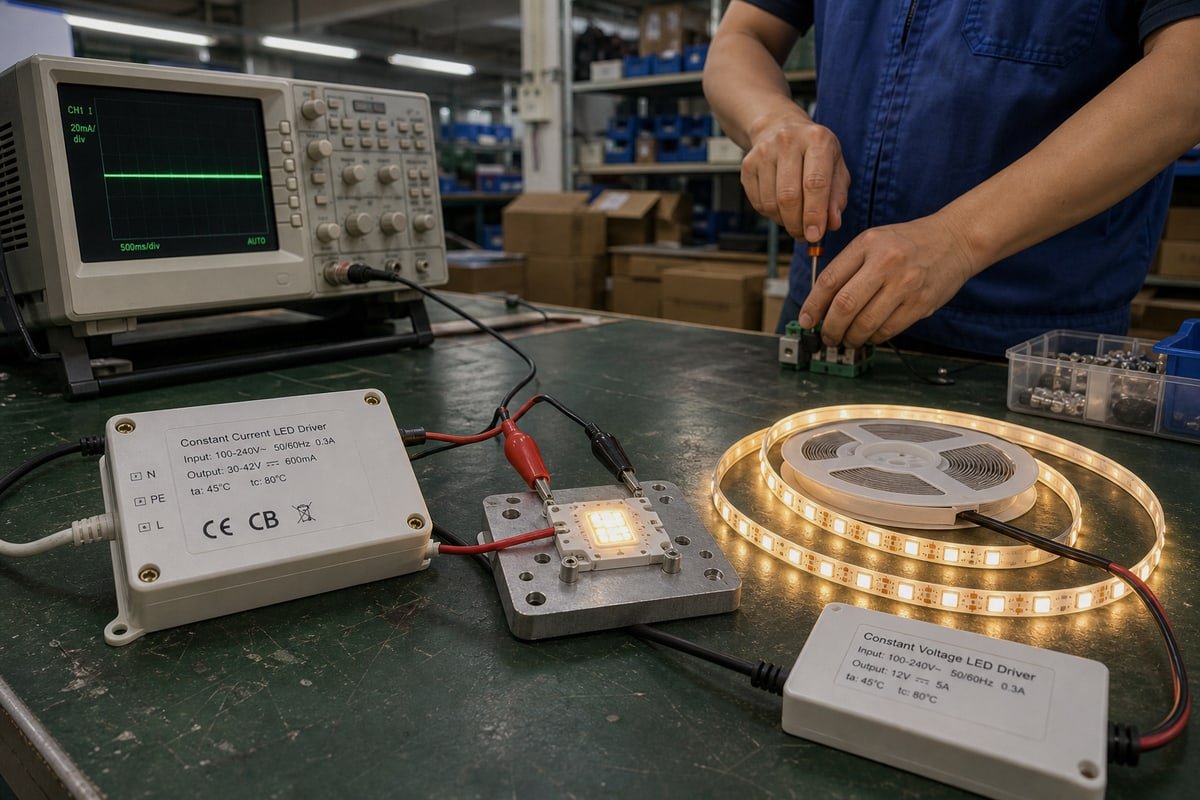
Let me be honest about the objection first, because our distributors raise it often. A CC driver can carry a higher unit price than a basic constant voltage driver, and it is less flexible if you plan to add or remove modules later, since it is designed around a specific current and forward-voltage window. Both points are true. But for fixtures with a fixed configuration, which describes most downlights, panels, and architectural luminaires, the lifecycle math strongly favors constant current.
Start with efficiency. Resistor-limited CV designs burn 20% to 40% of their power as waste heat in the resistors. That is energy your client pays for twice: once at the meter, and again in larger heatsinks needed for heat dissipation. A CC driver eliminates those resistors entirely.
Where the savings actually show up
| Cost factor | Resistor-limited CV approach | Constant current approach |
|---|---|---|
| Energy wasted in limiting resistors | 20–40% lost as heat | Essentially eliminated |
| Heatsink and enclosure size | Larger, costlier | Smaller, cheaper |
| Long cable runs | Brightness drops with voltage drop | Driver raises voltage to compensate |
| Warranty returns | Higher overcurrent failure risk | Current capped at rated value |
| Grid compliance (PF, THD) | Often basic conditioning | Typically superior power conditioning |
The voltage drop point deserves emphasis for large installations. On long runs or big arrays, a CC driver simply raises its output voltage to keep the target amperage flowing, so the last fixture shines as brightly as the first. And because CC drivers usually carry more sophisticated power conditioning, they help projects meet utility requirements for Total Harmonic Distortion and power factor, which several of our European clients now specify in every tender.
How do I select the right constant current driver for my custom LED module specifications?
One of the costliest mistakes I have watched a client make was ordering drivers by wattage alone. Three hundred fixtures flickered on cold starts because the compliance voltage never matched.
Select a constant current driver by matching the LED module’s specified drive current first, then confirming its forward voltage falls inside the driver’s output-voltage compliance window across the full operating temperature range. Finally, check thermal conditions, dimming needs, and safety certifications. Never choose by wattage alone.

Here is the plain truth we repeat to every OEM client: wattage tells you how much power the LED consumes; it does not tell you whether the driver is electrically compatible with the LED. Compatibility lives in two numbers, and here is the process we follow when we develop custom drivers.
- Match the current. If the module specifies 700 mA, the driver must regulate 700 mA. No rounding.
- Verify the compliance voltage. A driver marked 700 mA / 18–36 V does not output 36V continuously. It regulates 700 mA while its voltage floats to whatever the load needs, provided that value stays inside 18–36V.
- Add temperature margin. Forward voltage is not a fixed number. It shifts with junction temperature, so a room-temperature Vf reading is not enough. Demand headroom across the real operating range, especially for high-power COBs, enclosed fixtures, and high-ambient installations.
- Check dimming, wiring, and certifications. Confirm the dimming protocol, the L, N, and PE terminal arrangement, and marks like CE and CB on the label, which is standard on every unit leaving our line.
A worked matching example
Suppose your module needs 700 mA at a 28V nominal forward voltage.
| Driver option | Current | Voltage range | Verdict |
|---|---|---|---|
| Driver A | 700 mA | 10–25V | Not suitable: 28V exceeds the window |
| Driver B | 700 mA | 18–36V | Suitable: 28V sits comfortably inside |
| Driver C | 700 mA | 30–60V | Not suitable: 28V is below the minimum |
The rule is simple: LED current must match, and LED forward voltage must fall inside the driver’s regulation window. One final engineer’s warning. CC drivers pair naturally with a series circuit, but paralleling bare LED strings on one CC driver is risky, because small forward-voltage differences cause unequal current sharing between branches. Design parallel branches deliberately or avoid them.
Conclusion
Unregulated current quietly destroys LED modules. Constant current drivers break that chain. Match current first, verify voltage compliance second, check thermal margin third — never select by wattage alone.
Footnotes
- Authoritative engineering resource explaining the principles and applications of constant current regulation in electrical circuits. ↩︎
- U.S. Department of Energy resource explaining fundamental LED physics and the importance of voltage management. ↩︎
- Standard definition of the characteristic of visible light, essential for understanding LED binning and consistency. ↩︎
- Technical overview of the measure of perceived light power, a key performance metric for LED modules. ↩︎