Skip to content











Last month, our Shenzhen lab bench-tested a batch of TRIAC dimmers 1 against forty LED drivers. Some pairs flickered badly. That mismatch costs installers real money — and this article explains why.
Yes, TRIAC dimmers can be used with LED lights, but only when the LED driver is specifically designed for TRIAC/forward-phase dimming. A “dimmable” label alone does not guarantee compatibility; check the dimmer’s LED load rating, minimum load, inrush current, and manufacturer compatibility list.
The short answer hides a lot of engineering detail. The TRIAC sits on the dimmer side. The LED driver’s input stage 2 decides whether that chopped waveform can be handled correctly. Below, I break down the [flicker](https://bo-qi.com/?p=6205) problem, driver selection, load requirements, and custom sourcing — one question at a time.
Why do my LED lights flicker or buzz when using a TRIAC dimmer?
A German distributor once shipped a flickering fixture back to our QC bench. The bulb was fine. The dimmer was fine. The pairing was the problem — and that is typical.
LED lights flicker or buzz on TRIAC dimmers when the driver’s electronic input stage cannot handle the chopped AC waveform, or when the LED load falls below the dimmer’s minimum holding current. Incompatible driver design, insufficient load, and unstable TRIAC latching are the three main causes.

TRIAC dimmers were built for incandescent bulbs. An incandescent filament is a simple resistive load. It happily accepts phase-cut dimming, where the dimmer slices away part of each AC half-cycle. LEDs are different. They run through an electronic driver 3, not a bare filament. That driver has its own input circuit, and this is where trouble starts.
The TRIAC Is on the Dimmer Side
Here is the distinction I build every technical training around. The TRIAC lives inside the dimmer. It uses leading-edge phase control to chop the front of each AC waveform. The LED driver then has to interpret that mangled signal. If the driver’s input stage was never designed for forward phase dimming, it will misfire, hum, or flash.
There is a second mechanism. A TRIAC needs enough current to latch and then hold during each half-cycle. A small LED load may not supply it. The TRIAC drops out, re-fires, drops out again — and you see flicker. High-efficiency LEDs can even show “ghosting,” a faint glow when switched off, because tiny leakage current still powers the dimmer’s internal electronics. The rapid switching can also generate high-frequency electrical noise that interferes with power-line communication and sensitive smart-home sensors.
Common Symptoms and Their Causes
| Symptom | Possible cause |
|---|---|
| Flickering | Driver/dimmer incompatibility, insufficient load, unstable TRIAC operation |
| Buzzing | Electrical interaction between dimmer and driver, magnetics, or mechanical parts |
| Poor low-end dimming | Driver minimum output, dimmer characteristics, or insufficient load |
| LEDs glow when OFF | Leakage current or electronic switching behavior |
| Random dropout | TRIAC holding-current or driver input interaction |
| Works with one fixture but not many | Combined load, inrush, or control characteristics |
| Dimmer gets unusually hot | Excessive load, poor installation, or unsuitable dimmer/driver pairing |
So a 20W LED load does not behave like a 20W incandescent load. That single sentence resolves most of the support tickets we see from installers.
How do I choose LED drivers that are fully compatible with TRIAC dimmers?
Every time we design a dimmable LED driver, we weigh smooth low-end dimming against cost and size. That trade-off sits inside the input stage, where compatibility is won or lost.
Choose an LED driver that explicitly lists TRIAC or forward-phase dimming as its supported control method. Verify the datasheet’s dimming curve, minimum dimming level, and manufacturer compatibility list, and bench-test the driver with your exact dimmer model before committing to volume orders.

The phrase “TRIAC-compatible LED driver” is far more useful than “dimmable LED driver.” A driver may be genuinely dimmable but engineered for a completely different control method. These methods are not interchangeable, and mixing them up is the single most common sourcing mistake we see from new buyers.
Match the Control Method First
Before you compare price or efficiency, confirm the dimming interface. Here is how the main options line up:
| Dimming method | Also called | Works with a standard TRIAC dimmer? |
|---|---|---|
| TRIAC / forward phase | Leading-edge phase control | Yes, when explicitly rated |
| Trailing-edge | Reverse phase, Electronic Low Voltage (ELV) | No — different phase-cut direction |
| 0–10V | Analog low-voltage | No — needs separate control wires |
| DALI | Digital addressable | No — digital protocol |
| PWM | Pulse Width Modulation | No — direct duty-cycle control |
A driver built for 0–10V or Pulse Width Modulation control will not respond correctly to a chopped mains waveform. Never pair a non-dimmable power supply, or a driver designed for another protocol, with a phase-cut wall dimmer.
TRIAC vs Trailing-Edge: The Honest Answer
Buyers often ask me whether trailing-edge dimmers are simply “better” for LEDs. My honest answer is more careful. Trailing-edge dimming often performs better with certain electronic drivers because it reduces the interaction between the dimmer and the driver’s capacitive input, and it offers a softer start. However, it is not universally better. The LED driver’s specified dimming method should always take priority. Some modern smart dimmers even use adaptive phase-cut logic — a microprocessor analyzes the load and automatically toggles between forward and reverse phase for the best dimming curve.
In our own development work for European and Australian brand clients, we validate flicker-free performance across the full dimming range, not just at 100% output. A driver that dims smoothly from 90% down to 40% but shimmers at 10% is not a compatible driver. It is a future complaint.
What minimum load and wattage requirements should I check before pairing TRIAC dimmers with LED fixtures?
A procurement manager in Singapore recently asked me why her 20W LED order behaved worse than the old 60W halogens it replaced. My answer surprised her: the load was too small.
Check the dimmer’s minimum load requirement, its maximum LED load rating, and the driver’s inrush current before pairing. Many legacy TRIAC dimmers need more current than a small LED load can provide, causing flicker, dropout, or ghosting. Total inrush matters more than steady-state wattage.
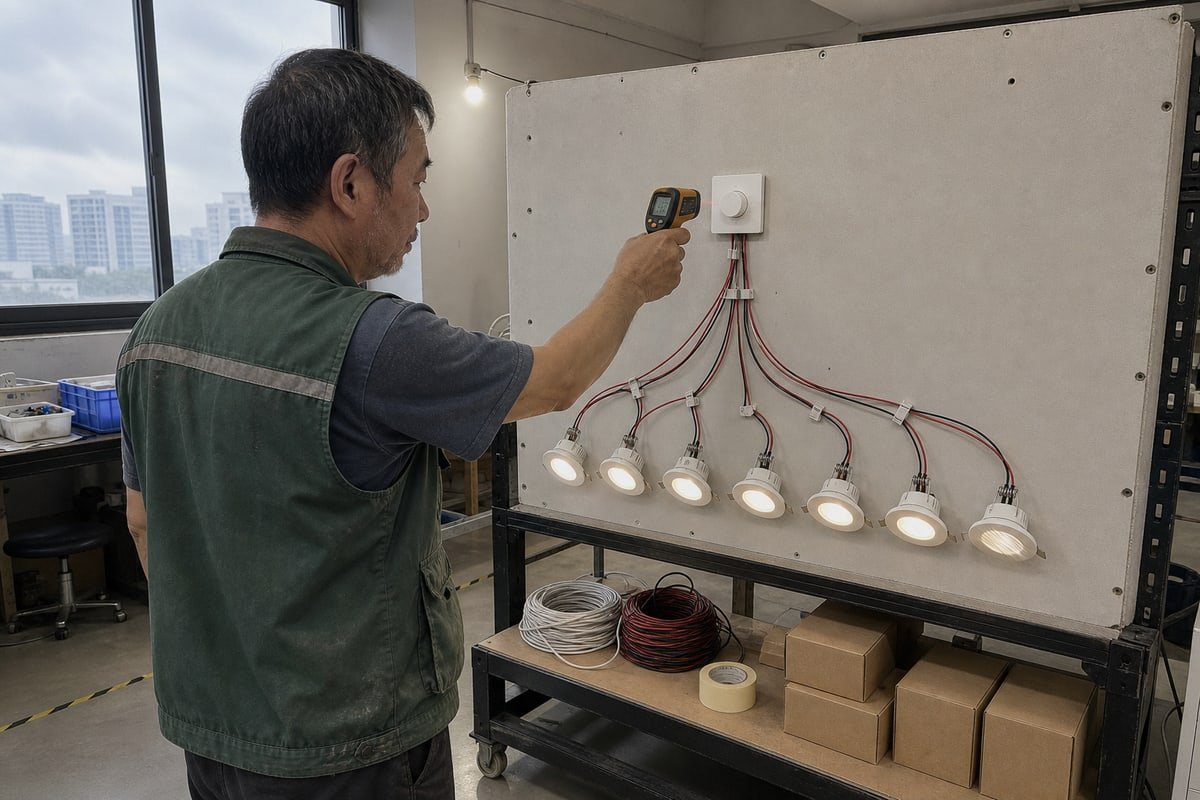
Minimum load is the hidden problem in most strange LED installations. Older TRIAC dimmers were specified for incandescent loads of 25W, 40W, or more. Swap in a handful of efficient LEDs and the total draw may sit below the level the TRIAC needs to trigger and stay latched. The result: flashing when “off,” unstable low-end dimming, or lights that never fully switch off.
The Inrush Current Trap
Do not look only at the rated wattage. Many LED drivers contain an input capacitor. When AC power is first applied, that capacitor draws a short, high inrush current. So you can have a system where steady-state wattage sits comfortably within the dimmer rating, yet startup inrush still trips protection or shortens the dimmer’s life. Connect multiple drivers to one dimmer and the combined inrush multiplies. This is exactly why “works with one fixture but not many” appears in our troubleshooting table above. There is also a long-term cost: the chopped voltage from phase-cut dimming raises ripple current inside the driver, which can accelerate electrolytic capacitor degradation in poorly ventilated fixtures.
A Pre-Installation Checklist
- Read the dimmer’s LED load rating. Some products advertise ranges like 3W–200W for LED/CFL — this support is product-specific, never universal.
- Confirm the minimum load. Add up your actual LED wattage and make sure it clears the threshold.
- Check the driver datasheet for inrush current, and derate the dimmer when ganging multiple drivers.
- For ultra-low-wattage circuits, consider an external bypass or “shunt” module. Professional installers use these to provide the TRIAC’s holding current without adding light output.
- Test one circuit before rolling out the full installation.
My industry rule after years of export projects: never select a TRIAC dimmer from the LED wattage alone. Select it from the LED driver’s electrical behavior. That is where most real-world compatibility problems originate.
Can I source custom TRIAC-compatible LED drivers for my private-label lighting products?
Early in our export business, I learned that off-the-shelf drivers rarely fit a brand’s exact spec. That lesson pushed us into collaborative OEM/ODM development, and it changed how we work.
Yes, you can source custom TRIAC-compatible LED drivers for private-label products. Specialized OEM/ODM suppliers can tune the driver’s input stage, dimming curve, minimum load behavior, and housing to your specification, then add your logo and packaging for turnkey private-label supply.

For brand owners and wholesalers, custom development 4 solves the exact problems this article describes. Instead of gambling on whether a generic driver will pair with the dimmers your market already uses, you specify the pairing up front. At our Shenzhen facility, we start every OEM project by asking which dimmers the client’s end customers actually install — legacy leading-edge units in the UK, trailing-edge dimmers common in Germany and Sweden, or adaptive smart dimmers in Australia. Then we engineer the driver’s input stage for that reality.
What Can Be Customized
| Customization area | What we adjust for private-label clients |
|---|---|
| Input stage design | Forward phase dimming compatibility, holding-current stability, bleeder circuits |
| Dimming curve | Linear, logarithmic, or custom low-end behavior for smooth 1%–100% control |
| Load behavior | Minimum load tolerance, inrush current limiting for multi-driver circuits |
| Compliance and markets | Voltage and safety requirements for your target export regions |
| Branding | Custom logos, labels, packaging, and matching wall dimmer aesthetics |
How the Collaboration Works
The process is straightforward. You share your target dimmer models, fixture wattages, and market requirements. We prototype, then run compatibility testing across the full dimming range on our QC bench — checking latching stability, low-end shimmer, audible noise, and ghosting. You receive test samples and a documented compatibility list you can publish with your own brand. For procurement teams under tight deadlines, this parallel approach beats sequential trial-and-error sourcing. It also addresses the total-cost question: one field failure and return shipment usually costs more than the entire price gap between a generic driver and a properly matched one. Clean, minimalist hardware — like an all-white rotary dimmer knob paired with a driver tuned to it — only looks premium if the dimming behind it is genuinely flicker-free.
Conclusion
TRIAC dimmers and LED lights can work beautifully together — but only when the driver’s input stage is designed for phase-cut dimming. Verify compatibility first, and your installations stay flicker-free.
Footnotes
- Technical overview of the TRIAC component and its role in AC power control. ↩︎
- Authoritative source for electrical engineering standards and circuit design principles. ↩︎
- Official government resource defining energy-efficient lighting components and driver requirements. ↩︎
- International standards body for manufacturing quality and product development processes. ↩︎