Skip to content










Flicker, dead sliders, ghosting glow — I have seen every failure a cheap dimmer can cause. On our production line, a high-quality 0-10V dimmer is defined long before shipping.
A high-quality 0-10V dimmer delivers stable, flicker-free control, smooth dimming across the full range, verified LED driver compatibility, adequate sink/source control-current capacity, and reliable electrical and thermal protection. Crucially, the dimmer, control standard, and LED driver must work as one electrically compatible system.
That last point matters most. A 0-10V label alone guarantees nothing. The dimmer sends an analog dimming signal 1, and the drivers on the other end must interpret it correctly. In this guide, I will walk you through certifications, quality control verification, the technical specifications that actually matter, and how to protect yourself on warranty terms. These are the four questions our buyers in Singapore, Germany, and Australia ask us most often, so I will answer them the way I answer them across the table at trade shows — directly.
What certifications should I look for when sourcing a high-quality 0-10V dimmer?
Last spring, a German distributor asked for our full CE technical file before discussing prices. Smart move — that single request filters out weak suppliers faster than anything else.
Look for UL or ETL listing for North America, CE and RoHS for Europe, and conformity with IEC 60929 Annex E for the 1-10V/0-10V control interface. Also confirm Class 2 wiring compliance and, for US projects, the 2022 NEC pink-and-purple control-wire color convention.

Certifications split into two groups, and buyers often confuse them. The first group covers safety and market access. The second group covers the control interface itself. You need both, and they answer different questions.
Market-access certifications by region
Our export markets stretch from Japan to Finland, so we keep a certification map for every product family. Here is the short version for wall-mounted dimmers used in commercial lighting controls:
| Certification | Region | What it actually verifies |
|---|---|---|
| UL / ETL listing | USA, Canada | Electrical safety: fire, shock, and thermal risk under fault conditions |
| CE (LVD + EMC) | EU (Italy, France, Germany, etc.) | Self-declared conformity with low-voltage and electromagnetic directives |
| RoHS | EU and beyond | Restriction of hazardous substances in components and solder |
| UKCA | United Kingdom | UK equivalent of CE after Brexit |
| RCM | Australia, New Zealand | Safety and EMC compliance for the Australian market |
| PSE | Japan | Japanese electrical appliance safety law |
Standards that govern the control signal
The 0-10V interface traces back to IEC 60929 Annex E 2, which originally defined the 1-10V analog interface for fluorescent ballasts. Many LED products still follow its electrical logic today. In North America, the low voltage control circuit typically must meet Class 2 wiring standards 3, which limit power on the control side so the wiring is safe to route without conduit in many cases. And since the 2022 National Electrical Code 4, quality dimmers use pink and purple control wires. That prevents dangerous confusion with gray neutral wires during installation — a small detail that signals a serious factory.
Documents to request before ordering
Ask for the actual certificate numbers, not photos of logos. UL and ETL numbers can be verified in public databases 5. For CE, request the Declaration of Conformity plus the underlying EMC and LVD test reports. When a supplier hesitates on any of these, walk away.
How can I verify a supplier’s quality control process before placing a bulk order?
Our aging room runs 24 hours a day. Every dimmer batch cycles from zero to full output for hours before packing, because failures caught here never reach a job site.
Verify quality control by requesting the supplier’s IQC, in-process, and OQC procedures, reviewing burn-in and aging test records, testing golden samples against your project loads, arranging a factory audit or third-party inspection, and confirming batch traceability before you commit to a bulk order.
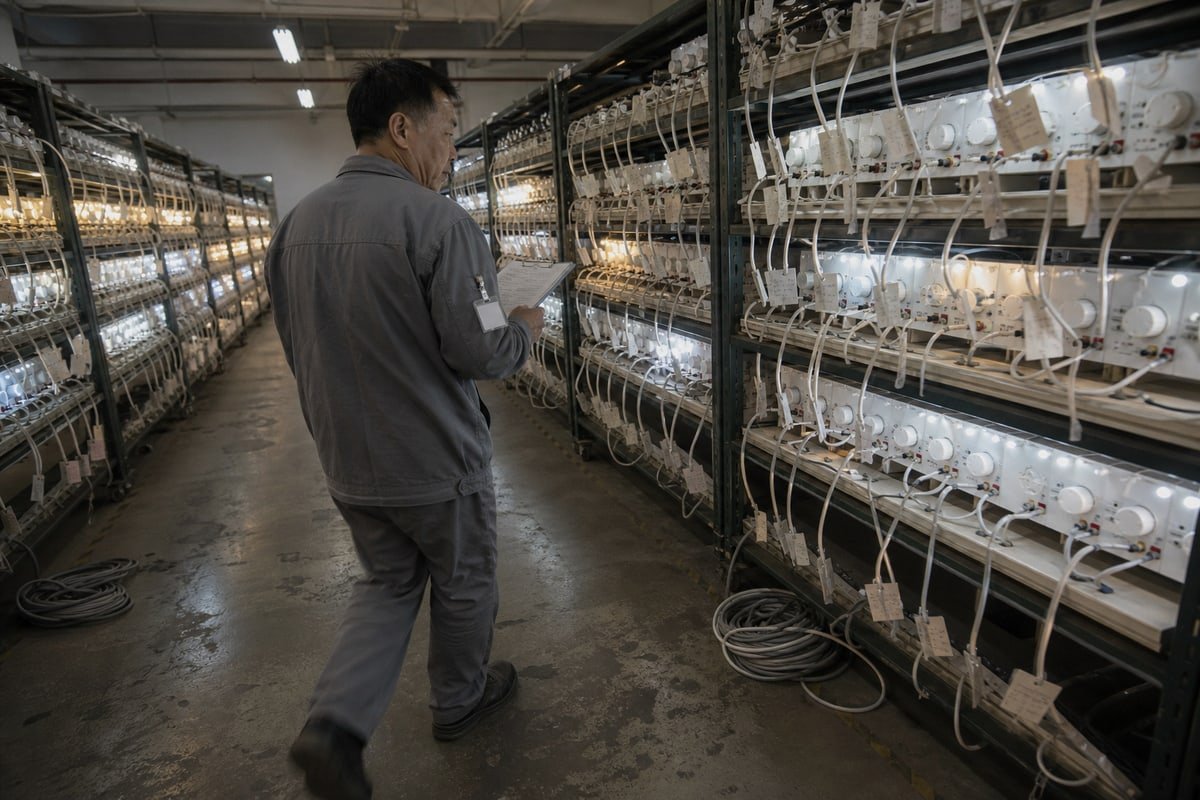
A brochure can claim anything. A process leaves evidence. When distributors visit our facility, I show them evidence, and you should demand the same from any supplier. Here is the verification sequence I recommend, in the order that costs you the least:
- Request the QC flowchart. A real factory documents incoming inspection (IQC) for components, in-process checks (IPQC) on the line, and outgoing inspection (OQC) before packing. If the answer is a vague “we test everything,” that is a red flag.
- Ask for burn-in and aging records. Every unit should run a powered aging cycle. For 0-10V dimmers, we also verify the output voltage at multiple knob positions, because a drifting analog dimming signal causes uneven brightness across fixtures later.
- Test golden samples with your actual drivers. Do not test the dimmer alone. Connect it to the exact LED drivers your project uses, then check flicker-free performance at low output, full brightness, and everywhere between.
- Check the physical build. On our white rotary models, OQC includes knob rotation torque, faceplate finish, and the fit of the inset groove around the knob. Loose knobs and uneven bevels reveal sloppy tooling — and sloppy tooling usually means sloppy circuits.
- Arrange an audit or third-party inspection. A video factory tour costs nothing. A pre-shipment inspection against an agreed AQL costs a little and saves a lot.
- Confirm batch traceability. If a unit fails in year two, the factory should trace its production date, component lots, and test records. No traceability means no accountability.
Run this sequence once, and you will know more about your supplier than a hundred emails could tell you.
What technical specifications matter most when choosing a 0-10V dimmer for my projects?
Years ago, an engineering client in Thailand connected sixty drivers to one dimmer and blamed our product when fixtures dimmed unevenly. The real cause? Control-current overload. I never forgot it.
The most important specifications are sink/source control-current capacity, maximum driver count, minimum dimming level, dim-to-off capability, load and voltage ratings, selectable linear or logarithmic dimming curves, and protection features such as zero-crossing switching and surge immunity. Compatibility with your LED drivers matters more than any single number.
Let me start with the specification most generic articles miss entirely, because it caused that Thailand incident.
Sinking and sourcing current: the hidden limit
A 0-10V dimmer does not simply “send a voltage” to an unlimited number of drivers. Depending on the architecture, every connected driver draws current from — or contributes current to — the control loop. That is what sinking and sourcing current means in practice. Overload the loop, and the dimmer can no longer hold the intended control voltage. The symptoms look random but are not: lights that never reach full brightness, fixtures dimming differently from each other, an unstable bottom end, non-linear response, or system behavior that changes the moment you add more drivers. Professional-grade units are rated to control 50 or more fixtures without signal degradation, but only when the current math works.
Don’t judge a 0-10V dimmer by its 0-10V label alone. Check the control standard, sink/source current, maximum number of drivers, minimum dimming level, driver compatibility, and whether separate ON/OFF switching is required.

The specification checklist
| Specification | Why it matters | What to ask the supplier |
|---|---|---|
| Sink/source current | Determines how many drivers one dimmer can control accurately | Rated mA and maximum driver count |
| Minimum dimming level | Poor low-end reveals cheap dimmers; good units reach 5% or lower smoothly | Tested low-end performance with your driver model |
| Dim-to-off capability | True 0V turns lights fully off; 1-10V systems often leave a ghosting glow | Whether separate line-voltage switching is required |
| Load and voltage rating | Commercial products commonly rate around 120V 10A / 277V 5A; leading wall dimmers handle up to 960W / 8A | Rated wattage per voltage, and any multi-gang derating |
| Dimming curve | Linear vs logarithmic curve selection matches the eye’s non-linear brightness perception | Whether the curve is selectable |
| Zero-crossing switching | Relay engages at lowest voltage, surviving LED driver inrush current | Relay type and inrush rating |
| Protection and isolation | ESD, surge protection, and galvanic isolation between AC and DC sides prevent catastrophic failure | Which protections are built in |
| Signal integrity | Active signal conditioning strips EMI; voltage drop compensation matters on long control runs | Maximum recommended wire run length |
One more point on LED driver compatibility: high-end trim settings let installers correct mismatches on site, and preset memory improves daily usability. Neither replaces system-level testing before you buy a high-quality 0-10V dimmer in volume.
How do I make sure my supplier honors warranty and after-sales support commitments?
Holding spare replacement stock in our warehouse costs us money every month. We accept that cost, because a warranty claim answered in days — not weeks — keeps distributors loyal.
Get warranty terms in writing before ordering, including the warranty period, failure-rate threshold, replacement process, and response time. Test the supplier’s after-sales behavior with small issues first, keep dated records of every commitment, and choose suppliers who assign a named contact for technical support.

The most common complaint I hear from buyers switching to us is not about product quality. It is about suppliers who promised warranty coverage during the sales stage, then disappeared after the wire transfer cleared. You can prevent that, but you must do it before the first bulk order, not after the first failure.
Start with the contract. A warranty that lives only in a WhatsApp message is a suggestion, not a commitment. Put the warranty period, the defect definition, the failure-rate threshold, and the remedy — repair, replacement, or credit — into the sales agreement or the proforma invoice terms. Then define the process: who ships the failed unit back, who pays freight, and how many working days until a resolution. In our own contracts, we spell out the replacement procedure line by line, because vague terms always favor the seller.
Next, test behavior early. Order samples, then deliberately raise a small technical question — perhaps about minimum dimming level with a specific driver. Time the response. A supplier who takes ten days to answer a pre-sale question will take longer after the sale.
| What to verify | Red flag | Good sign |
|---|---|---|
| Warranty documentation | Verbal promises only | Terms written into the contract |
| Response time | Replies stop after payment | Named contact, replies within 1–2 working days |
| Replacement process | “Send it back and we will see” | Defined RMA steps, spare stock held for fast swaps |
| Technical support | Sales rep cannot answer engineering questions | Direct access to an engineer for compatibility issues |
| Track record | No references offered | Existing distributors willing to speak with you |
Finally, keep dated records of every commitment. If a dispute ever comes, documentation decides it.
Conclusion
A high-quality 0-10V dimmer proves itself as a system: verified certifications, transparent quality control, honest specifications, and warranty terms in writing. Check those four areas, and your projects stay flicker-free.
Footnotes
- Technical overview of the 0-10V analog signaling protocol for lighting. ↩︎
- The international standard defining the electrical characteristics of 0-10V control. ↩︎
- Safety standards for low-voltage circuits to prevent fire and shock. ↩︎
- The primary US standard for safe electrical design and installation. ↩︎
- Official directory for verifying safety certification and listing information. ↩︎