Skip to content










Buyers ask me about CC DALI drivers weekly. Many wired a whole floor, then discovered every downlight dimmed together DALI lighting system 1. Our Shenzhen engineering team solves exactly that problem daily.
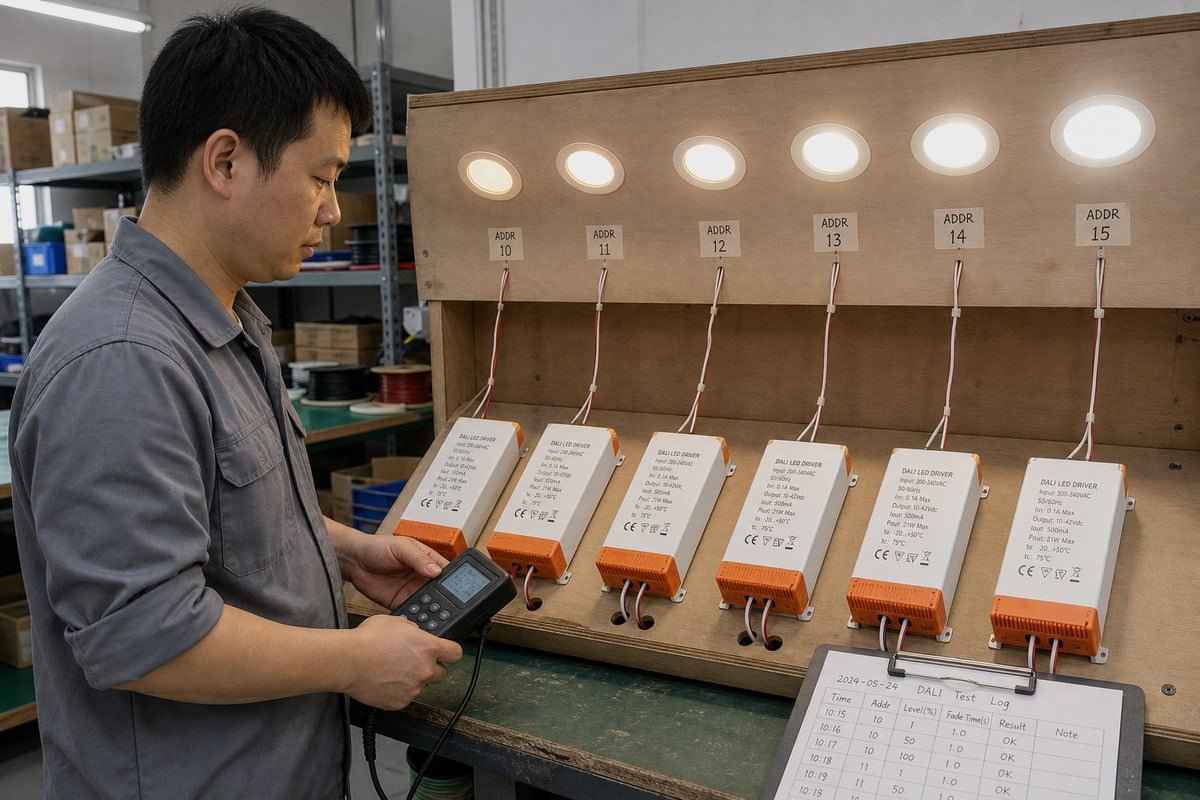
Single-fixture control with a CC DALI driver lets each constant-current LED fixture be independently addressed through a DALI lighting system. The driver regulates the LED module’s required current, while its DALI interface receives digital commands, so multiple fixtures share one bus at different brightness levels.
The key idea is simple. The DALI address belongs to the driver, not the LED fixture itself. The fixture becomes independently controllable because its driver has its own address. Let me break down how this works and what you should demand from a supplier.
What Makes CC DALI Drivers Different From Standard Dimming Drivers for Individual Addressing?
There is a trade-off we weigh in every driver project: analog dimming is cheap and simple, but it cannot target one fixture. Digital addressing costs more, yet it changes everything.
CC DALI drivers combine a constant-current power stage with a digital addressable lighting interface. Unlike standard dimming drivers, each driver holds its own short address (0–63), so a controller can dim one fixture without affecting others on the same two-wire control bus.
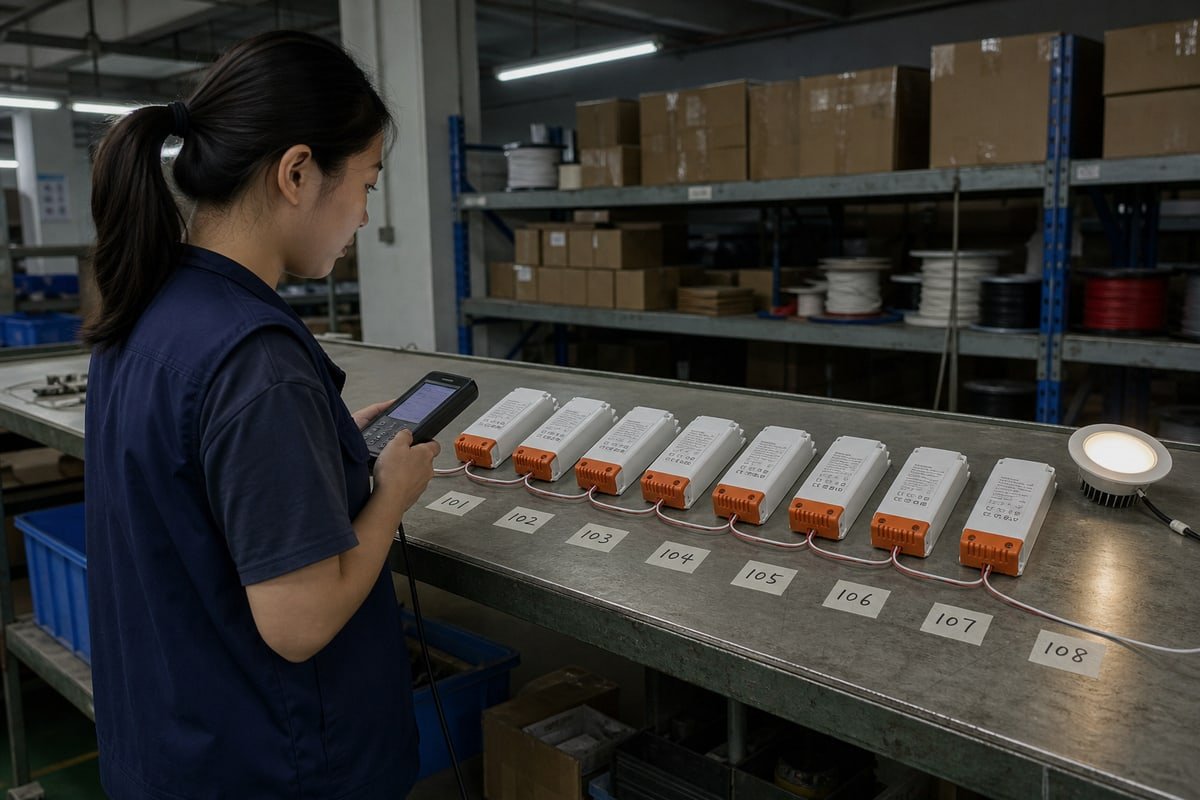
Think of the system as two separate functions. On the LED side, the driver delivers a regulated current to the LED module. On the control side, a DALI controller sends commands over the bus, and the driver interprets them. The DALI command does not directly regulate LED current. The driver’s internal control electronics interpret the command and adjust the LED output accordingly. Our expert rule at the factory: CC determines how the LED is electrically driven; DALI determines how that driver is digitally controlled.
One Bus, Many Brightness Levels
A standard 0–10V circuit gives you one dimming level per wire run. A DALI line supports up to 64 short addresses. So Driver A can sit at 30%, Driver B at 70%, Driver C at 100%, and Driver D at 15% — all on the same network. You can then place drivers into software-defined groups, such as reception, corridor, and display lighting. The physical wiring does not have to change when the control zoning changes.
| Feature | CC DALI driver | Standard dimming driver (0–10V / analog) |
|---|---|---|
| Addressing | Individual addressing per driver (0–63) | None; the whole circuit dims together |
| Control wiring | Two-wire control bus, polarity-independent in many designs | Dedicated dimming wires per zone |
| Dimming behavior | Standardized logarithmic dimming curves | Varies by manufacturer, often linear |
| Grouping and scenes | Software-defined, re-zoned without rewiring | Fixed by physical wiring |
| Output stage | Fixed current, voltage varies with load | Same CC stage, but simpler control input |
DT6 Is Usually Enough for Single-White Fixtures
For single-color spotlights and downlights, a DT6 constant-current driver is the typical fit. It provides one controlled channel for brightness only. DT8 matters when you need tunable white or RGBW under a single address. If a luminaire only needs intensity control, specifying DT8 is over-engineering, and it adds cost your project does not need.
How Can I Confirm DALI-2 Compatibility Before Integrating These Drivers Into My Lighting Systems?
A lesson our team learned early: a datasheet that says “DALI compatible” proves almost nothing. One European client returned samples because an older DALI-1 driver ignored his DALI-2 controller’s query commands.
Confirm DALI-2 compatibility by requesting the driver’s DALI-2 certification listing in the DALI Alliance product database, verifying IEC 62386 compliance for the relevant parts, and testing bi-directional data exchange with your intended controller before committing to volume orders.

Individual addressing does not automatically mean unlimited flexibility. Practical capability depends on the DALI device type 2, DALI version and features, the controller, the commissioning software, and the driver implementation. DALI-2 certification improves interoperability, but real capability still varies between manufacturers. So do not stop at “DALI compatible.” Push the supplier for specifics.
Questions Worth Asking Before You Buy
| Question to the supplier | Why it matters |
|---|---|
| Is DALI-2 supported and certified? | DALI-2 certification includes stricter interoperability testing under IEC 62386 |
| Which device type — DT6 or DT8? | DT6 suits single-white; DT8 covers tunable white and RGBW |
| What is the true dimming range? | “DALI dimmable” does not guarantee the same minimum level on every driver |
| What happens after a bus failure? | System failure level defines fixture behavior when the bus goes down |
| What happens when mains power is restored? | Power-on level affects safety and the user experience |
| Does it support the required scenes and groups? | Not every implementation exposes every feature |
| Does it report status back? | Bi-directional data exchange enables luminaire health monitoring and fault reporting |
Commissioning Is Part of the System Design
DALI’s biggest advantage can become a project risk. The system requires proper commissioning. With a basic switched circuit, the electrician energizes the line and lights turn on. With individually controlled DALI fixtures, someone must correctly: discover the devices, assign addresses, create groups, configure scenes, set parameters, test minimum and maximum levels, and verify behavior after a power interruption. Also confirm the DALI bus power supply is sized for the number of devices on the line. For larger commercial installations, treat commissioning as part of the design — not an afterthought.
Can I Customize CC DALI Drivers With My Own Branding for Private-Label Projects?
One Singapore procurement manager messaged us on WhatsApp with a simple brief: her logo on the casing, her packaging, her default dimming parameters. Six weeks later, her branded samples shipped from Shenzhen.
Yes. Most CC DALI driver manufacturers offer OEM/ODM services, including custom logos, private-label casing colors, tailored labels, packaging, and firmware parameter presets. Typical requirements include a signed agreement, artwork files, and a minimum order quantity agreed during collaborative development.
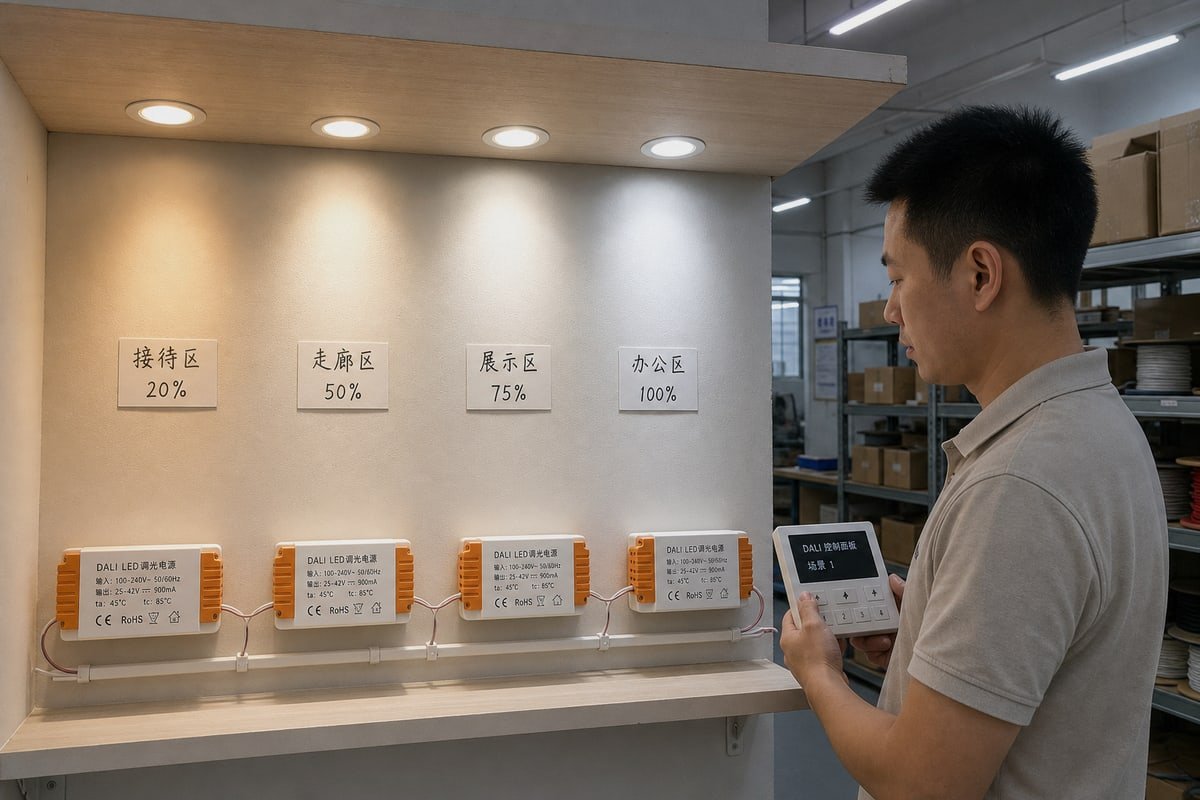
Private-label work is more than a logo swap. In our OEM/ODM projects for brand owners and wholesalers across Europe, Southeast Asia, and Australia, the branding layer and the technical layer move together. A driver that carries your name must also behave the way your controllers and installers expect. That is why we run customization as a structured process, not a print job.
How a Typical Private-Label Project Runs
- Requirement briefing. We confirm the LED current range, forward-voltage window, DALI device type, and target market certifications.
- Design lock. Casing color, logo position, label layout, terminal diagrams, and marks such as CE, CB, and SELV symbols are approved on artwork proofs.
- Firmware presets. Default power-on level, system failure level, minimum dim level, and logarithmic dimming curves are set to your specification.
- Sampling. You test branded samples with your intended controller, including grouping, scenes, and smart building integration platforms 4 if relevant.
- Pilot batch. A small production run validates the process before volume orders.
- Volume production. Full QC applies to every batch, with documentation under your brand.
For buyers facing tight project deadlines, the firmware-preset step is the hidden time-saver. If drivers ship with the correct defaults, commissioning teams on site spend far less time adjusting parameters fixture by fixture. That directly cuts total project cost — usually the first pain point a procurement officer raises with me.
What QC Standards Should I Require When Sourcing CC DALI Drivers for Single-Fixture Control?
During one pre-shipment inspection at our facility, a batch passed every electrical test at room temperature, then showed unstable minimum-level dimming at elevated case temperature. We caught it because thermal testing is mandatory on our line.
Require 100% burn-in testing, DALI protocol verification per IEC 62386, dimming-range checks at minimum and maximum levels, thermal testing at rated case temperature, protection tests for short-circuit, overload, and no-load conditions, plus documented AQL sampling before shipment.
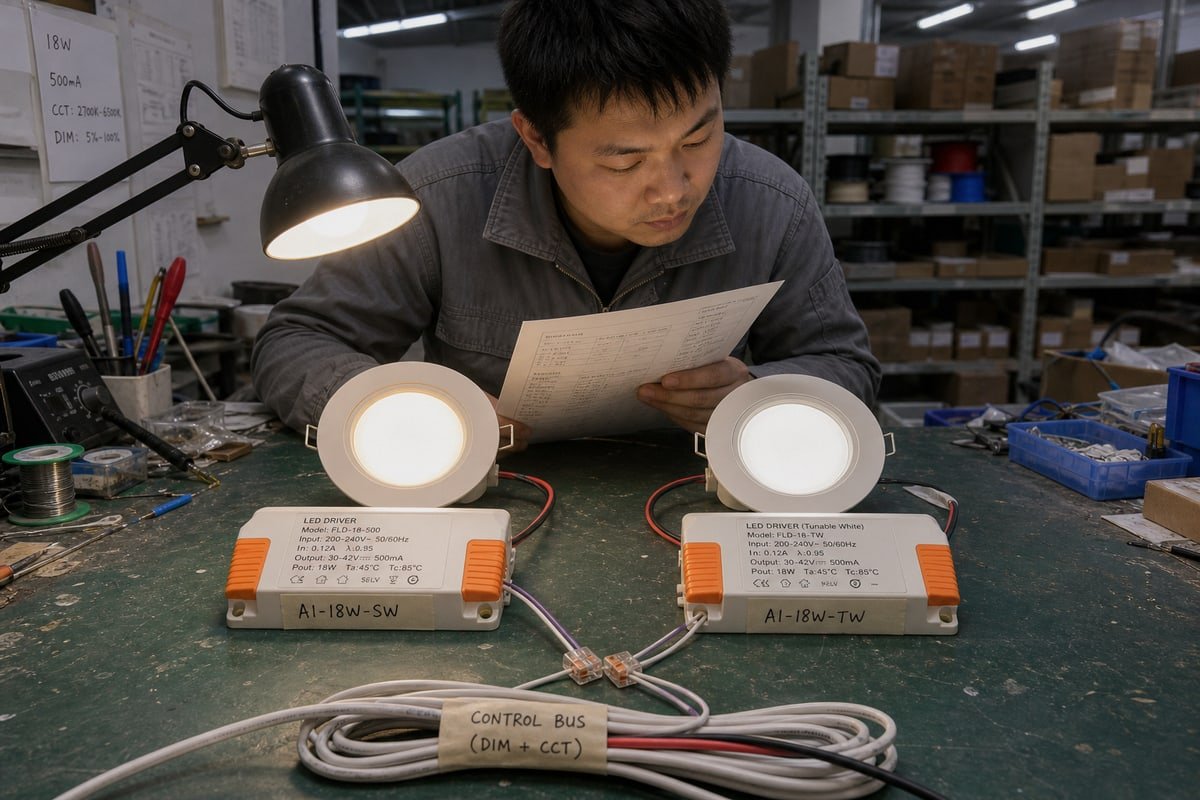
Quality control for a CC DALI driver has two halves, and both matter. The power half proves the driver runs the LED correctly. The digital half proves the driver answers the bus correctly. A driver can pass one and fail the other. Your QC requirements should force the supplier to test both, on every batch, under realistic conditions.
The Selection and QC Sequence I Recommend
Follow this order before anything else. First, match the driver’s regulated output current to the LED module. Second, confirm the LED’s actual operating voltage falls inside the driver’s compliance range. Third, verify the resulting operating power sits within the driver’s specification. Only then check DALI functionality, dimming range, thermal performance, and physical integration — dimensions, mounting holes, wiring, and IP requirements.
| QC checkpoint | What it verifies | Failure risk if skipped |
|---|---|---|
| Output current accuracy | Regulated current matches LED binning and spec | Overdriven LEDs, early lumen depreciation |
| Burn-in test | Stability under sustained load | Early-life field failures |
| DALI addressing test | Individual addressing and command response | Fixtures ignore commissioning software |
| Minimum dim level check | Actual low-end output, not the datasheet claim | Flicker or dropout at low scenes |
| Thermal test at rated tc | Performance at real case temperature | Derating, drift, shortened lifetime |
| Protection tests | Short-circuit, no-load, overload, thermal cutoff | Safety incidents, fixture damage |
| Power-cycle behavior | Correct level after mains restoration | Wrong brightness after outages |
Why Thermal Conditions Deserve Special Attention
For downlights and spotlights, driver thermal conditions can matter more than the nominal room temperature. A driver installed in a compact ceiling void, or directly above a high-output downlight, may run significantly hotter than the surrounding room. Higher temperature affects lifetime, output regulation, component stress, dimming behavior, and protection derating. So the correct question is not merely “can this driver supply my LED?” It is: can this driver supply my LED at the required current and dimming level under the actual thermal conditions of the fixture?
Conclusion
CC DALI drivers deliver single-fixture control by pairing precise current regulation with digital addressability. Verify the electrical match first, then the DALI features, then insist on rigorous QC.
Footnotes
- Provides a comprehensive technical overview of the Digital Addressable Lighting Interface protocol and its history. ↩︎
- Official industry organization defining DALI device types and managing DALI-2 certification standards. ↩︎
- The international standards body responsible for the IEC 62386 standard governing the DALI-2 framework. ↩︎
- Leading technical authority for electronics and communication standards used in smart building integration platforms. ↩︎