Ga naar de inhoud









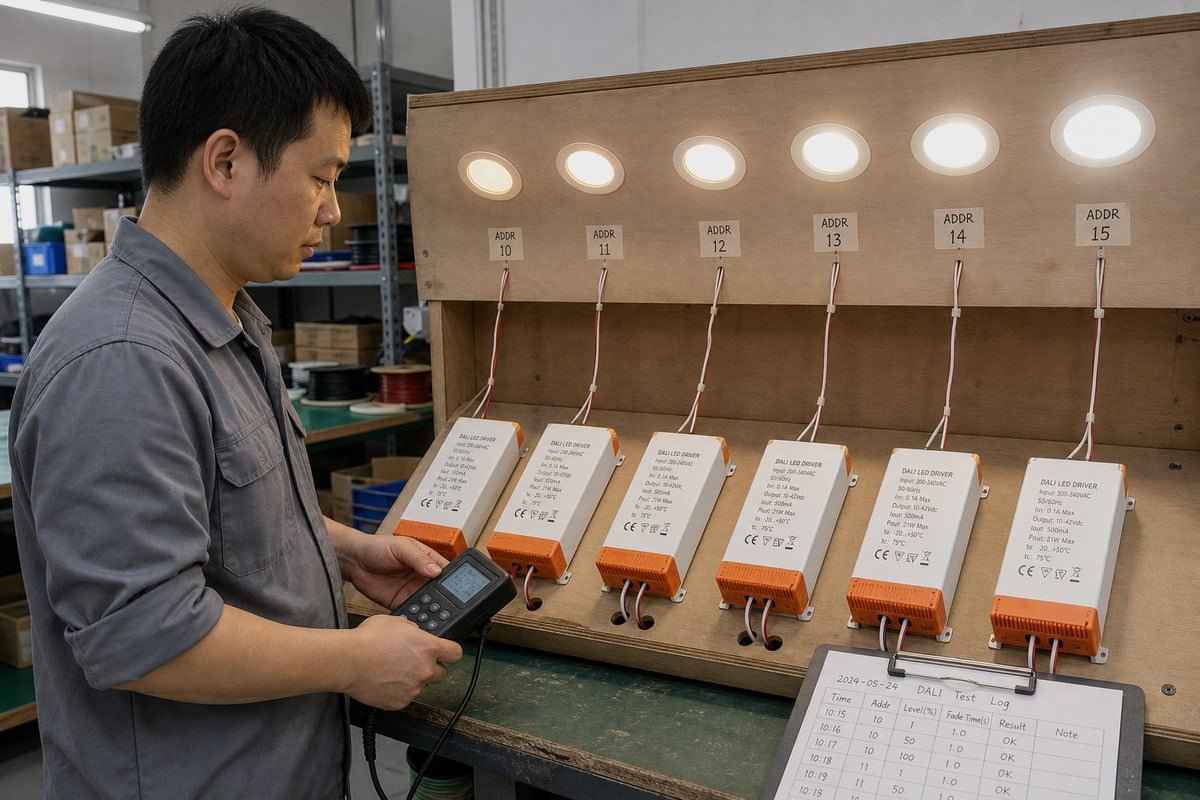
Kopers vragen mij wekelijks naar CC DALI-drivers. Velen hebben een hele verdieping bedraad en ontdekten daarna dat elke downlight samen dimde. DALI-verlichtingssysteem 1. Ons technische team in Shenzhen lost precies dat probleem dagelijks op.
Enkele-armatuurregeling met een CC DALI-driver zorgt ervoor dat elk LED-armatuur met constante stroom onafhankelijk kan worden geadresseerd via een DALI-verlichtingssysteem. De driver regelt de vereiste stroom van de LED-module, terwijl de DALI-interface digitale commando's ontvangt, zodat meerdere armaturen één bus delen op verschillende helderheidsniveaus.
Het kernidee is eenvoudig. Het DALI-adres behoort toe aan de driver, niet aan het LED-armatuur zelf. Het armatuur wordt onafhankelijk regelbaar omdat de driver een eigen adres heeft. Laat me uitleggen hoe dit werkt en wat je van een leverancier moet eisen.
Wat maakt CC DALI-drivers anders dan standaard dimdrivers voor individuele adressering?
Er is een afweging die we in elk driverproject wegen: analoge dimming is goedkoop en eenvoudig, maar kan niet één armatuur targeten. Digitale adressering kost meer, maar verandert alles.
CC DALI-drivers combineren een constante-stroomtrap met een digitaal adresseerbare verlichtingsinterface. In tegenstelling tot standaard dimdrivers heeft elke driver een eigen kort adres (0–63), zodat een controller één armatuur kan dimmen zonder andere op dezelfde tweedraads regelbus te beïnvloeden.
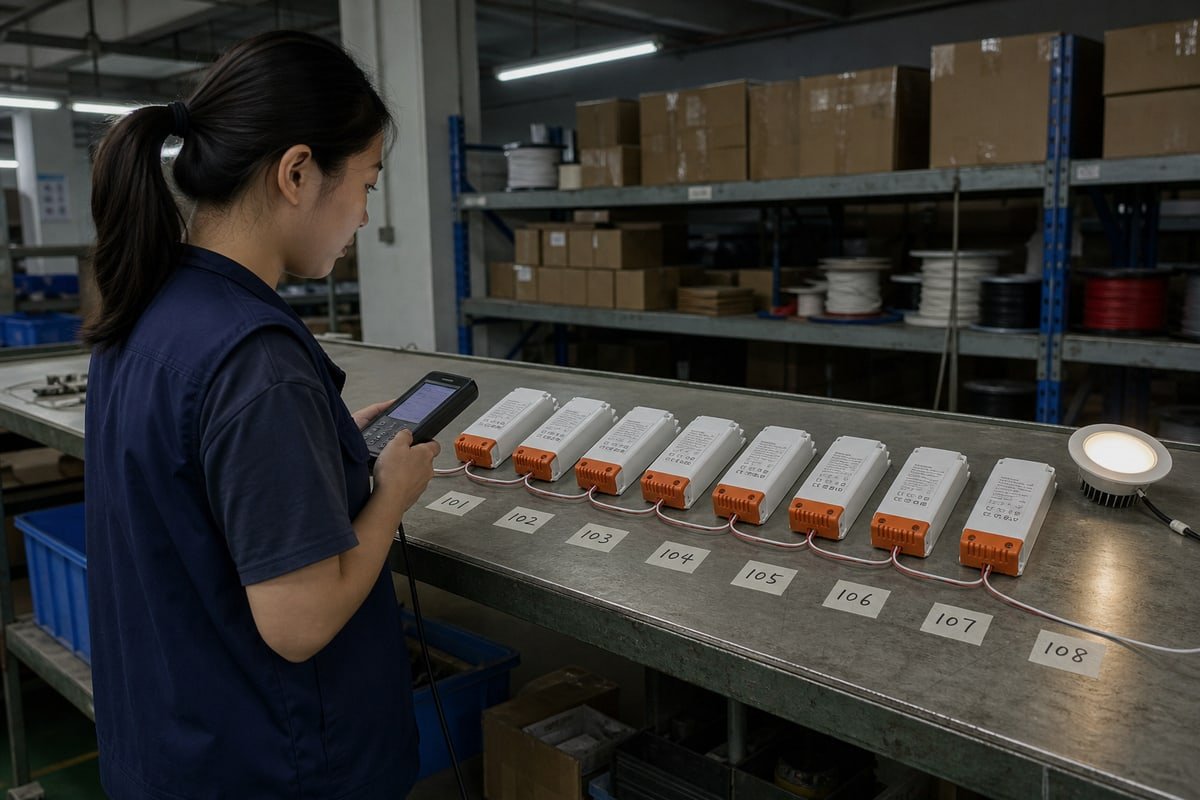
Zie het systeem als twee afzonderlijke functies. Aan de LED-zijde levert de driver een geregelde stroom aan de LED-module. Aan de regelzijde stuurt een DALI-controller commando's over de bus, en de driver interpreteert deze. Het DALI-commando regelt niet direct de LED-stroom. De interne regel-elektronica van de driver interpreteert het commando en past de LED-output dienovereenkomstig aan. Onze expertregel in de fabriek: CC bepaalt hoe de LED elektrisch wordt aangestuurd; DALI bepaalt hoe die driver digitaal wordt geregeld.
Eén Bus, Veel Helderheidsniveaus
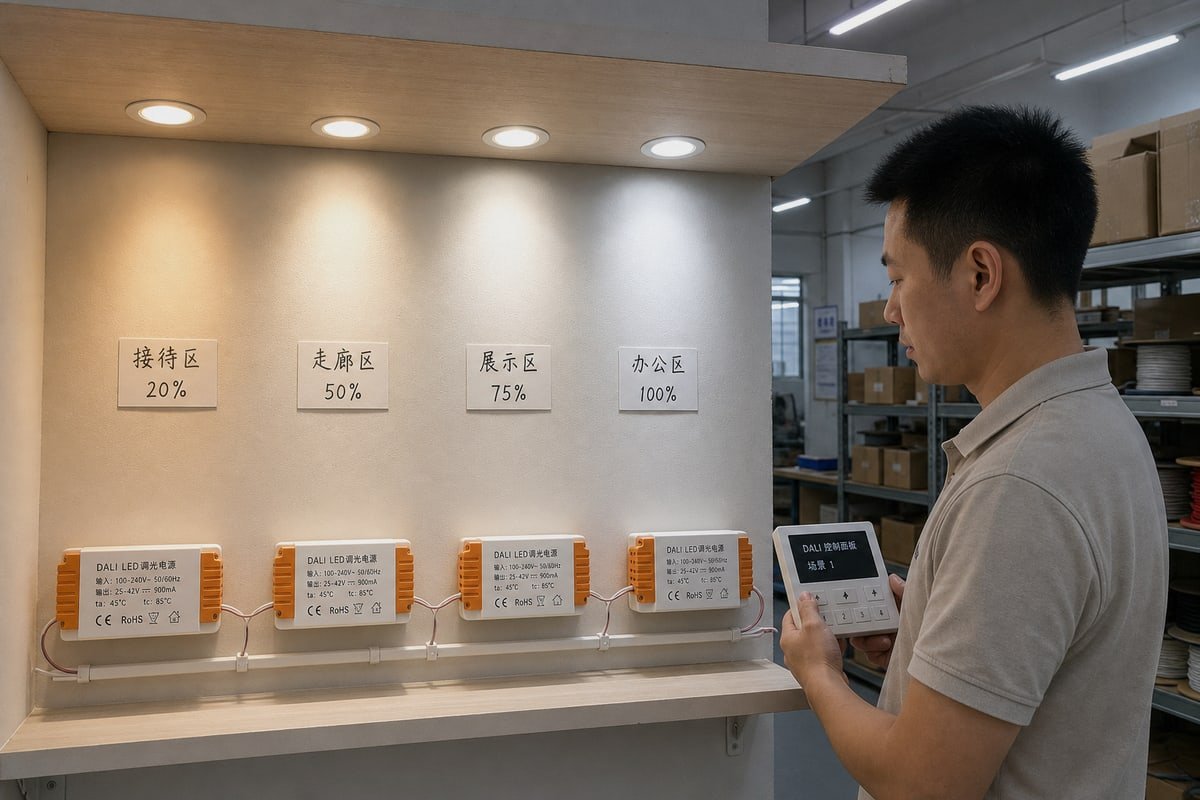
Een standaard 0–10V-circuit geeft één dimniveau per draadrun. Een DALI-lijn ondersteunt tot 64 korte adressen. Dus Driver A kan op 30% zitten, Driver B op 70%, Driver C op 100% en Driver D op 15% — allemaal op hetzelfde netwerk. Je kunt drivers vervolgens in softwaregedefinieerde groepen plaatsen, zoals receptie, gang en displayverlichting. De fysieke bedrading hoeft niet te veranderen wanneer de regelzones veranderen.
| Kenmerk | CC DALI-driver | Standaard dimdriver (0–10V / analoog) |
|---|---|---|
| Adressering | Individuele adressering per driver (0–63) | Geen; het hele circuit dimt samen |
| Besturingsbedrading | Tweedraads regelbus, in veel ontwerpen polariteit-onafhankelijk | Speciale dimdraden per zone |
| Dimgedrag | Gestandaardiseerde logaritmische dimcurves | Verschilt per fabrikant, vaak lineair |
| Groepering en scènes | Softwaregedefinieerd, herzoneerbaar zonder herbedrading | Vast door fysieke bedrading |
| Uitgangstrap | Vaste stroom, spanning varieert met belasting | Zelfde CC-trap, maar eenvoudigere regelingang |
DT6 Is Meestal Voldoende voor Enkelvoudig Witte Armaturen
Voor spotlights en downlights met één kleur is een DT6 constante-stroomdriver de typische keuze. Deze biedt één geregeld kanaal voor alleen helderheid. DT8 is nodig bij tunable white of RGBW onder één adres. Als een armatuur alleen intensiteitsregeling nodig heeft, is DT8 specificeren over-engineering en voegt het kosten toe die je project niet nodig heeft.
Hoe Kan Ik DALI-2-compatibiliteit Bevestigen Voordat Ik Deze Drivers In Mijn Verlichtingssystemen Integreer?
Een les die ons team vroeg leerde: een datasheet met “DALI-compatibel” bewijst bijna niets. Een Europese klant stuurde samples terug omdat een oudere DALI-1-driver de query-commando's van zijn DALI-2-controller negeerde.
Bevestig DALI-2-compatibiliteit door de DALI-2-certificeringslijst van de driver in de productdatabase van de DALI Alliance op te vragen, IEC 62386-naleving voor de relevante delen te verifiëren en bidirectionele gegevensuitwisseling met je beoogde controller te testen voordat je overgaat tot volumeorders.
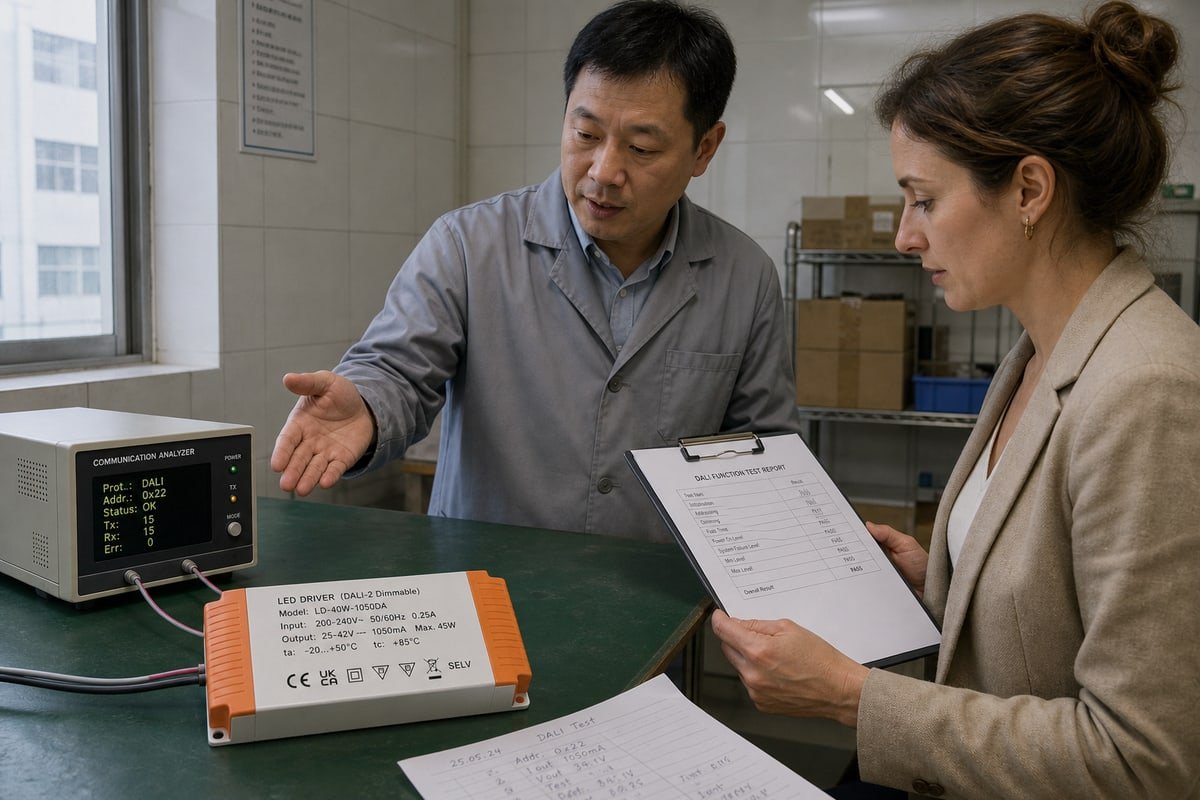
Individuele adressering betekent niet automatisch onbeperkte flexibiliteit. Praktische mogelijkheden hangen af van het DALI-apparaattype 2, de DALI-versie en -functies, de controller, de inbedrijfstellingssoftware en de driverimplementatie. DALI-2-certificering verbetert interoperabiliteit, maar echte mogelijkheden variëren nog steeds per fabrikant. Dus stop niet bij “DALI-compatibel”. Dring bij de leverancier aan op specifieke details.
Vragen Die De Moeite Waard Zijn Voor Je Koopt
| Vraag aan de leverancier | Waarom het ertoe doet |
|---|---|
| Wordt DALI-2 ondersteund en gecertificeerd? | DALI-2-certificering omvat strengere interoperabiliteitstests onder IEC 62386 |
| Welk apparaattype — DT6 of DT8? | DT6 is geschikt voor enkelvoudig wit; DT8 dekt tunable white en RGBW |
| Wat is het werkelijke dimbereik? | “DALI-dimbare” garandeert niet hetzelfde minimumniveau op elke driver |
| Wat gebeurt er na een busstoring? | Het systeemstoringsniveau bepaalt het armatuurgedrag wanneer de bus uitvalt |
| Wat gebeurt er wanneer de netspanning wordt hersteld? | Aanloopniveau beïnvloedt veiligheid en de gebruikerservaring |
| Ondersteunt het de vereiste scènes en groepen? | Niet elke implementatie stelt elke functie beschikbaar |
| Rapporteert het de status terug? | Bidirectionele gegevensuitwisseling maakt gezondheidsmonitoring van armaturen en foutrapportage mogelijk |
Inbedrijfstelling maakt deel uit van het systeemontwerp
DALI’s grootste voordeel kan een projectrisico worden. Het systeem vereist een correcte inbedrijfstelling. Bij een eenvoudig geschakeld circuit activeert de elektricien de lijn en gaan de lampen aan. Bij individueel aangestuurde DALI-armaturen moet iemand correct: de apparaten ontdekken, adressen toewijzen, groepen creëren, scènes configureren, parameters instellen, minimum- en maximumniveaus testen en het gedrag na een stroomonderbreking verifiëren. Bevestig ook dat de DALI-busvoeding geschikt is voor het aantal apparaten op de lijn. Voor grotere commerciële installaties behandelt u inbedrijfstelling als onderdeel van het ontwerp — niet als een bijzaak.
Kan ik CC DALI-drivers aanpassen met mijn eigen branding voor private-labelprojecten?
Een inkoopmanager uit Singapore stuurde ons een bericht via WhatsApp met een eenvoudige opdracht: haar logo op de behuizing, haar verpakking, haar standaard dimparameters. Zes weken later werden haar merkmonsters vanuit Shenzhen verzonden.
Ja. De meeste CC DALI-driverfabrikanten bieden OEM/ODM-diensten aan, waaronder aangepaste logo's, behuizingskleuren onder eigen merk, op maat gemaakte labels, verpakking en vooraf ingestelde firmwareparameters. Typische vereisten zijn onder meer een ondertekende overeenkomst, artworkbestanden en een minimale bestelhoeveelheid die tijdens gezamenlijke ontwikkeling wordt overeengekomen.
Private-label werk is meer dan een logowissel. In onze OEM/ODM-projecten voor merkeigenaren en groothandels in Europa, Zuidoost-Azië en Australië bewegen de brandinglaag en de technische laag samen. Een driver die uw naam draagt, moet zich ook gedragen zoals uw controllers en installateurs verwachten. Daarom voeren we maatwerk uit als een gestructureerd proces, niet als een printopdracht.
Hoe een typisch private-label project verloopt
- Eisenbriefing. We bevestigen het LED-stroombereik, het forward-voltage venster, het DALI-apparaattype en de certificeringen voor de doelmarkt.
- Ontwerpvergrendeling. Behuizingskleur, logopositie, labelindeling, terminaldiagrammen en markeringen zoals CE-, CB- en SELV-symbolen worden goedgekeurd op artwork-proofs.
- Firmware-voorinstellingen. Standaard aanloopniveau, systeemfoutniveau, minimaal dimniveau en logaritmische dimcurves worden ingesteld volgens uw specificatie.
- Monsterneming. U test merkmonsters met uw beoogde controller, inclusief groepering, scènes en slimme gebouwintegratieplatforms 4 indien relevant.
- Pilotbatch. Een kleine productierun valideert het proces vóór volumeorders.
- Volumeproductie. Volledige QC geldt voor elke batch, met documentatie onder uw merk.
Voor kopers met strakke projectdeadlines is de firmware-voorinstellingsstap de verborgen tijdswinst. Als drivers met de juiste standaardinstellingen worden verzonden, besteden inbedrijfstellingsteams ter plaatse veel minder tijd aan het aanpassen van parameters per armatuur. Dat verlaagt direct de totale projectkosten — meestal het eerste pijnpunt dat een inkoopfunctionaris bij mij aankaart.
Welke QC-normen moet ik vereisen bij het inkopen van CC DALI-drivers voor enkelvoudige armatuurbesturing?
Tijdens een inspectie vóór verzending in onze faciliteit doorstond een batch alle elektrische tests bij kamertemperatuur, maar vertoonde daarna instabiel dimmen op minimumniveau bij verhoogde behuizingstemperatuur. We ontdekten dit omdat thermische tests verplicht zijn op onze lijn.
Vereis 100% burn-in-testen, DALI-protocolverificatie volgens IEC 62386, dimbereikcontroles op minimale en maximale niveaus, thermische tests bij nominale behuizingstemperatuur, beschermingstests voor kortsluiting, overbelasting en nullastcondities, plus gedocumenteerde AQL-steekproeven vóór verzending.
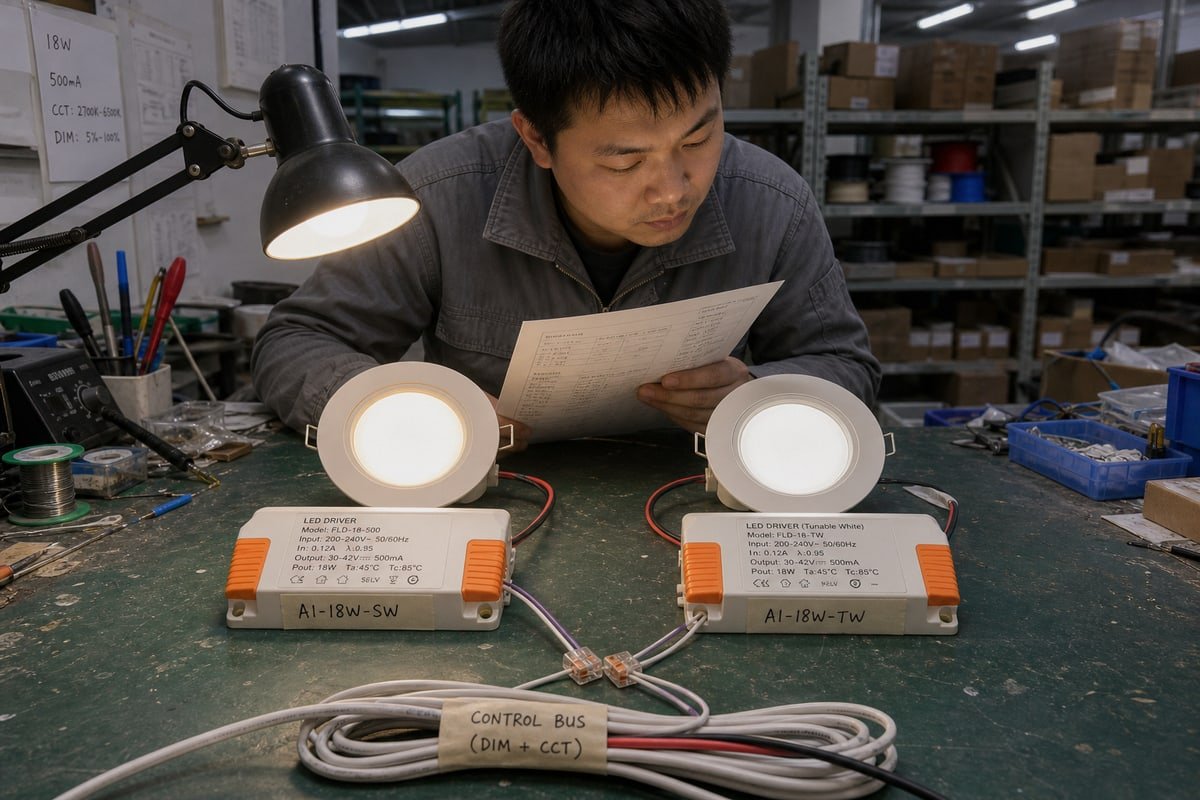
Kwaliteitscontrole voor een CC DALI-driver heeft twee helften, en beide zijn belangrijk. De vermogenshelft bewijst dat de driver de LED correct aanstuurt. De digitale helft bewijst dat de driver correct op de bus reageert. Een driver kan de ene doorstaan en de andere falen. Uw QC-vereisten moeten de leverancier dwingen beide te testen, op elke batch, onder realistische omstandigheden.
De selectie- en QC-volgorde die ik aanbeveel
Volg deze volgorde vóór al het andere. Stem eerst de gereguleerde uitgangsstroom van de driver af op de LED-module. Bevestig ten tweede dat de werkelijke bedrijfsspanning van de LED binnen het compliantiebereik van de driver valt. Controleer ten derde of het resulterende bedrijfsvermogen binnen de specificatie van de driver ligt. Pas daarna controleert u DALI-functionaliteit, dimbereik, thermische prestaties en fysieke integratie — afmetingen, montagegaten, bedrading en IP-vereisten.
| QC-controlepunt | Wat het verifieert | Faalrisico indien overgeslagen |
|---|---|---|
| Nauwkeurigheid uitgangsstroom | Gereguleerde stroom komt overeen met LED-binning en specificatie | Overbelaste LED’s, vroege lumenvermindering |
| Burn-in-test | Stabiliteit onder aanhoudende belasting | Vroege veldstoringen |
| DALI-adresseringstest | Individuele adressering en commandorespons | Armaturen negeren inbedrijfstellingssoftware |
| Controle minimaal dimniveau | Werkelijke lage uitgang, niet de datasheetclaim | Flikkering of uitval bij lage scènes |
| Thermische test bij nominale tc | Prestaties bij werkelijke behuizingstemperatuur | Derating, drift, verkorte levensduur |
| Beschermingstests | Kortsluiting, nullast, overbelasting, thermische uitschakeling | Veiligheidsincidenten, schade aan armaturen |
| Gedrag bij stroomcycli | Correct niveau na herstel van de netspanning | Onjuiste helderheid na stroomuitval |
Waarom thermische omstandigheden speciale aandacht verdienen
Bij downlights en spots kunnen de thermische omstandigheden van de driver belangrijker zijn dan de nominale kamertemperatuur. Een driver die in een compacte plafondholte of direct boven een krachtige downlight is geïnstalleerd, kan aanzienlijk heter worden dan de omringende ruimte. Een hogere temperatuur beïnvloedt de levensduur, uitgangsregeling, componentstress, dimgedrag en beschermingsderating. De juiste vraag is dus niet alleen “kan deze driver mijn LED voeden?” Het is: kan deze driver mijn LED voeden met de vereiste stroom en het dimniveau onder de werkelijke thermische omstandigheden van het armatuur?
Conclusie
CC DALI-drivers leveren regeling per armatuur door nauwkeurige stroomregeling te combineren met digitale adresseerbaarheid. Controleer eerst de elektrische match, daarna de DALI-functies, en sta vervolgens op strenge kwaliteitscontrole.
Voetnoten
- Biedt een uitgebreid technisch overzicht van het Digital Addressable Lighting Interface-protocol en de geschiedenis ervan. ↩︎
- Officiële brancheorganisatie die DALI-apparaattypen definieert en DALI-2-certificeringsnormen beheert. ↩︎
- De internationale normalisatie-instelling die verantwoordelijk is voor de IEC 62386-norm die het DALI-2-kader regelt. ↩︎
- Toonaangevende technische autoriteit voor elektronica- en communicatiestandaarden die worden gebruikt in slimme gebouwintegratieplatforms. ↩︎