Ir al contenido










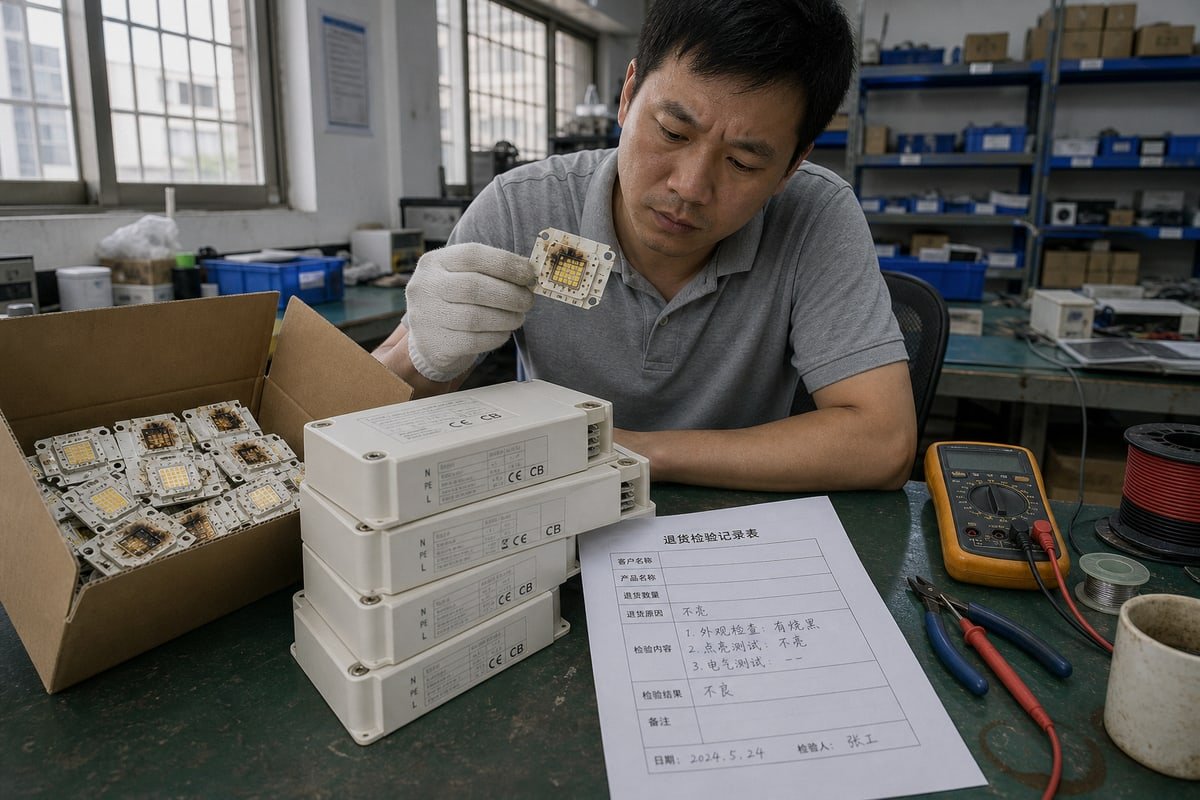
Un lote devuelto de módulos LED muertos le enseñó a nuestro equipo de Shenzhen una dura verdad: sin control de corriente constante 1, los módulos LED se cocinan silenciosamente. Aquí está el porqué de eso.
La corriente constante es preferida para módulos LED diseñados como cargas de corriente constante porque el voltaje directo de un LED cambia con la temperatura y la corriente. Un controlador de corriente constante regula la corriente en lugar de dejar que aumente, manteniendo una salida de luz predecible, limitando el estrés térmico y extendiendo la vida útil del LED. Iguala primero la corriente, luego verifica el cumplimiento del voltaje.
Una aclaración importa antes de continuar. La corriente constante no es preferida para todos los productos LED del mundo. Es preferida para cargas LED que fueron diseñadas como cargas de corriente constante: módulos desnudos, matrices COB y cadenas en serie. Las tiras LED con limitación de corriente integrada son otra historia. Este artículo recorre la física, las ganancias de fiabilidad, las matemáticas de costos y un método práctico de selección. Comencemos con la pregunta central.
¿Por qué debería elegir controladores de corriente constante en lugar de voltaje constante para mis módulos LED?
Un gerente de compras en Singapur me preguntó una vez por qué su proveedor insistía en controlador de corriente constantes para módulos COB desnudos. Nuestra respuesta se redujo a una palabra: física.
Elija controladores de corriente constante para módulos LED diseñados como cargas de corriente constante, porque los LED desnudos no pueden regular su propia corriente. Un pequeño aumento de voltaje crea una gran sobretensión de corriente. Los controladores de voltaje constante son adecuados para tiras LED con limitación de corriente integrada; los módulos desnudos, los COB y las cadenas en serie necesitan corriente regulada.

El concepto más importante aquí es el comportamiento de resistencia diferencial negativa del LED. Un LED no regula naturalmente su propia corriente. Una vez que se alcanza su tensión directa 2 , un aumento relativamente pequeño en el voltaje puede producir un aumento desproporcionadamente grande en la corriente. La cadena se ve así: una corriente más alta eleva la temperatura del LED, la temperatura más alta cambia el voltaje directo, el punto de operación se desplaza y la corriente puede subir aún más. Es exactamente por eso que conectar un módulo LED desnudo directamente a una fuente de voltaje es peligroso.
Un controlador de corriente constante bien diseñado rompe esa cadena. Controla la corriente, mientras que el voltaje del LED se asienta en el valor que la carga requiera dentro del rango de operación del controlador. Déjame matar un concepto erróneo común de inmediato: un controlador de corriente constante no fuerza un voltaje fijo en el LED. El LED determina su voltaje de operación; el controlador regula la corriente.
¿Dónde pertenece cada tipo de controlador?
| Característica | Corriente Constante (CC) | Voltaje Constante (CV) |
|---|---|---|
| Salida regulada | Actual | Tensión |
| Especificación típica | 350 mA, 500 mA, 700 mA | 12V, 24V |
| Aplicación típica | Módulos LED desnudos, COBs, muchos downlights | Tiras LED, módulos CV |
| Parámetro de selección principal | Corriente del LED | Voltaje del LED |
| Parámetro secundario | Rango de voltaje directo/cumplimiento | Corriente/potencia máxima de carga |
| Limitación de corriente | Integrada en el controlador | Generalmente requerida dentro de la carga LED |
Así que un controlador de voltaje constante no está mal. Es simplemente la herramienta adecuada para una arquitectura diferente. Los controladores CC también se combinan naturalmente con un circuito en serie, porque la misma corriente fluye a través de cada LED en la cadena mientras el controlador ajusta su voltaje de salida para cubrir el voltaje directo combinado.
¿Cómo mejora la corriente constante la fiabilidad y la vida útil de mis proyectos de iluminación LED?
Cada lote de controladores en nuestra línea pasa por una prueba de quemado completa antes del envío. Ese hábito comenzó después de que estudiamos por qué las fallas de campo se agrupan alrededor del calor, no del brillo.
La corriente constante mejora la fiabilidad al prevenir el descontrol térmico, manteniendo los LED dentro de su clasificación de corriente máxima absoluta y estabilizando la temperatura de unión. La corriente estable mantiene el flujo luminoso y la consistencia del color predecibles, reduce el estrés eléctrico en el chip y típicamente extiende la vida útil del LED en todo el rango de temperatura de operación del accesorio.
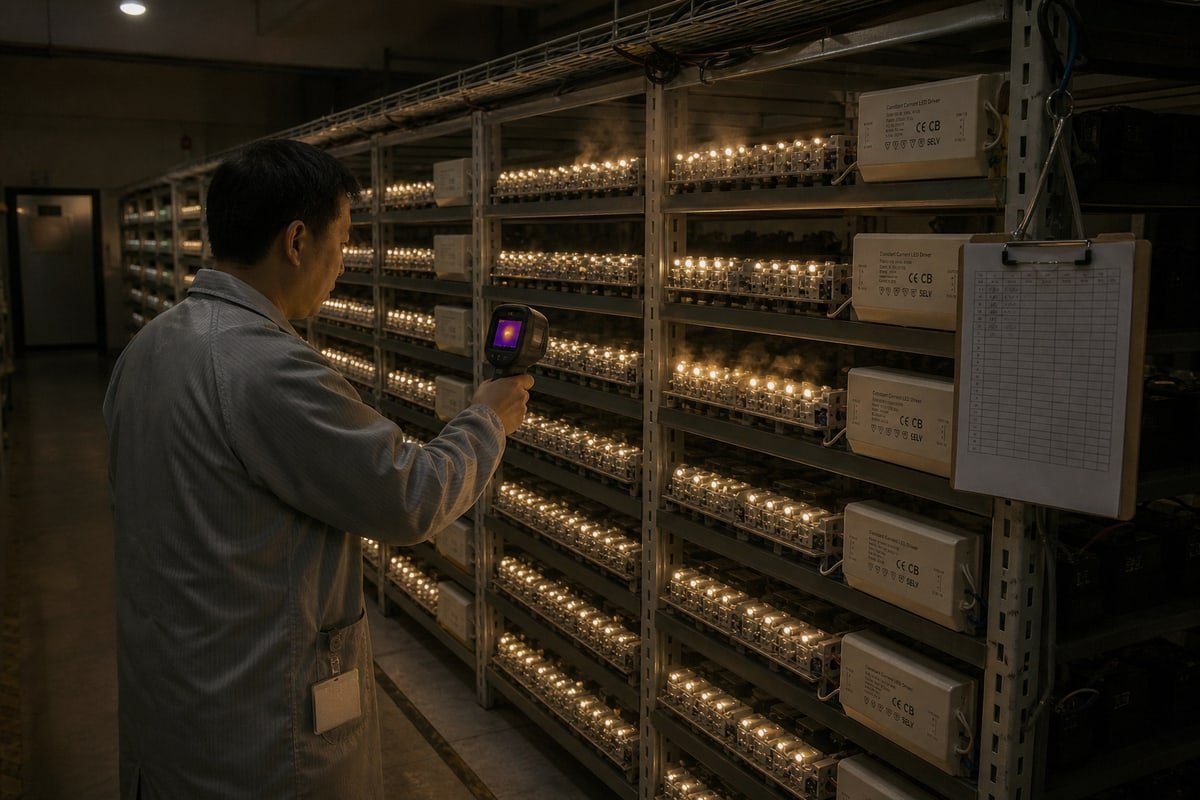
Los LED tienen un coeficiente de temperatura negativo. A medida que la unión se calienta, la resistencia efectivamente cae y el diodo atrae más corriente al mismo voltaje. En un suministro no regulado, ese bucle se alimenta a sí mismo hasta que el chip falla. Los ingenieros llaman a esto descontrol térmico, y es el mayor asesino de módulos sobrecargados. Un controlador CC compensa automáticamente: a medida que el LED se calienta y su voltaje directo se desplaza, el controlador ajusta su voltaje de salida y mantiene la corriente en el punto de ajuste. Eso es protección contra sobrecarga integrada, manteniendo el chip dentro de la Clasificación de Corriente Máxima Absoluta del fabricante independientemente de las fluctuaciones de entrada.
Beneficios de calidad de luz que puedes medir
La fiabilidad no se trata solo de supervivencia. Los chips LED se clasifican a una corriente calibrada. Cuando la corriente se desvía de ese punto de clasificación, la temperatura de color 3 se desplaza, y una pared de downlights deja de coincidir. La corriente regulada previene esa deriva de CCT y mantiene el flujo luminoso 4 uniforme en cada módulo de una cadena en serie. Los controladores CC bien diseñados también reducen el índice de parpadeo y mitigan el efecto estroboscópico, lo que importa en fábricas con maquinaria rotativa o estudios que usan cámaras de alta velocidad.
| Riesgo de falla o calidad | Cómo ayuda la corriente constante |
|---|---|
| Descontrol térmico | Mantiene la corriente fija a medida que la temperatura sube |
| Quemado del chip | Respeta la clasificación de corriente máxima absoluta |
| Deriva de CCT | Mantiene los LED en su corriente de clasificación calibrada |
| Brillo desigual | Misma corriente a través de cada LED en la cadena |
| Parpadeo | Índice de parpadeo más bajo con filtrado de salida adecuado |
Un beneficio de diagnóstico oculto
Hay un beneficio que la mayoría de los artículos omiten. Debido a que el controlador mantiene la corriente constante, puede monitorear el voltaje directo necesario para mantenerla. Un cambio a largo plazo en ese voltaje indica envejecimiento del LED o degradación de la interconexión antes de que la luminaria realmente falle. Varios de nuestros clientes de ingeniería en Alemania y Japón usan exactamente este método para mantenimiento predictivo en luminarias cerradas, donde la disipación de calor es más difícil.
¿Qué ventajas de coste puedo esperar al cambiar a controladores LED de corriente constante?
El precio por vatio es el primer número que la mayoría de los compradores nos citan en ferias comerciales. Sin embargo, los controladores que parecen más baratos en una cotización rara vez son los más baratos a lo largo de la vida de un proyecto.
Los controladores de corriente constante reducen costos al eliminar resistencias limitadoras de corriente que desperdician aproximadamente 20–40% de la potencia como calor, reduciendo facturas de energía, disminuyendo devoluciones por garantía debido a fallas por sobrecorriente y compensando la caída de voltaje en recorridos largos. Un mejor factor de potencia y menor THD también facilitan los costos de cumplimiento de servicios públicos.
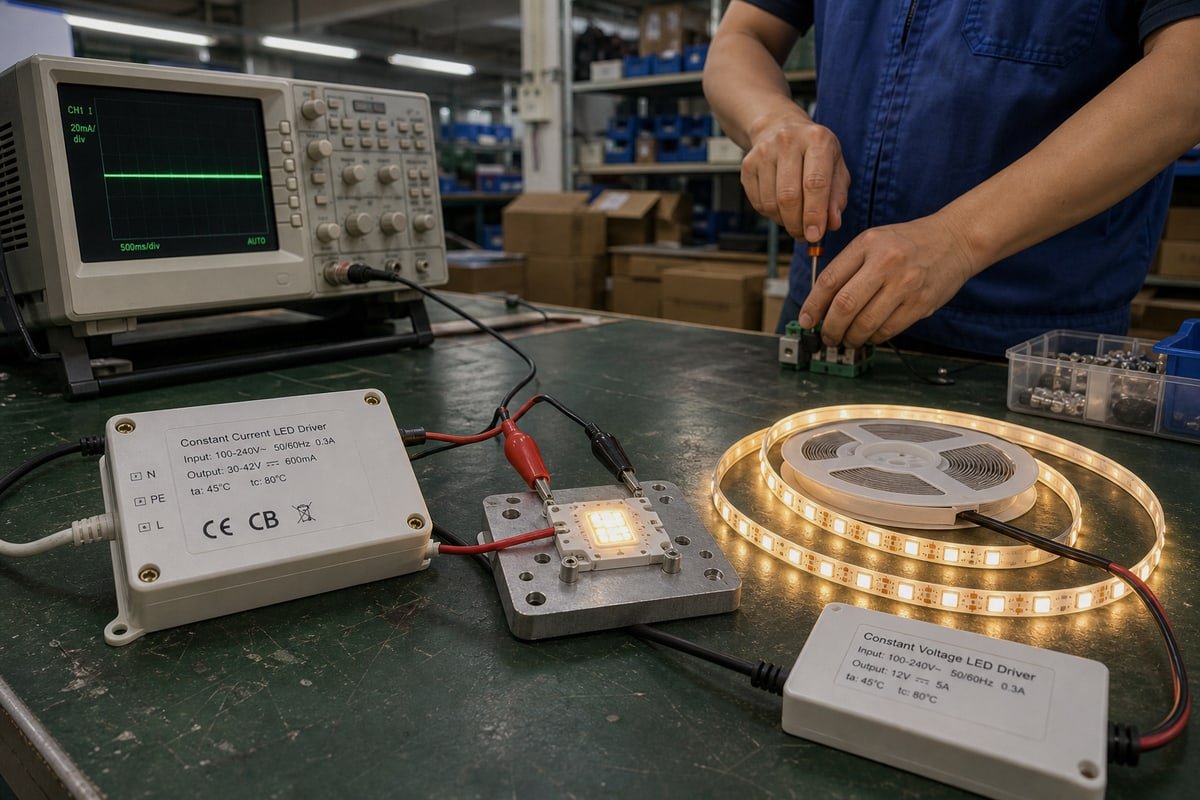
Déjame ser honesto sobre la objeción primero, porque nuestros distribuidores la plantean a menudo. Un controlador de CC puede tener un precio unitario más alto que un controlador básico de voltaje constante, y es menos flexible si planea agregar o quitar módulos más tarde, ya que está diseñado alrededor de una corriente específica y una ventana de voltaje directo. Ambos puntos son ciertos. Pero para luminarias con configuración fija, que describe la mayoría de downlights, paneles y luminarias arquitectónicas, las matemáticas del ciclo de vida favorecen fuertemente la corriente constante.
Comience con la eficiencia. Los diseños de CV limitados por resistencia desperdician del 20% al 40% de su potencia como calor residual en las resistencias. Esa es energía que su cliente paga dos veces: una vez en el medidor, y otra en disipadores más grandes necesarios para la disipación de calor. Un controlador de CC elimina esas resistencias por completo.
Donde realmente aparecen los ahorros
| Factor de costo | Enfoque de CV limitado por resistencia | Enfoque de corriente constante |
|---|---|---|
| Energía desperdiciada en resistencias limitadoras | 20–40% perdido como calor | Esencialmente eliminado |
| Tamaño del disipador y la carcasa | Más grande, más costoso | Más pequeño, más barato |
| Cables largos | El brillo cae con la caída de voltaje | El controlador aumenta el voltaje para compensar |
| Devoluciones por garantía | Mayor riesgo de falla por sobrecorriente | Corriente limitada al valor nominal |
| Cumplimiento de red (PF, THD) | A menudo acondicionamiento básico | Acondicionamiento de potencia típicamente superior |
El punto de caída de voltaje merece énfasis para instalaciones grandes. En recorridos largos o matrices grandes, un controlador de CC simplemente aumenta su voltaje de salida para mantener el amperaje objetivo fluyendo, por lo que la última luminaria brilla tanto como la primera. Y debido a que los controladores de CC suelen llevar un acondicionamiento de potencia más sofisticado, ayudan a los proyectos a cumplir con los requisitos de servicios públicos para Distorsión Armónica Total y factor de potencia, que varios de nuestros clientes europeos ahora especifican en cada licitación.
¿Cómo selecciono el controlador de corriente constante adecuado para las especificaciones de mi módulo LED personalizado?
Uno de los errores más costosos que he visto cometer a un cliente fue pedir controladores solo por vataje. Trescientas luminarias parpadearon en arranques en frío porque el voltaje de cumplimiento nunca coincidió.
Seleccione un controlador de corriente constante igualando primero la corriente de accionamiento especificada del módulo LED, luego confirmando que su voltaje directo cae dentro de la ventana de voltaje de cumplimiento de salida del controlador en todo el rango de temperatura de operación. Finalmente, verifique las condiciones térmicas, las necesidades de atenuación y las certificaciones de seguridad. Nunca elija solo por vataje.

Aquí está la verdad simple que repetimos a cada cliente OEM: el vataje le dice cuánta potencia consume el LED; no le dice si el controlador es eléctricamente compatible con el LED. La compatibilidad vive en dos números, y aquí está el proceso que seguimos cuando desarrollamos controladores personalizados.
- Iguale la corriente. Si el módulo especifica 700 mA, el controlador debe regular 700 mA. Sin redondeos.
- Verifique el voltaje de cumplimiento. Un controlador marcado como 700 mA / 18–36 V no emite 36V continuamente. Regula 700 mA mientras su voltaje flota a lo que la carga necesite, siempre que ese valor permanezca dentro de 18–36V.
- Agregue margen de temperatura. El voltaje directo no es un número fijo. Se desplaza con la temperatura de unión, por lo que una lectura de Vf a temperatura ambiente no es suficiente. Exija margen en el rango de operación real, especialmente para COB de alta potencia, luminarias cerradas e instalaciones de alta temperatura ambiente.
- Verifique atenuación, cableado y certificaciones. Confirme el protocolo de atenuación, la disposición de los terminales L, N y PE, y las marcas como CE y CB en la etiqueta, que es estándar en cada unidad que sale de nuestra línea.
Un ejemplo de coincidencia resuelto
Suponga que su módulo necesita 700 mA a un voltaje directo nominal de 28 V.
| Opción de controlador | Actual | Rango de tensión | Veredicto |
|---|---|---|---|
| Controlador A | 700 mA | 10–25 V | No adecuado: 28 V supera la ventana |
| Controlador B | 700 mA | 18–36 V | Adecuado: 28 V se encuentra cómodamente dentro |
| Controlador C | 700 mA | 30–60 V | No adecuado: 28 V está por debajo del mínimo |
La regla es simple: la corriente del LED debe coincidir, y el voltaje directo del LED debe caer dentro de la ventana de regulación del controlador. Una advertencia final de ingeniero. Los controladores de corriente constante se combinan naturalmente con un circuito en serie, pero conectar cadenas de LED desnudas en paralelo a un solo controlador de corriente constante es arriesgado, porque pequeñas diferencias en el voltaje directo causan una distribución desigual de corriente entre las ramas. Diseñe las ramas en paralelo deliberadamente o evítelas.
Conclusión
La corriente no regulada destruye silenciosamente los módulos de LED. Los controladores de corriente constante rompen esa cadena. Iguale la corriente primero, verifique el cumplimiento de voltaje en segundo lugar, revise el margen térmico en tercer lugar: nunca seleccione solo por potencia.
Notas al pie
- Recurso técnico autorizado que explica los principios y aplicaciones de la regulación de corriente constante en circuitos eléctricos. ↩︎
- Recurso del Departamento de Energía de EE. UU. que explica la física fundamental de los LED y la importancia de la gestión del voltaje. ↩︎
- Definición estándar de la característica de la luz visible, esencial para comprender la clasificación por contenedores y la consistencia de los LED. ↩︎
- Resumen técnico de la medida de la potencia luminosa percibida, una métrica clave de rendimiento para módulos de LED. ↩︎