




...
为什么LED模块优选恒流驱动?

为什么LED模块优选恒流驱动?

恒流驱动之所以被优选用于LED模块,是因为它调节电流而非电压,从而防止热失控并延长使用寿命。.

目录

太棒了!分享此案例:

Constant current preferred as ideal power source for LED modules (ID#1)

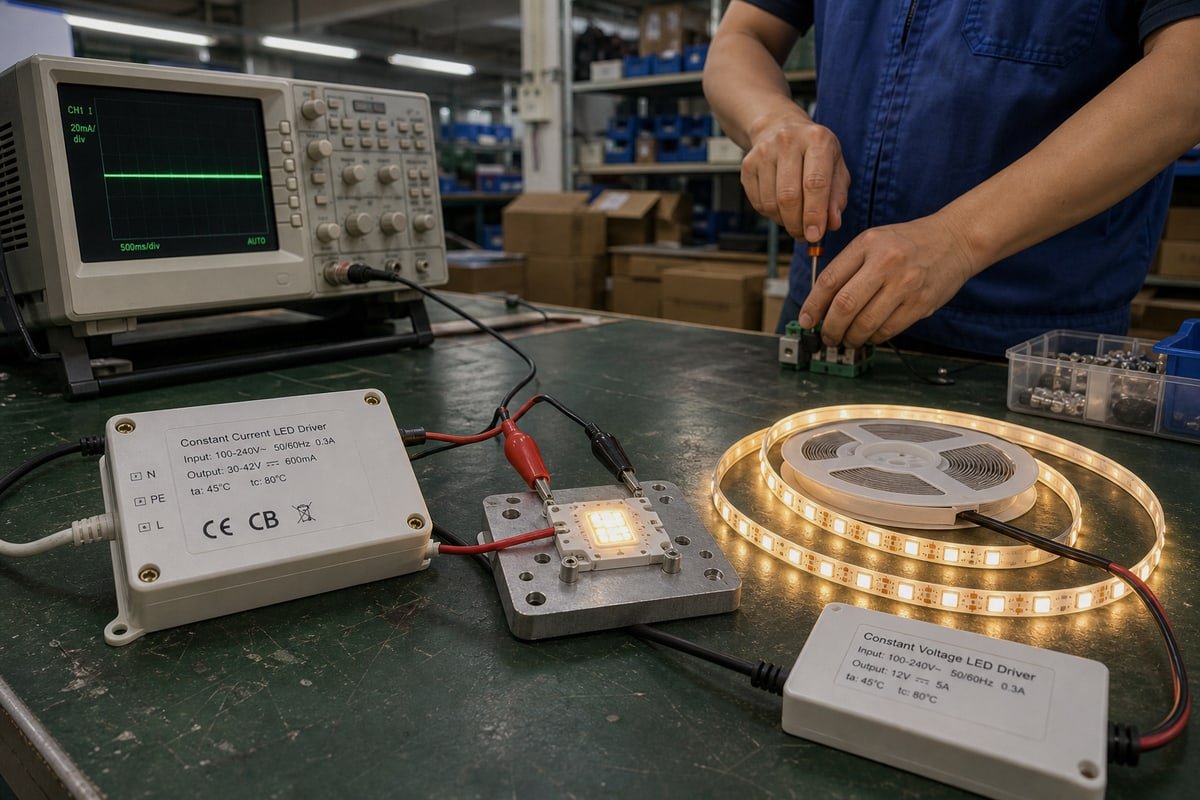
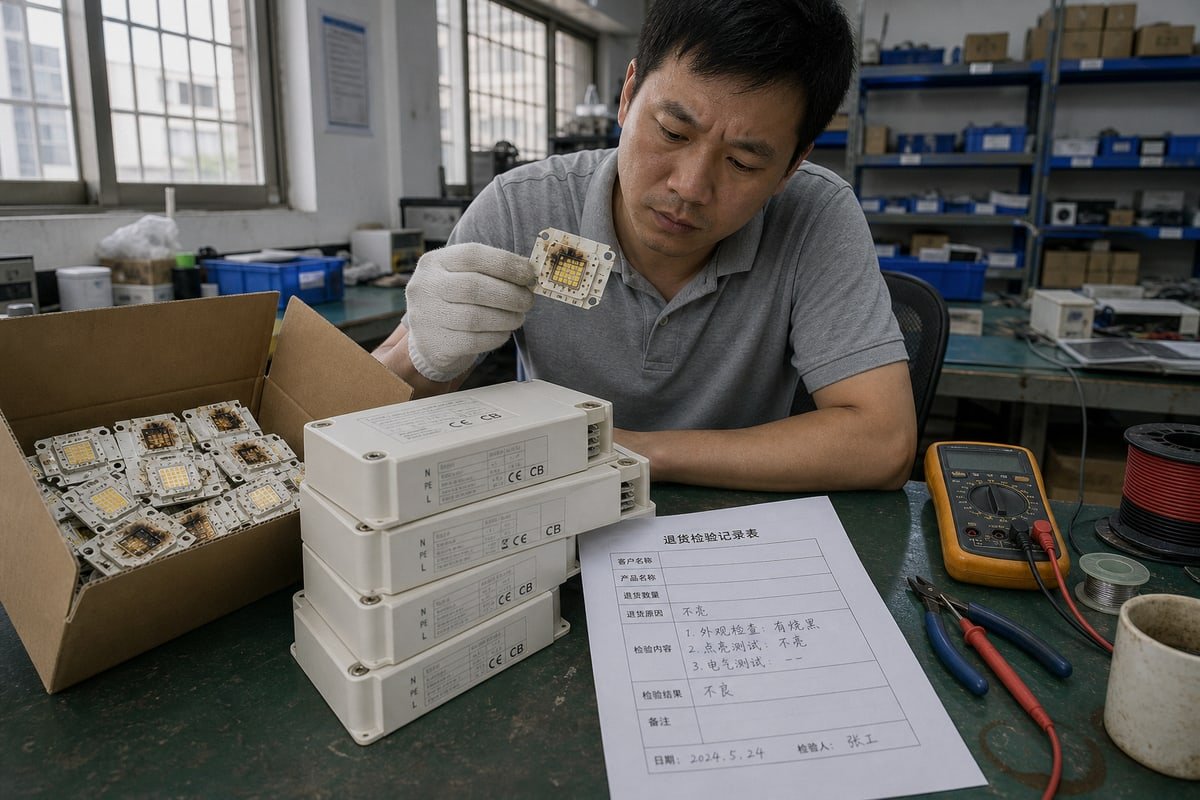
一批退回的失效LED模组给我们的深圳团队上了一课:没有 恒流控制 1, ,LED模组会悄悄“自热”烧毁。以下是原因。.

对于设计为恒流负载的LED模组,恒流是首选,因为LED的正向电压会随温度和电流变化。恒流驱动器调节电流而非任其攀升,从而保持可预测的光输出、限制热应力并延长LED寿命。先匹配电流,再验证电压合规范围。.

在深入之前,有一点需要澄清。恒流并非适用于地球上所有LED产品。它适用于设计为恒流负载的LED负载:裸模组、COB阵列和串联灯串。带有内置限流功能的LED灯带则另当别论。本文探讨物理原理、可靠性提升、成本计算和实用选型方法。让我们从核心问题开始。.

为什么我应该为我的LED模块选择恒流驱动器而不是恒压驱动器?

新加坡的一位采购经理曾问我,为什么她的供应商坚持要求 恒流驱动器用于裸COB模组。我们的答案归结为一个词:物理。.

为设计为恒流负载的LED模块选择恒流驱动器,因为裸LED无法自行调节电流。电压的微小上升会产生巨大的电流尖峰。恒压驱动器适用于内置限流功能的LED灯带;裸模块、COB和串联灯串则需要受控电流。.

Constant current drivers regulate LED modules better than constant voltage for stability (ID#2)

这里最重要的概念是LED的负微分电阻特性。LED不会自然调节自身电流。一旦达到其 正向电压 2 阈值,电压的微小增加可能导致电流不成比例地大幅上升。链条如下:电流升高导致LED温度上升,温度变化改变正向电压,工作点偏移,电流可能进一步攀升。这正是将裸LED模组直接连接到电压源的危险所在。.

设计得当的恒流驱动器能打破这一链条。它控制电流,而LED电压在驱动器工作范围内稳定在负载所需的任何值。让我立即消除一个常见误解:恒流驱动器不会向LED强制施加固定电压。LED决定其工作电压;驱动器调节电流。.

每种驱动器类型适用于哪里?

功能 恒流(CC) 恒压(CV)
稳压输出 电流 电压
典型规格 350 mA、500 mA、700 mA 12V、24V
典型应用 裸LED模组、COB、许多筒灯 LED灯带、恒压模组
主要选型参数 LED电流 LED电压
次要参数 正向电压/合规范围 最大负载电流/功率
限流 内置在驱动器中 通常需要在LED负载内

因此,恒压驱动器并非错误。它只是适用于不同架构的正确工具。恒流驱动器也自然与串联电路搭配,因为相同的电流流过灯串中的每个LED,而驱动器调整其输出电压以覆盖总正向电压。.

恒流驱动器让LED设定自身工作电压,同时驱动器保持电流稳定 True
驱动器的输出电压在其合规范围内浮动以匹配负载的正向电压需求,而电流保持在额定值受控。.
恒流适用于所有LED产品,包括成品LED灯带 错误
LED灯带包含自身限流元件,设计为恒压负载,因此应使用恒压驱动器,而非恒流单元。.

恒定电流如何提升我的LED照明项目的可靠性和使用寿命?

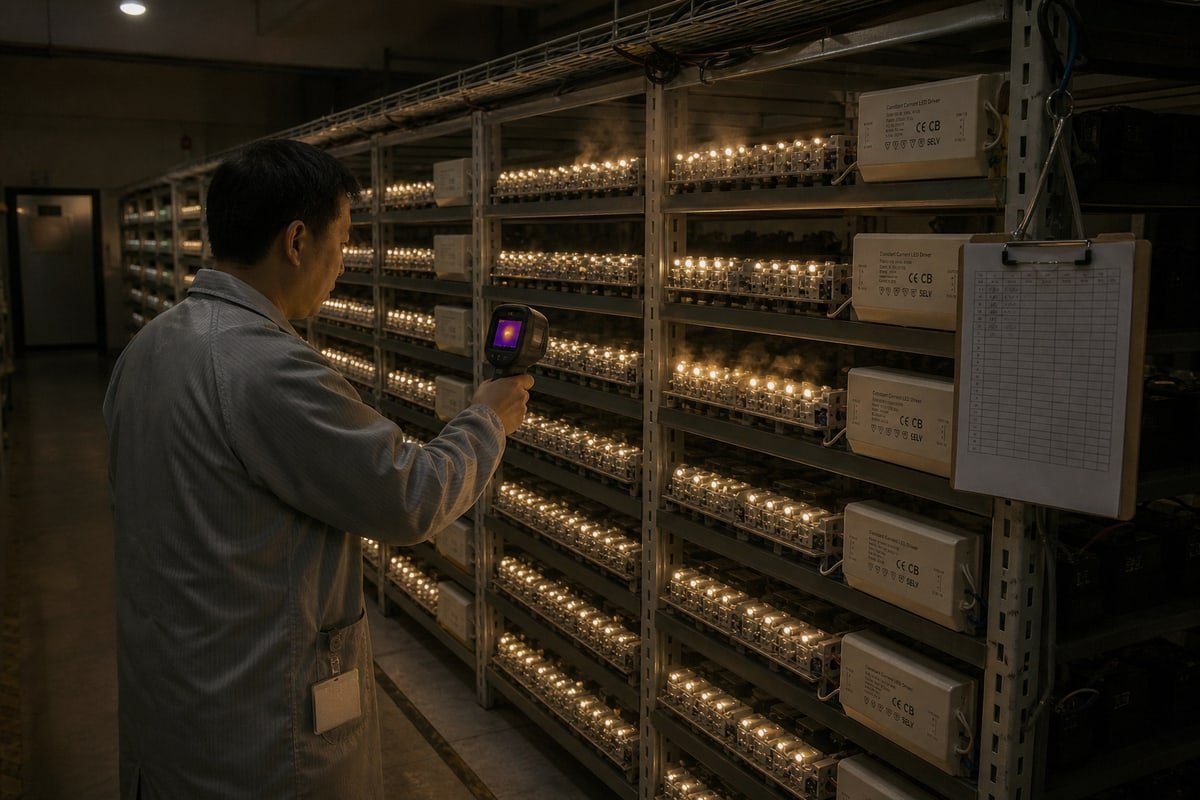
我们生产线上的每批驱动器在发货前都经过完整的老化测试。这个习惯始于我们研究为何现场故障集中在热量而非亮度之后。.

恒流通过防止热失控、将LED保持在绝对最大额定电流内并稳定结温来提高可靠性。稳定的电流保持光通量和颜色一致性可预测,减少芯片上的电应力,并通常在整个灯具工作温度范围内延长LED寿命。.
Constant current prevents thermal runaway and extends LED lighting lifespan reliably (ID#3)

LED具有负温度系数。随着结温升高,电阻有效下降,二极管在相同电压下吸取更多电流。在未稳压的电源上,这个循环会自我强化直到芯片失效。工程师称之为热失控,这是过驱动模组的最大杀手。恒流驱动器自动补偿:当LED升温且正向电压漂移时,驱动器调整其输出电压并将电流保持在设定点。这是内置的过驱动保护,无论输入波动如何,都将芯片保持在制造商的绝对最大额定电流内。.

可测量的光质量提升

可靠性不仅关乎生存。LED芯片在校准电流下分档。当电流偏离该分档点时, 色温 3 会偏移,一面筒灯墙就不再匹配。受控电流防止这种色温漂移,并保持 光通量 4 在串联灯串中的每个模组上均匀。设计良好的恒流驱动器还能 降低闪烁指数并减轻频闪效应, ,这对于有旋转机械的工厂或使用高速摄像机的演播室至关重要。.

失效或质量风险 恒流如何帮助
热失控 温度升高时保持电流固定
芯片烧毁 尊重绝对最大额定电流
色温漂移 Keeps LEDs at their calibrated binning current
Uneven brightness Same current through every LED in the string
闪烁 Lower flicker index with proper output filtering

A hidden diagnostic bonus

There is one benefit most articles skip. Because the driver holds current constant, you can monitor the forward voltage needed to maintain it. A long-term shift in that voltage signals LED aging or interconnect degradation before the fixture actually fails. Several of our engineering clients in Germany and Japan use exactly this method for predictive maintenance in enclosed fixtures, where heat dissipation is hardest.

Rising junction temperature changes an LED’s forward voltage, which can push current higher on a fixed-voltage supply True
This negative temperature coefficient is the mechanism behind thermal runaway, and it is why current must be regulated externally rather than left to the diode.
LEDs run cool, so heat management barely affects their lifespan 错误
LEDs convert a significant share of input power into heat at the junction, and elevated junction temperature is a primary driver of lumen depreciation and early failure.

改用恒流LED驱动器后,我能期待哪些成本优势?

Price-per-watt is the first number most buyers quote to us at trade shows. Yet the drivers that look cheapest on a quotation are rarely cheapest across a project’s life.

Constant current LED drivers cut costs by removing current-limiting resistors that waste roughly 20–40% of power as heat, lowering energy bills, reducing warranty returns from overcurrent failures, and compensating for voltage drop on long runs. Better power factor and lower THD also ease utility compliance costs.

Constant current LED drivers reduce costs by eliminating wasteful current-limiting resistors (ID#4)

Let me be honest about the objection first, because our distributors raise it often. A CC driver can carry a higher unit price than a basic constant voltage driver, and it is less flexible if you plan to add or remove modules later, since it is designed around a specific current and forward-voltage window. Both points are true. But for fixtures with a fixed configuration, which describes most downlights, panels, and architectural luminaires, the lifecycle math strongly favors constant current.

Start with efficiency. Resistor-limited CV designs burn 20% to 40% of their power as waste heat in the resistors. That is energy your client pays for twice: once at the meter, and again in larger heatsinks needed for heat dissipation. A CC driver eliminates those resistors entirely.

Where the savings actually show up

Cost factor Resistor-limited CV approach Constant current approach
Energy wasted in limiting resistors 20–40% lost as heat Essentially eliminated
Heatsink and enclosure size Larger, costlier Smaller, cheaper
Long cable runs Brightness drops with voltage drop Driver raises voltage to compensate
Warranty returns Higher overcurrent failure risk Current capped at rated value
Grid compliance (PF, THD) Often basic conditioning Typically superior power conditioning

The voltage drop point deserves emphasis for large installations. On long runs or big arrays, a CC driver simply raises its output voltage to keep the target amperage flowing, so the last fixture shines as brightly as the first. And because CC drivers usually carry more sophisticated power conditioning, they help projects meet utility requirements for Total Harmonic Distortion and power factor, which several of our European clients now specify in every tender.

如何根据我的定制LED模块规格选择合适的恒流驱动器?

One of the costliest mistakes I have watched a client make was ordering drivers by wattage alone. Three hundred fixtures flickered on cold starts because the compliance voltage never matched.

Select a constant current driver by matching the LED module’s specified drive current first, then confirming its forward voltage falls inside the driver’s output-voltage compliance window across the full operating temperature range. Finally, check thermal conditions, dimming needs, and safety certifications. Never choose by wattage alone.

Selecting the right constant current driver matches LED module specifications precisely (ID#5)

Here is the plain truth we repeat to every OEM client: wattage tells you how much power the LED consumes; it does not tell you whether the driver is electrically compatible with the LED. Compatibility lives in two numbers, and here is the process we follow when we develop custom drivers.

  1. Match the current. If the module specifies 700 mA, the driver must regulate 700 mA. No rounding.
  2. Verify the compliance voltage. A driver marked 700 mA / 18–36 V does not output 36V continuously. It regulates 700 mA while its voltage floats to whatever the load needs, provided that value stays inside 18–36V.
  3. Add temperature margin. Forward voltage is not a fixed number. It shifts with junction temperature, so a room-temperature Vf reading is not enough. Demand headroom across the real operating range, especially for high-power COBs, enclosed fixtures, and high-ambient installations.
  4. Check dimming, wiring, and certifications. Confirm the dimming protocol, the L, N, and PE terminal arrangement, and marks like CE and CB on the label, which is standard on every unit leaving our line.

A worked matching example

Suppose your module needs 700 mA at a 28V nominal forward voltage.

Driver option 电流 Voltage range Verdict
Driver A 700 mA 10–25V Not suitable: 28V exceeds the window
Driver B 700 mA 18–36V Suitable: 28V sits comfortably inside
Driver C 700 mA 30–60V Not suitable: 28V is below the minimum

The rule is simple: LED current must match, and LED forward voltage must fall inside the driver’s regulation window. One final engineer’s warning. CC drivers pair naturally with a series circuit, but paralleling bare LED strings on one CC driver is risky, because small forward-voltage differences cause unequal current sharing between branches. Design parallel branches deliberately or avoid them.

A driver rated 700 mA / 18–36 V regulates 700 mA while its output voltage floats within 18–36V to suit the load True
The voltage figure is a compliance range, not a fixed output; the driver only delivers whatever voltage the LED string requires inside that window.
Any driver with the right wattage will work with any LED module of the same wattage 错误
Two drivers of identical wattage can have completely different current ratings and voltage windows, so wattage alone cannot confirm electrical compatibility.

结论

Unregulated current quietly destroys LED modules. Constant current drivers break that chain. Match current first, verify voltage compliance second, check thermal margin third — never select by wattage alone.

脚注

  1. Authoritative engineering resource explaining the principles and applications of constant current regulation in electrical circuits. ↩︎

  1. U.S. Department of Energy resource explaining fundamental LED physics and the importance of voltage management. ↩︎

  1. Standard definition of the characteristic of visible light, essential for understanding LED binning and consistency. ↩︎

  1. Technical overview of the measure of perceived light power, a key performance metric for LED modules. ↩︎


为您的照明业务申请报价!

7×24小时服务,我们将始终尽快回复您,并在收到您的消息后12小时内给予答复。如有任何疑问,请随时联系我们。. 

相关文章

了解更多专业指导课程——这些是你犯错之前很少有人会告诉你的。.

立即获取报价

我们将在1个工作日内与您联系,请留意后缀为 “@bo-qi.com”