Pular para o conteúdo










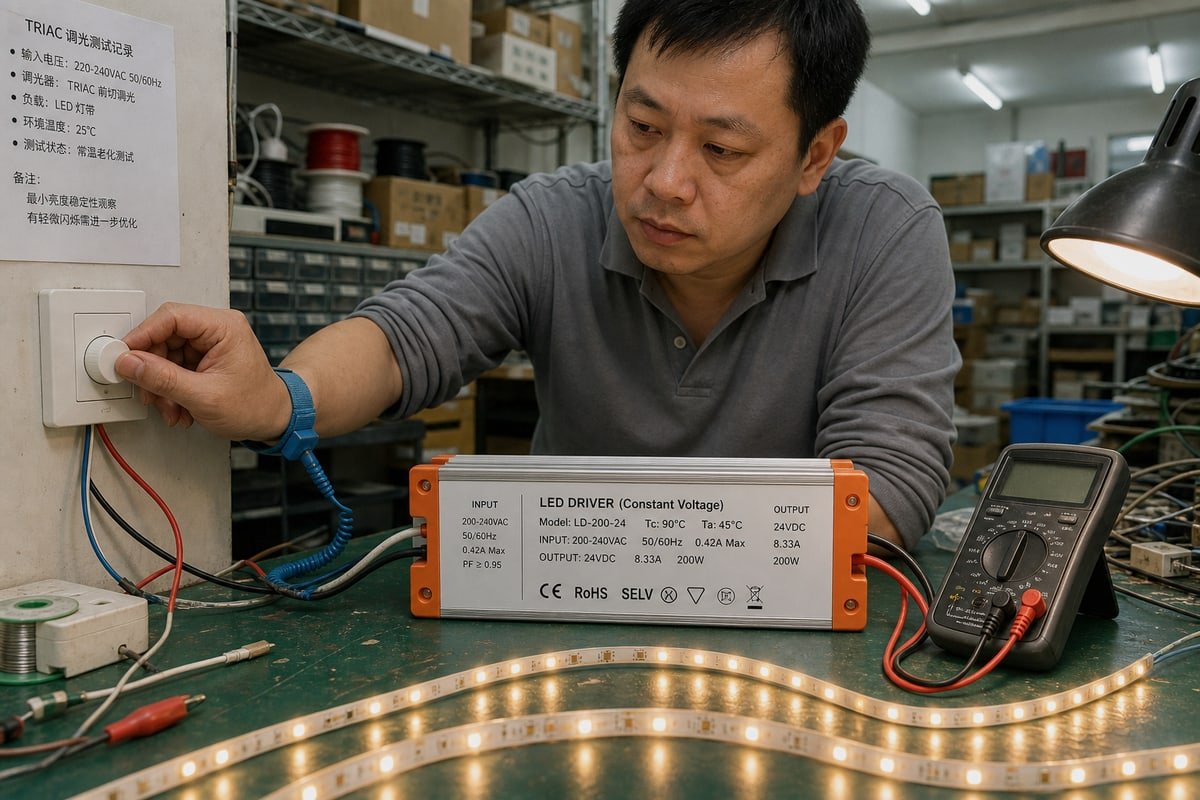
As fitas de LED de um cliente piscaram muito em um projeto de hotel no ano passado. Nosso laboratório em Shenzhen rastreou o problema até os requisitos de carga mínima para drivers CV TRIAC — uma especificação que a maioria dos compradores ignora.
Um driver de LED de tensão constante (CV) dimerizável por TRIAC pode precisar de uma carga conectada mínima para operação estável com um dimerizador de corte de fase TRIAC. Se a carga total de LED ficar abaixo do mínimo especificado do dimerizador, o sistema pode piscar, zumbir, cair, ou alternar de forma não confiável. Sempre verifique as classificações de carga do dimerizador e do driver.
Uma nota rápida sobre terminologia antes de aprofundarmos. O TRIAC normalmente fica dentro do dimerizador, não dentro do estágio de saída de tensão constante 1 do driver de LED. Então, quando as pessoas dizem “driver CV TRIAC”, geralmente querem dizer um driver CV projetado para aceitar entrada de corte de fase TRIAC. Essa distinção molda tudo neste artigo. Vamos dividir isso peça por peça.
Qual é o requisito de carga mínima para drivers TRIAC CV e por que isso importa para o meu projeto?
No mês passado, uma distribuidora de iluminação em Singapura me enviou uma mensagem no WhatsApp: seus drivers dimerizáveis por TRIAC de 6W piscavam em um dimerizador, mas funcionavam perfeitamente em outro. A terminologia era a culpada.
O requisito de carga mínima é a menor potência conectada que um dimerizador de corte de fase TRIAC precisa para manter seu TRIAC interno travado e conduzindo. Isso importa porque cargas abaixo desse limite podem causar cintilação, queda ou alternância não confiável — mesmo quando o driver CV em si está totalmente funcional.
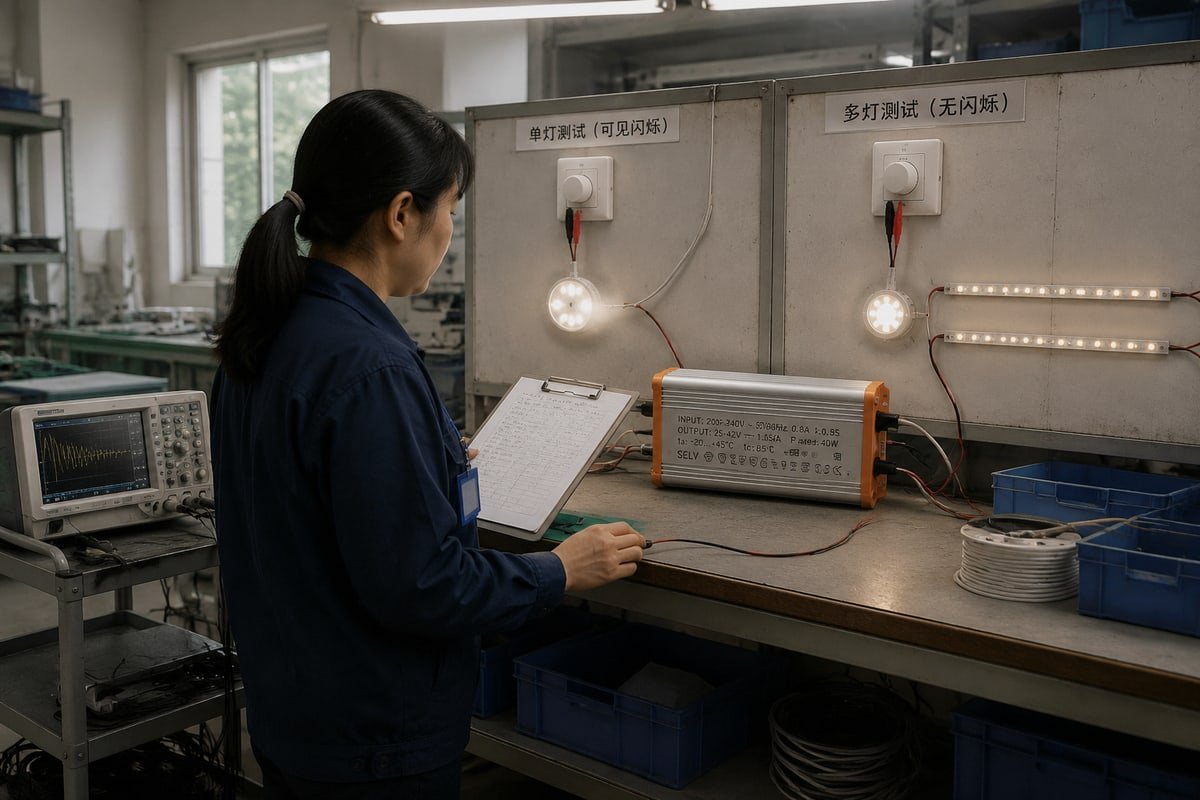
Este é o ponto que destaco muito com cada comprador: a carga mínima do dimerizador e a carga mínima do driver de LED são duas especificações diferentes. Confundi-las causa a maioria das falhas de campo que vejo.
Duas Especificações, Dois Significados
Um dimerizador pode declarar uma carga mínima de LED de 10W. Um driver pode declarar uma carga mínima de saída de 2W. Esses números descrevem coisas completamente diferentes. O primeiro diz respeito a se o dimerizador pode operar corretamente com a carga elétrica conectada. O segundo diz respeito a se o driver pode regular corretamente sua saída de LED em uma carga específica. Ambos devem ser satisfeitos.
| Especificação | Pertence a | O Que Governa | Exemplo Típico |
|---|---|---|---|
| Carga mínima de LED | O dimerizador de parede | Se o TRIAC permanece travado durante o ciclo de CA | Mínimo de 10W |
| Carga mínima de saída | O driver de LED | Se o driver regula sua saída de CC de forma limpa | Mínimo de 2W |
| Corrente de manutenção | O TRIAC dentro do dimerizador | Corrente necessária para permanecer conduzindo | 10–50mA |
| Corrente de disparo | O TRIAC dentro do dimerizador | Corrente necessária para começar a conduzir em cada meio ciclo | Varia conforme o dispositivo |
Por Que Apenas Watts Não Contam a História
Aqui está a percepção de especialista que sempre compartilho. A carga mínima não é simplesmente um problema de potência. É um problema de comportamento elétrico. Um Dimmer TRIAC foi projetado em torno de uma carga resistiva 2, como uma lâmpada incandescente, que consome corrente previsível em toda a forma de onda de CA. Um driver de LED CV se comporta de maneira muito diferente. Seu estágio de entrada pode conter circuitos retificadores, filtragem EMI, capacitores, eletrônica de comutação, correção ativa do fator de potência 3, e limitação de corrente de inrush. Então, um driver de LED de 6W não necessariamente “parece” uma carga resistiva de 6W para o TRIAC. É por isso que dois drivers diferentes de 6W podem se comportar de forma completamente diferente no mesmo dimerizador.
Isso também explica por que um dimerizador de borda de ataque 4 luta mais com pequenas cargas eletrônicas do que um dimerizador de borda de descida. Projetos de borda de descida usam MOSFETs e não precisam de corrente de manutenção, então toleram muito melhor a dimerização de corte de fase de baixa potência.
Como calculo a carga mínima necessária para a minha configuração de driver TRIAC CV?
Quando especificamos drivers para um projeto com múltiplas luminárias, sempre pesamos uma troca: adicionar margem de potência aumenta o custo dos componentes, mas operar no limite do dimerizador arrisca chamadas de serviço.
Some a potência de entrada real de cada driver no circuito, depois compare o total com as classificações de carga mínima e máxima de LED do dimerizador. Também verifique a carga mínima de saída do próprio driver, o número máximo de drivers e a corrente de inrush agregada antes de finalizar o design.

A matemática em si é simples. O julgamento por trás dela não é. Siga este processo, e você evitará os erros que vejo em consultas de projetos toda semana.
- Encontre a carga mínima de LED publicada do dimerizador. Dimerizadores legados de borda de ataque frequentemente especificam 20W–40W. Controles modernos de corte de fase otimizados para LED podem funcionar até 1W–3W. Nunca presuma; leia a folha de dados.
- Encontre a carga mínima de saída do driver. Alguns drivers anunciam que não têm carga mínima. Outros definem uma janela de operação real — uma folha de dados de um driver CV dimerizável por TRIAC de 24V que avaliamos mostra uma faixa de carga de 33–100W com consumo sem carga inferior a 1W. Isso é uma janela definida, não uma garantia de ausência de carga.
- Use a potência real medida, não as classificações nominais da luminária. A fita de LED frequentemente consome menos do que o rótulo sugere.
- Verifique os totais em relação às classificações mínimas e máximas.
- Deixe margem de segurança. Operar exatamente no mínimo convida à instabilidade à medida que os componentes envelhecem e as temperaturas mudam.
Exemplo Prático — Qualificado Corretamente
Se o dimerizador especificar uma carga mínima de LED de 10W e a carga conectada real for de 6W, a combinação está fora da faixa de operação especificada do dimerizador e pode ser instável. Observe que eu disse “pode”, não “vai”. Alguns dimerizadores toleram cargas abaixo do mínimo publicado; outros não. Operar fora da especificação simplesmente significa que o fabricante não garante mais a estabilidade da dimerização.
A Armadilha do Múltiplos Drivers
Isso é importante para iluminação comercial. Compare um driver de 6W contra vinte drivers de 6W. A carga nominal muda de 6W para 120W, mas outras características elétricas também mudam — especialmente a corrente de inrush agregada 5 e a interação de vinte circuitos de entrada em um único dimerizador. Portanto, o cálculo correto nunca é apenas 6W × 20 = 120W.
| Verificação | Driver Único de 6W | Vinte Drivers de 6W |
|---|---|---|
| Carga em estado estacionário | 6W | 120W |
| Carga mínima do dimerizador | Provavelmente abaixo dela | Confortavelmente acima dela |
| Corrente de inrush agregada | Desprezível | Potencialmente crítica |
| Número máximo de drivers por dimerizador | Não é uma preocupação | Deve ser verificado com o fabricante |
| Teste de compatibilidade necessário | Sim | Sim, na quantidade total |
Que problemas enfrentarei se minha carga de iluminação ficar abaixo do requisito mínimo?
Nossa equipe de controle de qualidade uma vez queimou três dias perseguindo uma cintilação que só aparecia após vinte minutos de operação. A causa nos ensinou como circuitos subcarregados podem ser traiçoeiros.
Cargas abaixo do requisito mínimo podem causar oscilação do LED, zumbido audível, comportamento de ligar com estalo, zonas mortas no topo da faixa de dimerização, fantasma quando desligado e queda em baixo brilho. Alguns sintomas aparecem apenas após o dimerizador aquecer e sua corrente de retenção aumentar.

Esse detalhe de aquecimento merece ênfase. O requisito de corrente de manutenção de um TRIAC é sensível à temperatura e tipicamente aumenta à medida que o dispositivo aquece. Portanto, um sistema que parece estável na inicialização pode começar a cintilar vinte minutos depois. Se seu instalador relatar “funcionou bem no início”, suspeite desse mecanismo.
Mapa de Sintoma para Causa
| Sintoma | Causa possível |
|---|---|
| Cintilação em nível baixo | Carga insuficiente ou incompatibilidade driver/dimerizador |
| Cintilação em toda a faixa | Incompatibilidade de corte de fase ou entrada instável do driver |
| Zumbido | Interação elétrica ou mecânica entre dimerizador e driver |
| Desliga durante a dimerização | Interação entre corrente de manutenção do TRIAC e corrente de entrada |
| Não desliga completamente | Corrente de fuga ou comportamento de entrada do driver |
| Funciona com várias luminárias, mas não com uma | Carga abaixo do mínimo |
| Funciona com uma luminária, mas falha com muitas | Corrente de inrush ou número máximo de drivers |
Alguns desses precisam de explicação extra. O comportamento de "pop-on" significa que os LEDs permanecem apagados em configurações baixas do dimerizador e acendem abruptamente mais acima no controle deslizante. Uma zona morta significa que a luz permanece em 100% de saída na parte superior do percurso do dimerizador. "Ghosting" — brilho fraco ou flashes periódicos no estado desligado — frequentemente aparece com dimerizadores inteligentes sem neutro, que consomem sua energia de espera através da própria carga. E o zumbido audível pode vir de drivers que usam PWM no lado secundário, que reflete pulsos de corrente de alta frequência de volta ao lado primário e perturba a detecção de cruzamento de zero do TRIAC.
Você Deve Adicionar uma Carga Fantasma?
Uma correção comum em campo é adicionar uma carga fantasma resistiva ou um "flicker-fixer" para elevar o circuito acima da classificação mínima do dimerizador. Isso pode funcionar, mas dou a cada comprador este aviso: adicionar uma carga fantasma pode resolver a instabilidade de carga mínima, mas também aumenta o consumo de energia e o calor, e não resolve necessariamente a incompatibilidade driver/dimerizador. Use-a somente quando ambos os fabricantes permitirem. Lembre-se — um problema de carga mínima não é um problema universal de compatibilidade. Se o estágio de entrada do driver for incompatível com a forma de onda do dimerizador, mais watts não curarão a cintilação. Observe também que drivers sem cintilação com circuitos de sangria ativos internos concentram calor em níveis baixos de dimerização, então o gerenciamento térmico importa mesmo quando os LEDs consomem quase nada.
Como posso encontrar um fornecedor de driver CV TRIAC que atenda às necessidades de carga mínima e personalização do meu projeto?
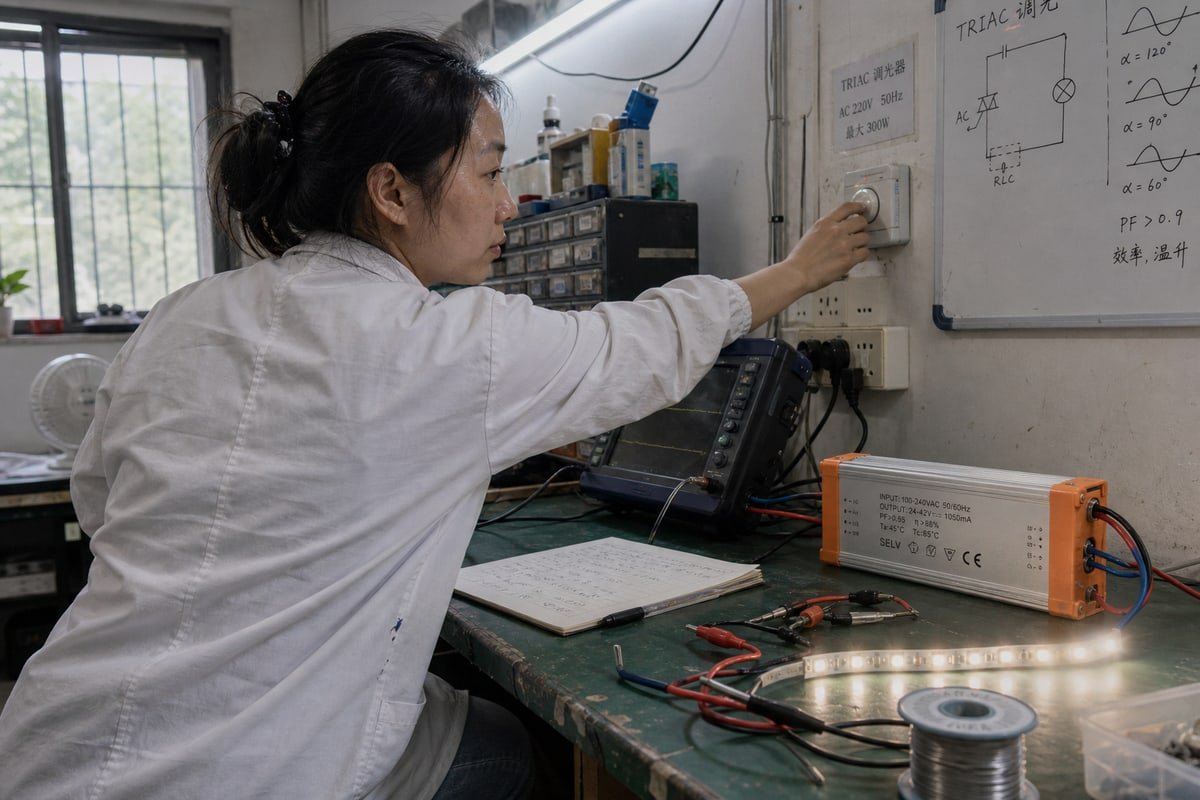
Na nossa linha de produção em Shenzhen, cada lote de driver dimerizável TRIAC é testado contra uma parede de dimerizadores reais antes do envio. Esse hábito veio de lições difíceis com projetos de exportação na Europa e no Sudeste Asiático.
Escolha um fornecedor que publique especificações de carga mínima e máxima, forneça listas de compatibilidade de dimmers, ofereça personalização OEM/ODM de faixas de carga e circuitos de sangria, e teste drivers contra dimmers reais de corte de fase. Solicite amostras, relatórios de teste e suporte técnico antes de se comprometer com pedidos em volume.
Na boqi, trabalhamos exclusivamente com proprietários de marcas, grossistas e fabricantes de iluminação, por isso avalio perguntas de fornecedores a partir da perspetiva do comprador todos os dias. Gestores de compras como a Olivia — uma das nossas clientes de longo prazo em Singapura — preocupam-se com três coisas: custo total do projeto, prazos apertados e acesso à tecnologia de design atual. Os requisitos de carga mínima para drivers CV TRIAC afetam todos os três. Um driver que falha no teste de compatibilidade após a instalação estoura tanto o orçamento quanto o cronograma.
Perguntas Que Separam Bons Fornecedores de Arriscados
Não pergunte apenas: “Quantos watts este dimerizador TRIAC suporta?” Pergunte tanto “Qual é a carga mínima de LED?” quanto “Como o comportamento de entrada do driver de LED interage com este dimerizador?” Essa segunda pergunta é a que a maioria dos fornecedores não consegue responder. Um parceiro capaz deve dizer-lhe se o driver suporta dimerização de fase direta, se também funciona com um dimerizador de borda descendente, como o circuito de sangria lida com condições de baixa carga e quais modelos específicos de dimerizador foram validados. Quando desenvolvemos um driver OEM para um cliente europeu, testamos a estabilidade da dimerização contra as marcas de dimerizadores de borda direta comuns nesse mercado — porque um driver que passa no ambiente elétrico de um país pode comportar-se de forma diferente noutro.
Lista de Verificação para Avaliação de Fornecedores
| O Que Verificar | Por que é importante | Sinal de Alerta |
|---|---|---|
| Especificações publicadas de carga mín/máx | Permite projetar circuitos com confiança | Folhas de dados vagas ou ausentes |
| Lista de compatibilidade de dimerizadores | Confirma testes reais de dimerização por corte de fase | “Alegações de ”funciona com todos os dimerizadores TRIAC” |
| Capacidade OEM/ODM | Faixa de carga e ajuste de sangria para o seu mercado | Apenas catálogo genérico |
| Certificações (CE, CB) | Necessárias para a UE e mercados de exportação | Certificados não verificáveis |
| Suporte para amostras e testes | Valida a sua cadeia exata dimerizador-driver-carga | Recusa em enviar amostras de pré-produção |
| Suporte técnico pós-venda | Resolução rápida de problemas protege o seu cronograma | Respostas lentas ou padronizadas |
O mercado em si é genuinamente confuso aqui. Alguns guias de fornecedores insistem que a dimerização TRIAC ainda precisa de 25W–40W de carga, enquanto alguns fabricantes de drivers anunciam nenhuma carga mínima. Ambas as afirmações podem ser verdadeiras, porque descrevem produtos diferentes e partes diferentes do sistema. O desempenho de carga mínima é uma especificação específica do design, não uma regra universal do TRIAC. Um fornecedor que explica isso honestamente é um fornecedor em quem pode confiar a sua marca.
Conclusão
Circuitos TRIAC subcarregados cintilam, zumbem e desligam — e a correção começa com um hábito: verificar a carga mínima do dimerizador, a carga mínima do driver e a compatibilidade real entre ambos.
Notas de rodapé
- Visão geral da Wikipédia sobre configurações de circuitos de LED e características do estágio de saída. ↩︎
- Documentação técnica de um fabricante líder de semicondutores sobre características elétricas e cargas do TRIAC. ↩︎
- Entrada autoritativa da Wikipédia explicando a correção ativa do fator de potência para cargas eletrónicas. ↩︎
- Entrada da Wikipédia explicando a operação e as diferenças técnicas entre tipos de dimerizadores por corte de fase. ↩︎
- Norma NEMA que define características e requisitos de corrente de irrupção para equipamentos de iluminação LED. ↩︎