Aller au contenu










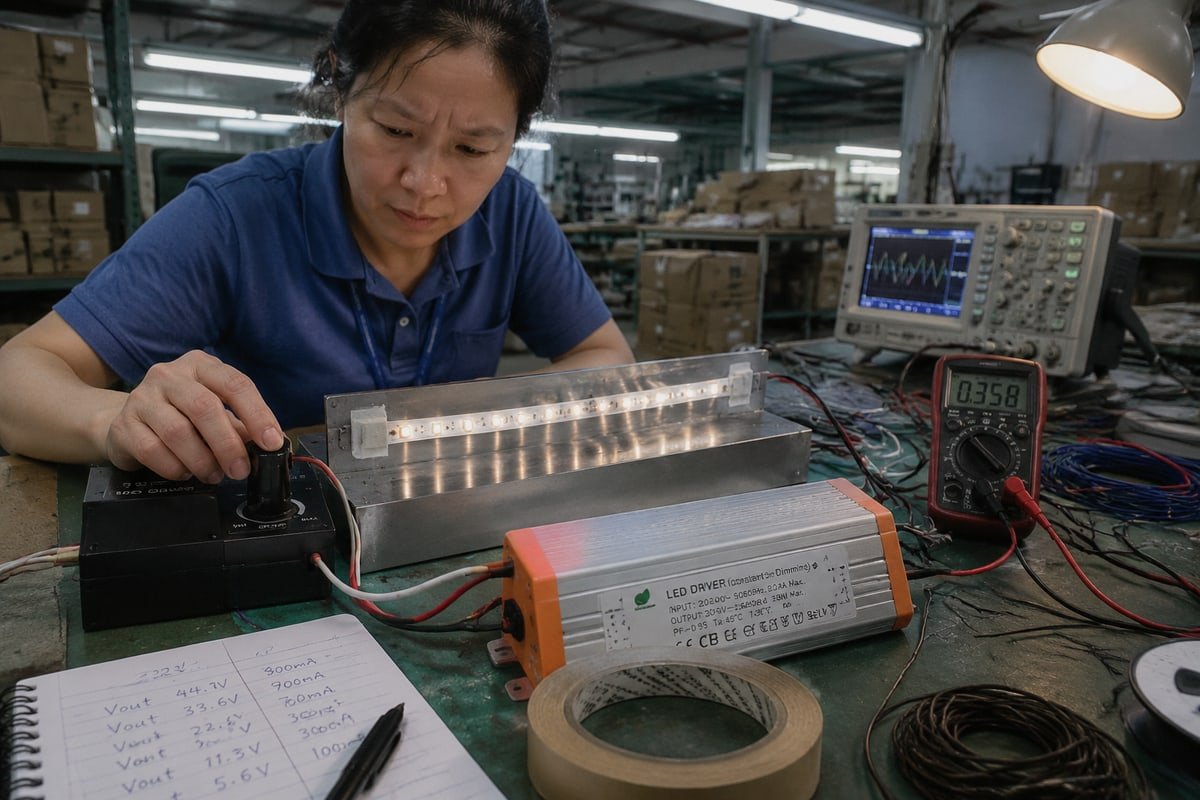
Les bandeaux LED scintillent avec les drivers TRIAC CV plus souvent que toute autre plainte que nous enregistrons dans notre usine de drivers. Cela frustre les installateurs, tue la confiance dans les projets et bloque les commandes répétées.
Les bandeaux LED scintillent avec les drivers TRIAC CV lorsque le variateur, le circuit d’entrée du driver et la charge LED ne sont pas correctement assortis. Le TRIAC coupe la forme d’onde AC, et un driver incompatible ne parvient pas à maintenir une régulation DC stable—surtout à des niveaux de gradation faibles, avec des charges faibles, ou avec un mauvais appariement bord montant/bord descendant.
Cette réponse semble simple. Mais les détails comptent. Ci-dessous, je décompose les causes réelles, les correctifs qui fonctionnent, et comment qualifier les produits avant d’acheter en gros.
Qu’est-ce qui cause le scintillement de mes bandes LED lorsque j’utilise des pilotes CV TRIAC ?
L’année dernière, notre équipe QC a tracé la plainte de scintillement d’un client de Singapour à une cause racine : le étage d’entrée 1 du driver ne pouvait pas maintenir le TRIAC verrouillé. Ce cas a façonné toute cette section.
Le scintillement se produit lorsque la forme d’onde coupée en phase, l’étage d’entrée du driver, sa boucle de régulation DC et la charge LED se désynchronisent. Les déclencheurs courants incluent la chute de courant de maintien, une capacitance d’entrée excessive, un désaccord bord montant/bord descendant, un cycle de protection par hoquet, et des charges inférieures à l’exigence de charge minimale du driver.
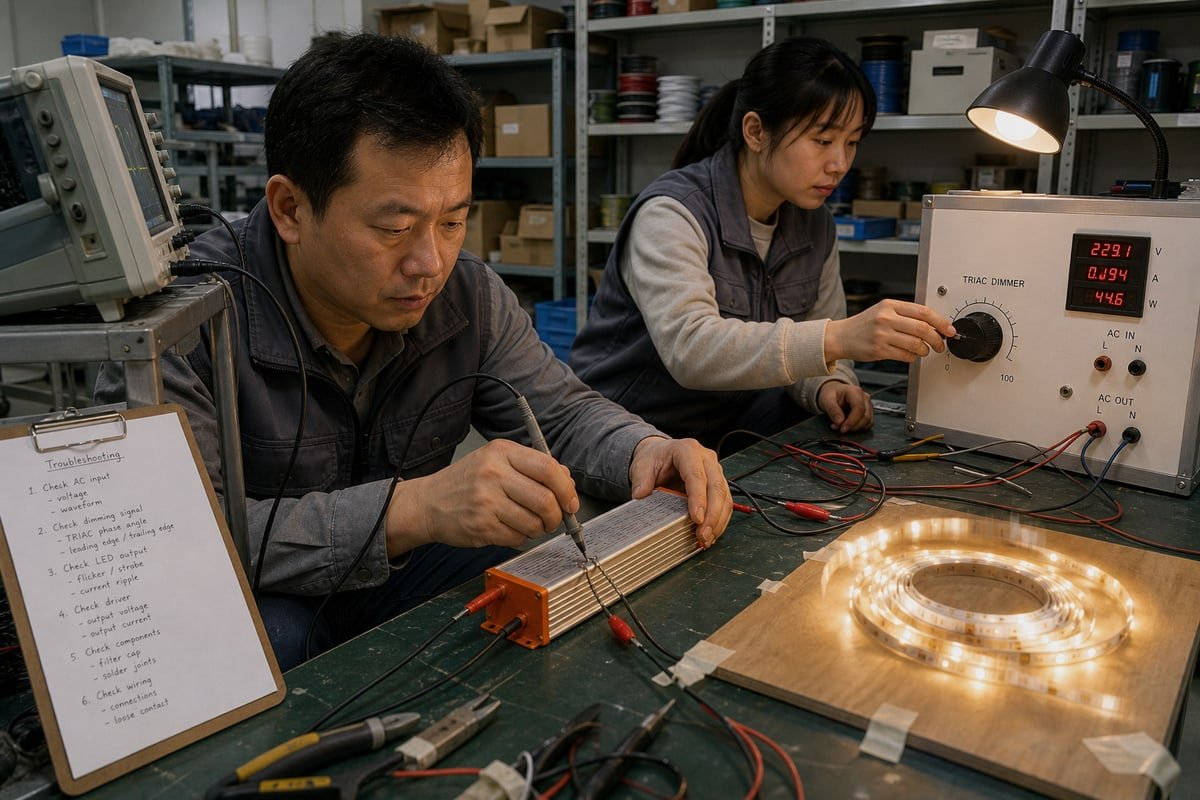
La plupart des gens présentent cela comme une “ incompatibilité TRIAC ”. Cette présentation est trop vague pour corriger quoi que ce soit. La chaîne réelle est celle-ci : forme d’onde coupée en phase → étage d’entrée du driver → régulation DC et boucle de contrôle → charge LED. Le scintillement apparaît lorsque n’importe quel maillon de cette chaîne se dégrade.
La cause la plus négligée : le courant de maintien
Un TRIAC a besoin d’un courant suffisant qui le traverse pour rester verrouillé pendant chaque demi-cycle AC. Un driver avec un courant d’entrée faible ou fortement non linéaire peut faire que le TRIAC s’éteigne tôt ou se déclenche de manière incohérente. Cela s’aggrave près du bas de la plage de gradation, car la fenêtre de conduction 2 est déjà courte. C’est pourquoi le scintillement apparaît souvent seulement en dessous d’environ 20% de luminosité. Le système fonctionne bien à pleine puissance, puis clignote, saute ou scintille lorsque vous diminuez.
La liste complète des mécanismes de scintillement
Dans notre laboratoire, nous classons les plaintes de scintillement dans les mécanismes ci-dessous. Chacun a un correctif différent, donc identifier le bon économise des semaines.
| Mécanisme | Ce qui se passe réellement | Symptôme typique |
|---|---|---|
| Chute de courant de maintien | Le driver tire trop peu de courant pour maintenir le TRIAC verrouillé | Clignotement ou saut à des niveaux de gradation faibles |
| Désaccord bord montant/bord descendant | Le driver ne peut pas décoder le style de coupure de phase du variateur | Scintillement sur toute la plage |
| Sonnerie d’ondulation du filtre EMI | Les condensateurs d’entrée sonnent à chaque déclenchement du TRIAC | Scintillement ou bourdonnement près de la plage moyenne |
| Gigue de détection de passage à zéro | Le driver lit mal le timing de la forme d’onde coupée | Scintillement aléatoire et irrégulier |
| Cycle de protection par hoquet | La protection contre la surcharge redémarre le driver à plusieurs reprises | Clignotement lent et rythmique allumé-éteint |
| Motifs de battement ondulation vs PWM | L’ondulation AC redressée interfère avec la fréquence de gradation PWM interne | Effet de roulement lent ou stroboscopique |
| Dérive thermique | Les seuils de verrouillage changent à mesure que les composants chauffent | Scintillement qui commence après le préchauffage |
| Pollution harmonique | D’autres charges non linéaires entaillent la forme d’onde AC sur la branche | Scintillement uniquement lorsque d’autres équipements fonctionnent |
| Chute de tension sur les lignes DC | Fil sous-dimensionné ou longues distances provoquent des oscillations de chute | Scintillement à l’extrémité lointaine du bandeau |
| Désadaptation d’impédance réfléchie | L’inductance parasite du bandeau perturbe la boucle de régulation de sortie | Instabilité avec des bandeaux très longs |
Notez que seulement certains de ces problèmes sont des problèmes de variateur. Plusieurs sont des problèmes de distribution d’énergie qui deviennent visibles lorsque la gradation supprime la marge du système.
Comment puis-je corriger le scintillement dans mes projets d’éclairage à bande LED dimmable TRIAC ?
Un client au Vietnam a un jour renvoyé trois drivers “ défectueux ” à notre atelier. Les trois ont réussi nos tests de banc. Son vrai problème était une chute de tension sur une longue bande installée sur le site.
Corrigez le scintillement en testant dans l’ordre : contournez le gradateur, vérifiez que la tension et la puissance du driver correspondent à la bande, confirmez que la charge minimale du gradateur est atteinte, serrez chaque connexion, mesurez la chute de tension le long du parcours, et enfin remplacez le driver par une unité CV certifiée pour la coupure de phase.
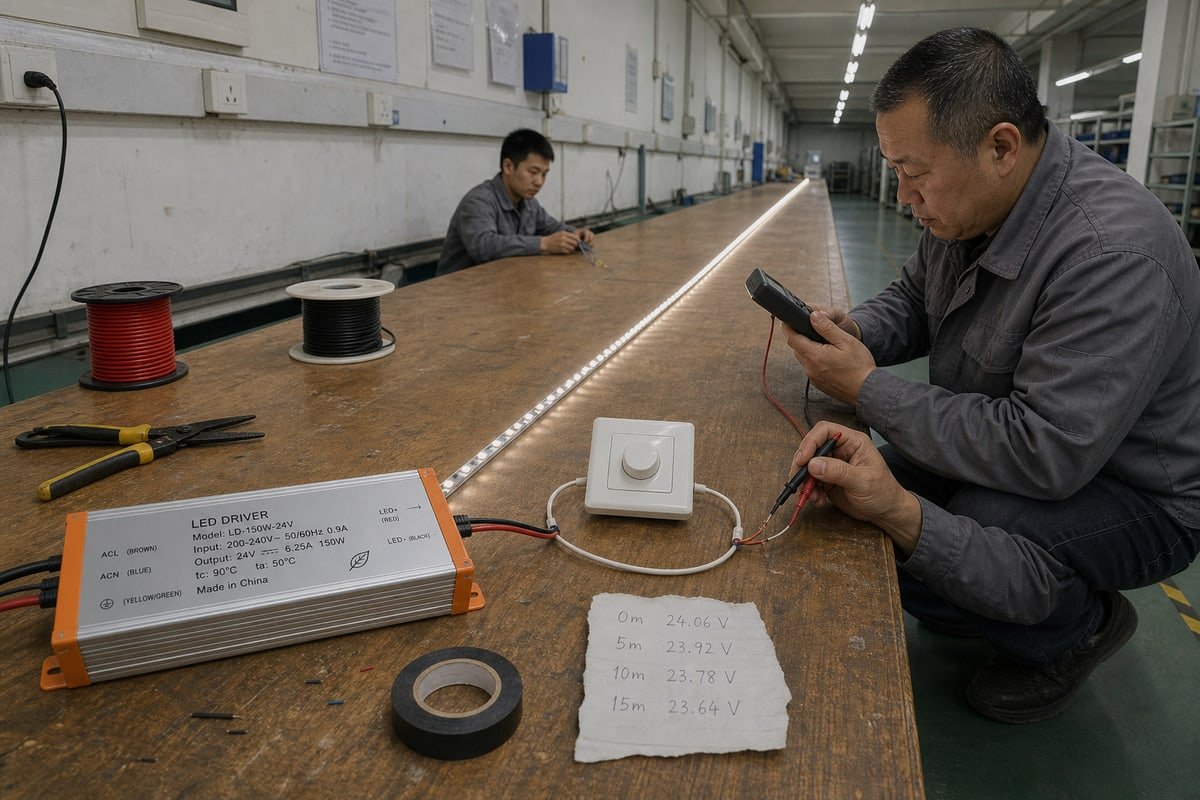
Le moyen le plus rapide de corriger le scintillement est d’arrêter de deviner et de commencer à éliminer. La distinction clé se fait entre le scintillement induit par le gradateur et le scintillement lié à l’alimentation. Ils semblent identiques à l’œil, mais nécessitent des corrections opposées. Voici la séquence d’élimination que nous recommandons à nos clients ingénieurs.
- Contournez le gradateur. Connectez le driver directement au secteur. Si le scintillement disparaît, le problème se situe dans la chaîne de gradation 3. S’il persiste, examinez plutôt l’alimentation.
- Vérifiez la correspondance électrique. Confirmez que le transformateur LED basse tension produit bien le 12V ou 24V correct, et que sa puissance couvre la bande avec une marge. Un driver fonctionnant à sa limite peut passer en protection par à-coups, ce qui ressemble à un clignotement rythmique.
- Vérifiez la charge minimale du gradateur. De nombreux gradateurs muraux nécessitent une puissance minimale pour fonctionner. Une bande courte à faible luminosité peut se situer sous ce seuil, ce qui fait que le gradateur s’allume et s’éteint en boucle.
- Inspectez chaque connexion. Des bornes desserrées, des épissures corrodées et des connecteurs clips bon marché créent un contact intermittent qui imite parfaitement un problème de gradateur.
- Mesurez la tension aux deux extrémités de la bande. Si vous observez plus d’environ 0,5V de chute du début à la fin, l’affaissement contribue au scintillement. Raccourcissez le parcours, augmentez la section du fil ou alimentez depuis les deux extrémités.
- Remplacez le driver en dernier. Si les étapes un à cinq passent et que le scintillement persiste, remplacez le driver par une unité explicitement certifiée pour la gradation par coupure de phase et confirmée avec votre modèle de gradateur.
Suivre cet ordre est important. Dans nos dossiers après-vente, une grande part des “ pannes de driver ” s’avère être des problèmes de câblage, de dimensionnement de charge ou de charge minimale du gradateur qu’un nouveau driver n’aurait jamais résolus.
Quels variateurs TRIAC sont réellement compatibles avec mes drivers LED CV ?
Choisir entre un gradateur à coupure de phase avant et un modèle à front descendant est un compromis que nos ingénieurs pèsent constamment : fiabilité de verrouillage brute contre performance fluide en bas de gamme.
Les gradateurs TRIAC compatibles correspondent à la méthode de gradation déclarée du driver—front montant, front descendant, ou les deux—répondent au profil de courant d’entrée du driver et portent une charge minimale que la bande connectée peut satisfaire. Confirmez toujours l’appairage avec la liste de compatibilité testée des gradateurs du fabricant du driver.
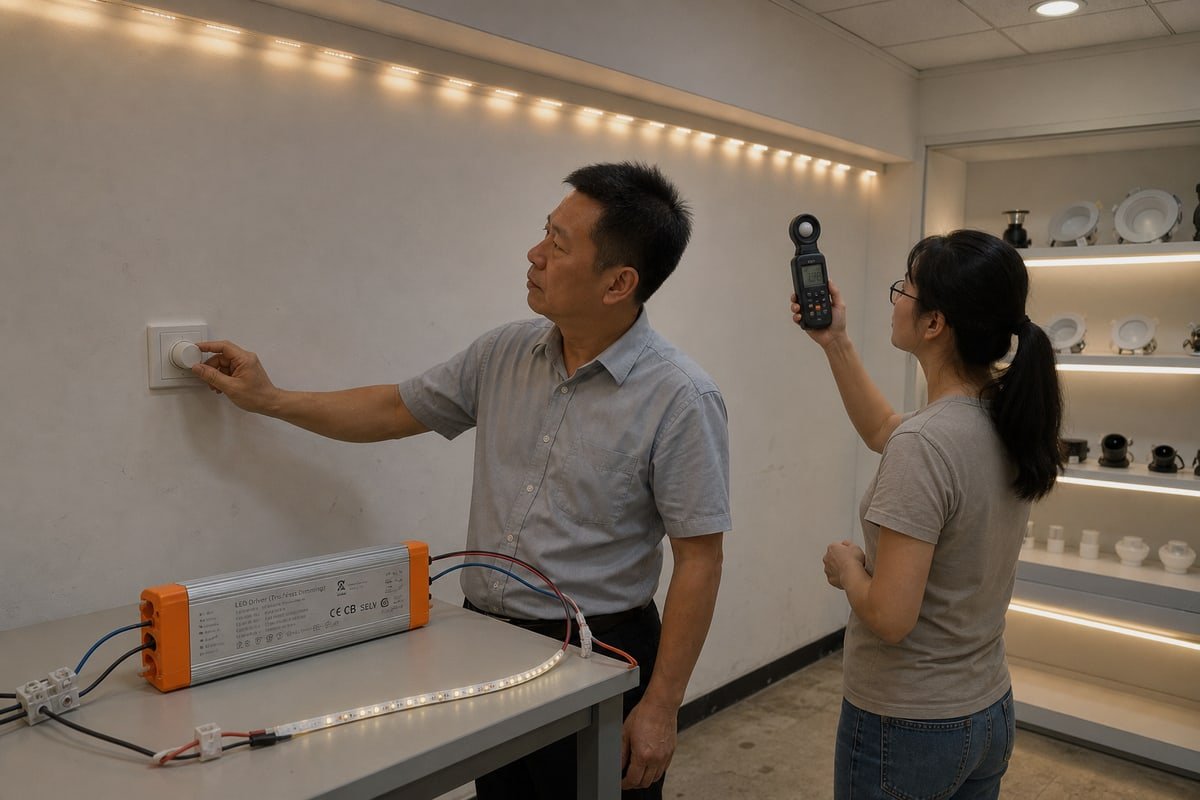
La compatibilité de l’interrupteur gradateur est là où la plupart des projets échouent, alors commencez par la comparaison front montant vs front descendant. Les deux technologies coupent la forme d’onde CA différemment, et un driver conçu pour l’une peut mal se comporter sur l’autre.
| Facteur | Front montant (phase avant) | Front descendant (type ELV) |
|---|---|---|
| Comment il coupe la forme d’onde | Coupe le début de chaque demi-cycle | Coupe la fin de chaque demi-cycle |
| Cible de conception d’origine | Charges incandescentes et magnétiques | Charges électroniques basse tension |
| Sensibilité au courant de maintien | Élevée—nécessite un courant stable pour rester verrouillé | Faible—utilise des transistors, pas un TRIAC à verrouillage |
| Exigence relative à la charge minimale | Souvent 25W ou plus | Généralement beaucoup plus faible |
| Comportement de gradation en bas de gamme | Sujet aux coupures et aux flashs | Généralement plus fluide et plus silencieux |
| Meilleur appairage | Drivers explicitement certifiés pour front montant | Conceptions de drivers dimmables ELV |
Maintenant, laissez-moi aborder une objection courante des acheteurs. Certains ingénieurs me disent que Gradation par TRIAC est intrinsèquement mauvais pour les bandes LED, et que seule une solution MOSFET ou à front descendant peut être sans scintillement. Je comprends d’où vient cette vue—les gradateurs incandescents hérités sur des alimentations à tension constante 4 génériques scintillent gravement. Mais la conclusion est dépassée. Un driver dont l’étage d’entrée est conçu pour décoder l’entrée à coupure de phase, présenter un courant stable au TRIAC et réguler proprement à des niveaux de gradation profonde peut très bien fonctionner sur du matériel à front montant 5. Le véritable spectre va des “ configurations génériques anciennes qui scintillent ” aux “ systèmes compatibles TRIAC conçus qui ne scintillent pas ”.”
La règle pratique que nous donnons aux distributeurs : ne qualifiez jamais un gradateur seul. Qualifiez le gradateur, le driver et le ruban comme un seul système, et demandez à votre fournisseur sa liste de compatibilité testée avant de spécifier quoi que ce soit.
Comment choisir un driver TRIAC CV fiable pour éviter le scintillement dans les commandes en gros ?
Une leçon tirée de années d’exportation de drivers vers l’Europe et l’Asie du Sud-Est me ressort : une ligne de fiche technique indiquant 24V à tension constante ne vous dit rien sur la gradation.
Choisissez un driver explicitement étiqueté 24V à tension constante, dimmable TRIAC/coupure de phase—pas simplement à tension constante. Vérifiez le support du front montant et du front descendant, la charge minimale et maximale, la stabilité de gradation à l’extrémité basse, le comportement du courant d’entrée, les marques de sécurité comme CE, CB et SELV, puis testez un échantillon de la combinaison complète gradateur-driver-ruban avant de vous engager.
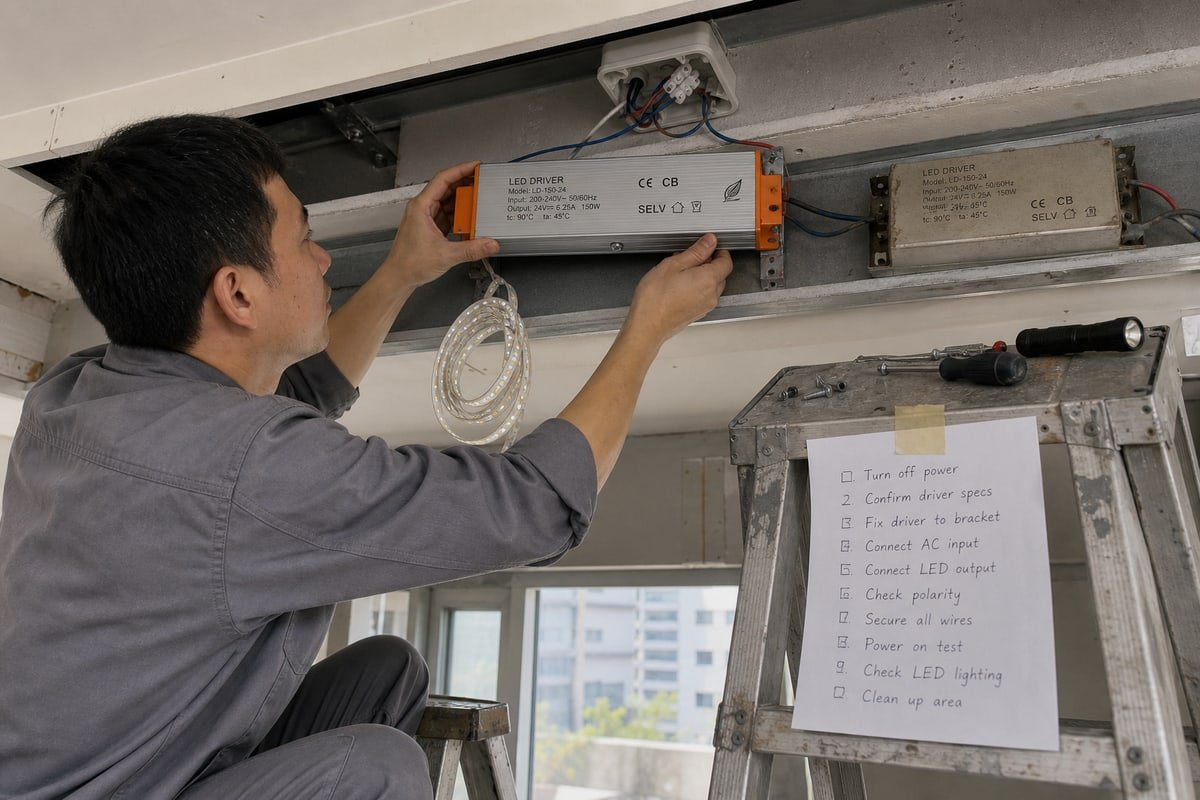
Voici le problème caché qui coûte le plus d’argent aux acheteurs. Un ruban LED 24V peut être parfaitement compatible électriquement avec un driver CV 24V et scintiller quand même lorsqu’il est gradué. La compatibilité de tension et la compatibilité de gradation sont deux choses différentes. Un bloc d’alimentation à tension constante conventionnel peut produire un excellent 24V DC en fonctionnement normal, mais son circuit d’entrée peut être totalement inadapté à une forme d’onde à coupure de phase. Le câbler derrière un gradateur TRIAC n’en fait pas magiquement un driver dimmable TRIAC. La spécification doit indiquer quelque chose comme “ 24V à tension constante, dimmable TRIAC/coupure de phase ”—pas simplement “ bloc d’alimentation à tension constante 24V ”.”
Les six questions à poser à chaque fournisseur
Avant toute commande en gros, nous disons aux acheteurs d’aller au-delà de “ est-ce dimmable TRIAC ? ” et de poser plutôt ces six questions :
- Est-il conçu pour le front montant, le front descendant, ou les deux ?
- Quelle est la charge minimale et maximale du driver ?
- Quelle est la forme d’onde du courant d’entrée du driver ?
- Maintient-il une régulation stable à votre niveau de gradation minimal prévu ?
- Le ruban LED consomme-t-il réellement assez de puissance pour la plage de fonctionnement du driver ?
- Le gradateur a-t-il sa propre exigence de charge minimale ?
La liste de contrôle de qualification pour commandes en gros
| Point de contrôle | Quoi vérifier | Drapeau rouge |
|---|---|---|
| Étiquette de gradation | Indique explicitement dimmable TRIAC/coupure de phase | Dit seulement à tension constante |
| Marques de sécurité | CE, CB et SELV imprimés sur le boîtier | Certificats manquants ou invérifiables |
| Conception thermique | Boîtier en aluminium avec rainures de dissipation thermique | Plastique scellé sans chemin thermique |
| Affirmations sans scintillement | Demandez si la gradation 0–100% s’applique à votre gradateur et votre charge | Affirmation donnée sans liste de gradateurs testés |
| Test à l’extrémité basse | Échantillon testé à votre luminosité minimale réelle | Testé uniquement à pleine sortie |
| Conditions de garantie | Garantie écrite honorée pour les défauts de gradation | Garantie exclut le comportement de gradation |
Côté matériel, la qualité de construction physique en dit long. Nos propres unités utilisent un boîtier en aluminium brossé avec des rainures nervurées de dissipation thermique, car la dérive thermique dans un driver chaud peut décaler le comportement de verrouillage et créer un scintillement qui n’apparaît qu’après l’échauffement. Traitez également le marketing “ 0–100% sans scintillement ” comme une affirmation de compatibilité, pas une garantie universelle—elle ne tient qu’avec des gradateurs testés sur la plage de charge indiquée. Mon principal enseignement B2B : ne qualifiez pas un driver CV comme dimmable TRIAC simplement parce qu’il accepte un gradateur TRIAC. Le vrai test est de savoir si la combinaison complète gradateur, driver et ruban LED reste stable sur toute votre plage de gradation requise.
Conclusion
Le scintillement est un désalignement du système, pas un mystère. Appariez le gradateur, le driver et le ruban ; testez la chaîne complète ; et n’achetez qu’auprès de fournisseurs qui qualifient des combinaisons complètes.
Notes de bas de page
- Explique la fonction de l’étage d’entrée dans le contrôle de puissance à base de TRIAC. ↩︎
- Explication technique du contrôle par coupure de phase et du timing de conduction. ↩︎
- L’URL originale du Département de l’Énergie est 404 ; c’est la page faisant autorité mise à jour expliquant les fondamentaux du scintillement LED et les composants du système. ↩︎
- Normes de la directive basse tension de l’UE pour les équipements électriques à tension constante. ↩︎
- Norme NEMA concernant la compatibilité de gradation pour l’éclairage à semi-conducteurs. ↩︎