Ga naar de inhoud









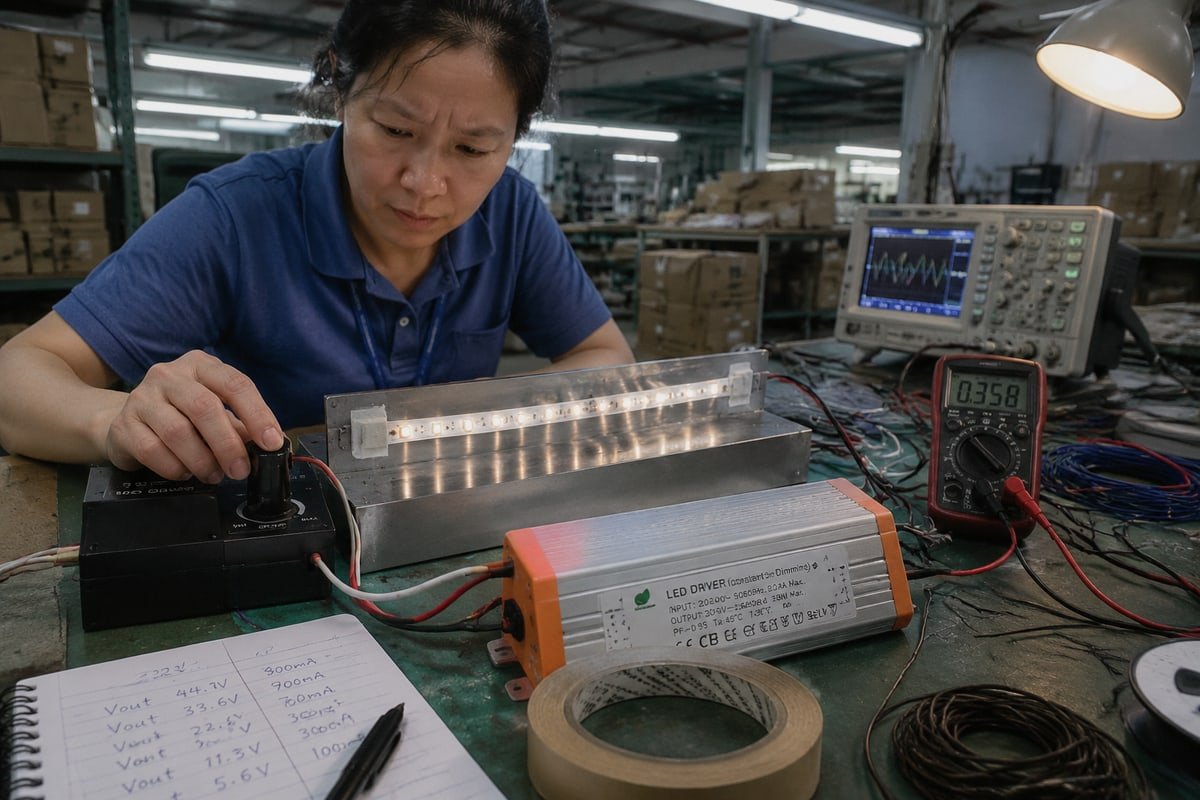
LED-strips flikkeren met CV TRIAC-drivers vaker dan welke andere klacht we ook registreren in onze driverfabriek. Het frustreert installateurs, ondermijnt het vertrouwen in projecten en vertraagt herhalingsorders.
LED-strips flikkeren met CV TRIAC-drivers wanneer de dimmer, het ingangscircuit van de driver en de LED-belasting niet goed op elkaar zijn afgestemd. De TRIAC knipt de AC-golfvorm, en een incompatibele driver slaagt er niet in om stabiele DC-regulatie te behouden—vooral bij lage dimniveaus, lage belastingen, of met de verkeerde leading-edge/trailing-edge-combinatie.
Dat antwoord klinkt eenvoudig. Maar de details doen ertoe. Hieronder breek ik de echte oorzaken, de oplossingen die werken, en hoe je producten kwalificeert voordat je in bulk koopt.
Wat veroorzaakt het flikkeren van mijn LED-strips wanneer ik CV TRIAC-drivers gebruik?
Vorig jaar traceerde ons QC-team de flikkerklacht van een klant in Singapore naar één hoofdoorzaak: de ingangstrap 1 van de driver kon de TRIAC niet gelatcht houden. Die casus vormde dit hele gedeelte.
Flikkeren gebeurt wanneer de fase-afgesneden golfvorm, de ingangstrap van de driver, de DC-regulatielus en de LED-belasting uit sync raken. Veelvoorkomende triggers zijn holding-current-uitval, overmatige ingangscapaciteit, leading-edge/trailing-edge-mismatch, hiccup-protection-cycli en belastingen onder de minimale belastingsvereiste van de driver.
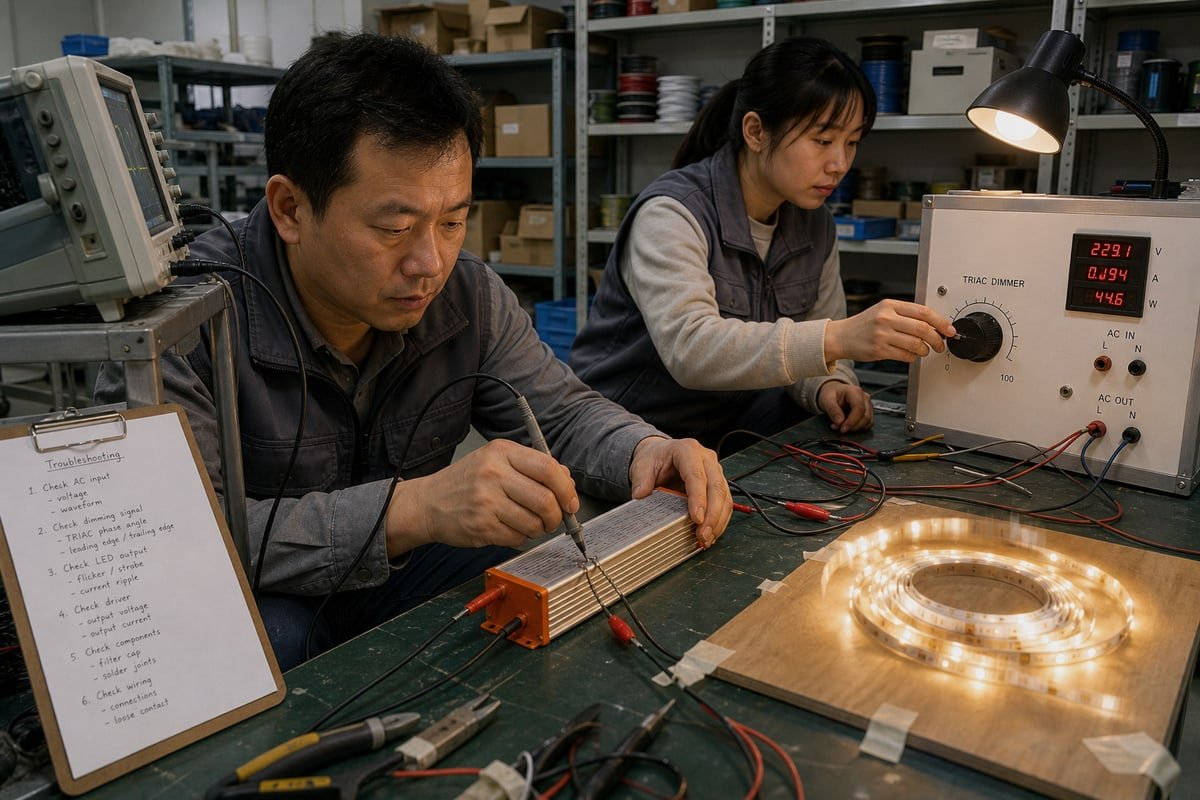
De meeste mensen framen dit als “TRIAC-incompatibiliteit.” Dat frame is te vaag om iets op te lossen. De echte keten is deze: fase-afgesneden golfvorm → ingangstrap van de driver → DC-regulatie en controllus → LED-belasting. Flikkeren verschijnt wanneer een schakel in die keten uitvalt.
De meest over het hoofd geziene oorzaak: holding current
Een TRIAC heeft voldoende stroom nodig die erdoorheen vloeit om gelatcht te blijven tijdens elke AC-halve cyclus. Een driver met een kleine of sterk niet-lineaire ingangsstroom kan ervoor zorgen dat de TRIAC vroeg uitschakelt of inconsistent vuurt. Dit wordt erger nabij de onderkant van het dimbereik, omdat het geleidingsvenster 2 al kort is. Daarom verschijnt flikkeren vaak alleen onder ongeveer 20% helderheid. Het systeem werkt prima op vol vermogen, maar flitst, knalt of glinstert wanneer je dimt.
De volledige lijst van flikker-mechanismen
In ons lab sorteren we flikkerklachten in de onderstaande mechanismen. Elk heeft een andere oplossing, dus het identificeren van de juiste bespaart weken.
| Mechanisme | Wat er daadwerkelijk gebeurt | Typisch symptoom |
|---|---|---|
| Holding-current-uitval | Driver trekt te weinig stroom om de TRIAC gelatcht te houden | Flitsen of knallen bij lage dimniveaus |
| Leading/trailing-edge-mismatch | Driver kan de fase-afsnijstijl van de dimmer niet decoderen | Flikkeren over het hele bereik |
| EMI-filter-inrush-ringing | Ingangscapaciteiten rinkelen bij elke TRIAC-trigger | Glinstering of gezoem nabij het middenbereik |
| Zero-cross-detectiejitter | Driver leest de timing van de geknipte golfvorm verkeerd | Willekeurig, onregelmatig flikkeren |
| Hiccup-protection-cycli | Overbelastingsbeveiliging herstart de driver herhaaldelijk | Langzaam, ritmisch aan-uit-knipperen |
| Rimpel vs PWM-beatpatronen | Gelijkeerde AC-rimpel interfereert met de interne PWM-dimfrequentie | Langzaam rollend of stroboscopisch effect |
| Thermische drift | Latch-drempels verschuiven naarmate componenten opwarmen | Flikkeren dat begint na het opwarmen |
| Harmonische vervuiling | Andere niet-lineaire belastingen kerven de AC-golfvorm op de tak | Flikkeren alleen wanneer andere apparatuur draait |
| Spanningsval op DC-runs | Te dunne draad of lange runs veroorzaken sag-oscillaties | Flikkeren aan het verre uiteinde van de strip |
| Gereflecteerde impedantie-mismatch | Parasitaire inductie van de strip verstoort de uitgangsregulatielus | Instabiliteit met zeer lange strips |
Merk op dat slechts sommige hiervan dimmerproblemen zijn. Verschillende zijn stroomtoevoerproblemen die alleen zichtbaar worden wanneer dimmen de marge van het systeem wegneemt.
Hoe kan ik flikkeren in mijn TRIAC dimbare LED-stripverlichtingsprojecten verhelpen?
Een klant in Vietnam stuurde ooit drie “defecte” drivers terug naar onze werkplaats. Alle drie slaagden voor onze banktesten. Zijn echte probleem was spanningsval over een lange stripafstand op de locatie.
Los flikkering op door in volgorde te testen: omzeil de dimmer, controleer of de driverspanning en het wattage overeenkomen met de strip, bevestig dat de minimale belasting van de dimmer wordt gehaald, draai elke verbinding aan, meet de spanningsval over de afstand, en vervang ten slotte de driver door een fase-afsnijdingsgeschikte CV-eenheid.
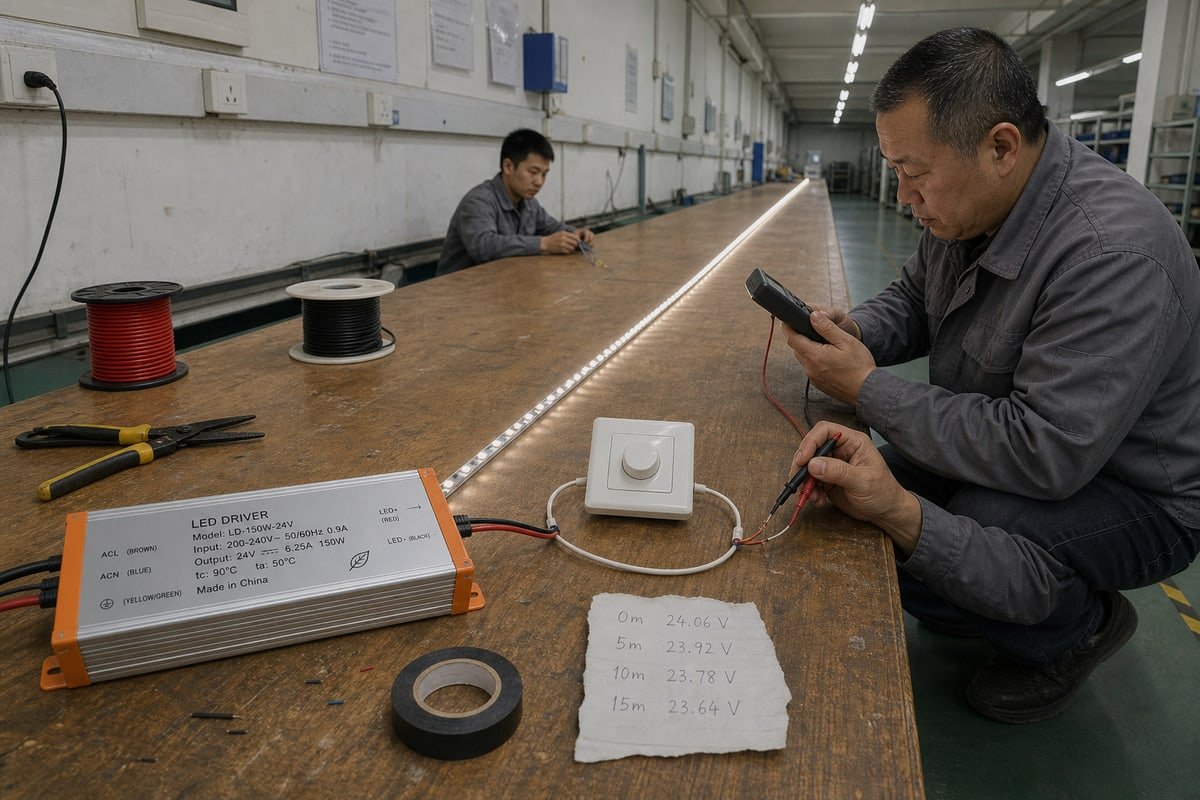
De snelste manier om flikkering op te lossen is stoppen met gokken en beginnen met elimineren. Het belangrijkste onderscheid is tussen dimmer-geïnduceerde flikkering en stroomtoevoer-flikkering. Ze zien er voor het oog identiek uit, maar vereisen tegenovergestelde oplossingen. Hier is de eliminatiesequentie die wij aan onze technische klanten aanbevelen.
- Omzeil de dimmer. Sluit de driver rechtstreeks aan op de netspanning. Als de flikkering verdwijnt, ligt het probleem in de dimmingsketen 3. Als het blijft, kijk dan naar de stroomtoevoer.
- Controleer de elektrische overeenkomst. Bevestig dat de laagspannings-LED-transformator de juiste 12V of 24V levert, en dat het wattage de strip met marge dekt. Een driver die op zijn maximum draait, kan in beveiligingsmodus vallen, wat eruitziet als ritmisch knipperen.
- Controleer de minimale belasting van de dimmer. Veel wanddimmers hebben een minimaal wattage nodig om te werken. Een korte strip op lage helderheid kan onder die drempel blijven, waardoor de dimmer aan en uit schakelt.
- Inspecteer elke verbinding. Losse klemmen, gecorrodeerde lasverbindingen en goedkope clipconnectoren creëren intermitterend contact dat perfect dimmerproblemen nabootst.
- Meet de spanning aan beide uiteinden van de strip. Als je meer dan ongeveer 0,5V daling ziet van begin tot eind, draagt spanningsval bij aan de flikkering. Verkort de afstand, gebruik dikkere draad, of voer stroom van beide uiteinden toe.
- Vervang de driver als laatste. Als stappen één tot en met vijf slagen en flikkering blijft, vervang dan de driver door een eenheid die expliciet geschikt is voor fase-afsnijdingsdimming en bevestigd is tegen jouw dimmermodel.
Het volgen van deze volgorde is belangrijk. In onze after-salesgegevens blijkt een groot deel van de “driverstoringen” bedradings-, belastings- of minimale-belastingsproblemen van de dimmer te zijn, die een nieuwe driver nooit zou hebben opgelost.
Welke TRIAC-dimmers zijn werkelijk compatibel met mijn CV-LED-drivers?
De keuze tussen een fase-aansnijdingsdimmer en een fase-afsnijdingsmodel is een afweging die onze ingenieurs voortdurend maken: ruwe latchbetrouwbaarheid versus soepele prestaties op laag niveau.
Compatibele TRIAC-dimmers matchen de door de driver aangegeven dimmethode—fase-aansnijding, fase-afsnijding, of beide—voldoen aan het ingangsstroomprofiel van de driver, en hebben een minimale belastingsclassificatie die de aangesloten strip kan vervullen. Bevestig altijd de koppeling tegen de geteste dimmercompatibiliteitslijst van de driverfabrikant.
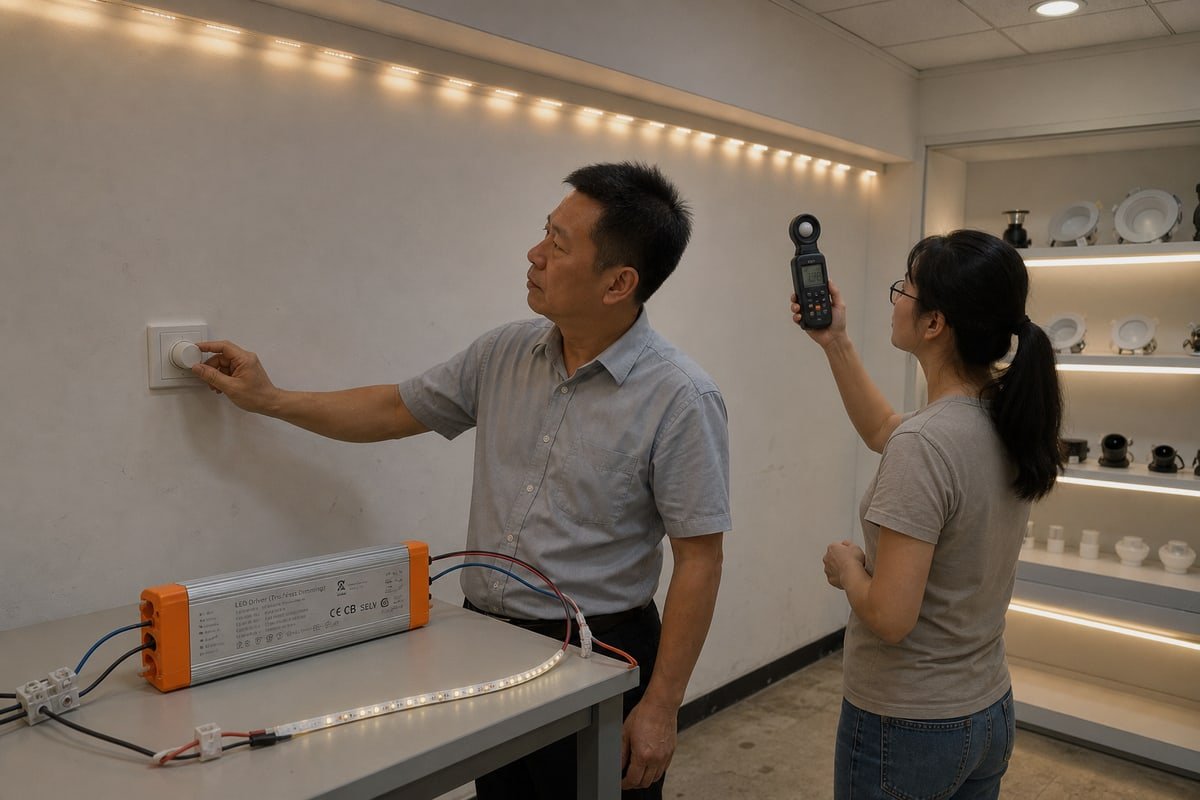
Dimmercompatibiliteit is waar de meeste projecten misgaan, dus begin met de fase-aansnijding versus fase-afsnijding vergelijking. De twee technologieën snijden de AC-golfvorm anders, en een driver ontworpen voor de ene kan zich misdragen op de andere.
| Factor | Fase-aansnijding (forward phase) | Fase-afsnijding (ELV-type) |
|---|---|---|
| Hoe het de golfvorm snijdt | Snijdt de voorkant van elke halve cyclus | Snijdt de achterkant van elke halve cyclus |
| Oorspronkelijk ontwerpdoel | Gloeilamp- en magnetische belastingen | Elektronische laagspanningsbelastingen |
| Houdstroomgevoeligheid | Hoog—heeft constante stroom nodig om gelatcht te blijven | Laag—gebruikt transistors, geen latching TRIAC |
| Minimale belastingsvereiste | Vaak 25W of meer | Meestal veel lager |
| Dimgedrag op laag niveau | Gevoelig voor uitval en flitsen | Doorgaans soepeler en stiller |
| Beste koppeling | Drivers expliciet geschikt voor fase-aansnijding | ELV-dimbare driverontwerpen |
Laat me nu een veelvoorkomend bezwaar van kopers behandelen. Sommige ingenieurs vertellen me TRIAC-dimmen is inherent verkeerd voor LED-strips, en dat alleen een MOSFET- of fase-afsnijdingsoplossing flikkervrij kan zijn. Ik begrijp waar die visie vandaan komt—oude gloeilampdimmers op generieke constante spanning voeding 4 eenheden flikkeren hevig. Maar de conclusie is achterhaald. Een driver waarvan de ingangstrap is ontworpen om fase-afsnijdingsinput te decoderen, een stabiele stroom aan de TRIAC te presenteren, en schoon te regelen op diepe dimniveaus, kan zeer goed presteren op fase-aansnijdingshardware 5. Het echte spectrum loopt van “oude generieke opstellingen die flikkeren” tot “technisch ontworpen TRIAC-compatibele systemen die dat niet doen.”
De praktische regel die wij aan distributeurs geven: kwalificeer nooit een dimmer alleen. Kwalificeer de dimmer, driver en strip als één systeem, en vraag uw leverancier om hun geteste compatibiliteitslijst voordat u iets specificeert.
Hoe kies ik een betrouwbare CV TRIAC-driver om flikkering te voorkomen bij bulkbestellingen?
Eén les uit jaren van het exporteren van drivers naar Europa en Zuidoost-Azië springt er voor mij uit: een datasheetregel met 24V constant-voltage vertelt je niets over dimmen.
Kies een driver die expliciet is gelabeld als 24V constant-voltage, TRIAC/phase-cut dimbaar—niet slechts constant-voltage. Controleer ondersteuning voor leading-edge en trailing-edge, minimale en maximale belasting, stabiliteit van het lage dimniveau, ingangsstroomgedrag, veiligheidskeurmerken zoals CE, CB en SELV, en test vervolgens de volledige dimmer-driver-stripcombinatie voordat u zich vastlegt.
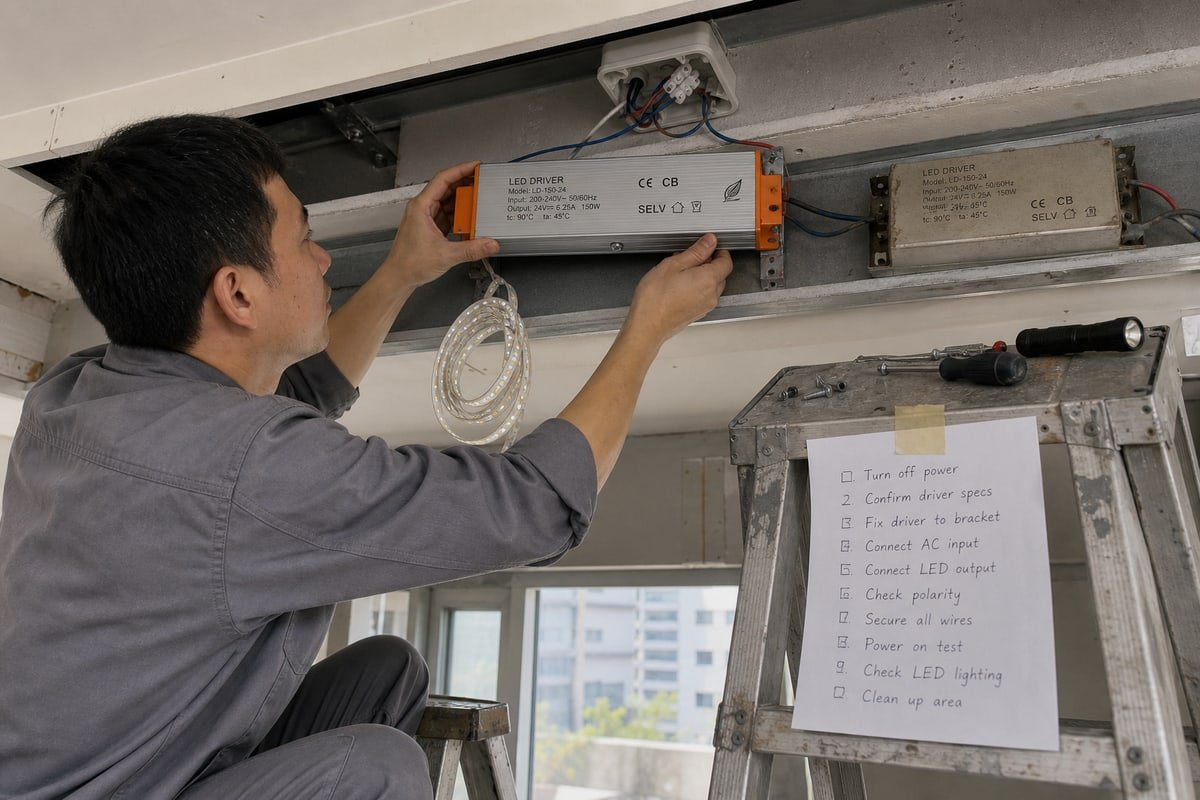
Hier is het verborgen probleem dat kopers het meeste geld kost. Een 24V LED-strip kan elektrisch perfect compatibel zijn met een 24V CV-driver en toch flikkeren wanneer deze wordt gedimd. Spanningscompatibiliteit en dimcompatibiliteit zijn twee verschillende dingen. Een conventionele constant-voltage voeding kan in normaal bedrijf uitstekende 24V DC leveren, maar de ingangscircuit kan volledig ongeschikt zijn voor een phase-cut golfvorm. Het achter een TRIAC-dimmer bedraden maakt het niet magisch een TRIAC-dimbare driver. De specificatie moet iets zeggen als “24V constant-voltage, TRIAC/phase-cut dimbaar”—niet simpelweg “24V constant-voltage voeding.”
De zes vragen die u elke leverancier moet stellen
Vóór elke bulkorder adviseren wij kopers om verder te gaan dan “is het TRIAC dimbaar?” en in plaats daarvan deze zes vragen te stellen:
- Is het ontworpen voor leading-edge, trailing-edge of beide?
- Wat is de minimale en maximale belasting van de driver?
- Wat is de ingangsstroomgolfvorm van de driver?
- Handhaaft het stabiele regeling op uw beoogde minimale dimniveau?
- Trekt de LED-strip daadwerkelijk genoeg vermogen voor het werkingsbereik van de driver?
- Heeft de dimmer een eigen minimale belastingseis?
De kwalificatiechecklist voor bulkorders
| Controlepunt | Wat te verifiëren | Rode vlag |
|---|---|---|
| Dimlabel | Vermeldt expliciet TRIAC/phase-cut dimbaar | Zegt alleen constant-voltage |
| Veiligheidskeurmerken | CE, CB en SELV gedrukt op de behuizing | Ontbrekende of niet-verifieerbare certificaten |
| Thermisch ontwerp | Aluminium behuizing met warmteafvoergroeven | Verzegeld plastic zonder thermisch pad |
| Flikkervrije claims | Vraag of 0-100% dimmen van toepassing is op uw dimmer en belasting | Claim gegeven zonder geteste dimmerlijst |
| Laag-niveau test | Monster getest op uw werkelijke minimale helderheid | Alleen getest op volledige output |
| Garantievoorwaarden | Schriftelijke garantie gehonoreerd bij dimfouten | Garantie sluit dimgedrag uit |
Aan de hardwarekant zegt fysieke bouwkwaliteit veel. Onze eigen units gebruiken een geborstelde aluminium behuizing met geribbelde warmteafvoergroeven, omdat thermische drift in een hete driver latchgedrag kan verschuiven en flikkeren kan creëren dat pas na het opwarmen verschijnt. Behandel ook “0-100% flikkervrij” marketing als een compatibiliteitsclaim, niet als een universele garantie—het geldt alleen met geteste dimmers over het aangegeven belastingsbereik. Mijn sterkste B2B-afsluiting: kwalificeer een CV-driver niet als TRIAC dimbaar alleen omdat deze een TRIAC-dimmer accepteert. De echte test is of de volledige dimmer-, driver- en LED-stripcombinatie stabiel blijft over uw volledige vereiste dimbereik.
Conclusie
Flikkeren is een systeemmismatch, geen mysterie. Match de dimmer, driver en strip; test de volledige keten; en koop alleen van leveranciers die volledige combinaties kwalificeren.
Voetnoten
- Legt de functie van de ingangstrap in TRIAC-gebaseerde vermogensregeling uit. ↩︎
- Technische uitleg van phase-fired control en geleidingstiming. ↩︎
- De originele Department of Energy URL is 404; dit is de bijgewerkte gezaghebbende pagina die LED-flikkerfundamenten en systeemcomponenten uitlegt. ↩︎
- EU-richtlijnen voor laagspanning voor constant-voltage elektrische apparatuur. ↩︎
- NEMA-standaard met betrekking tot dimcompatibiliteit voor solid-state verlichting. ↩︎