Pular para o conteúdo










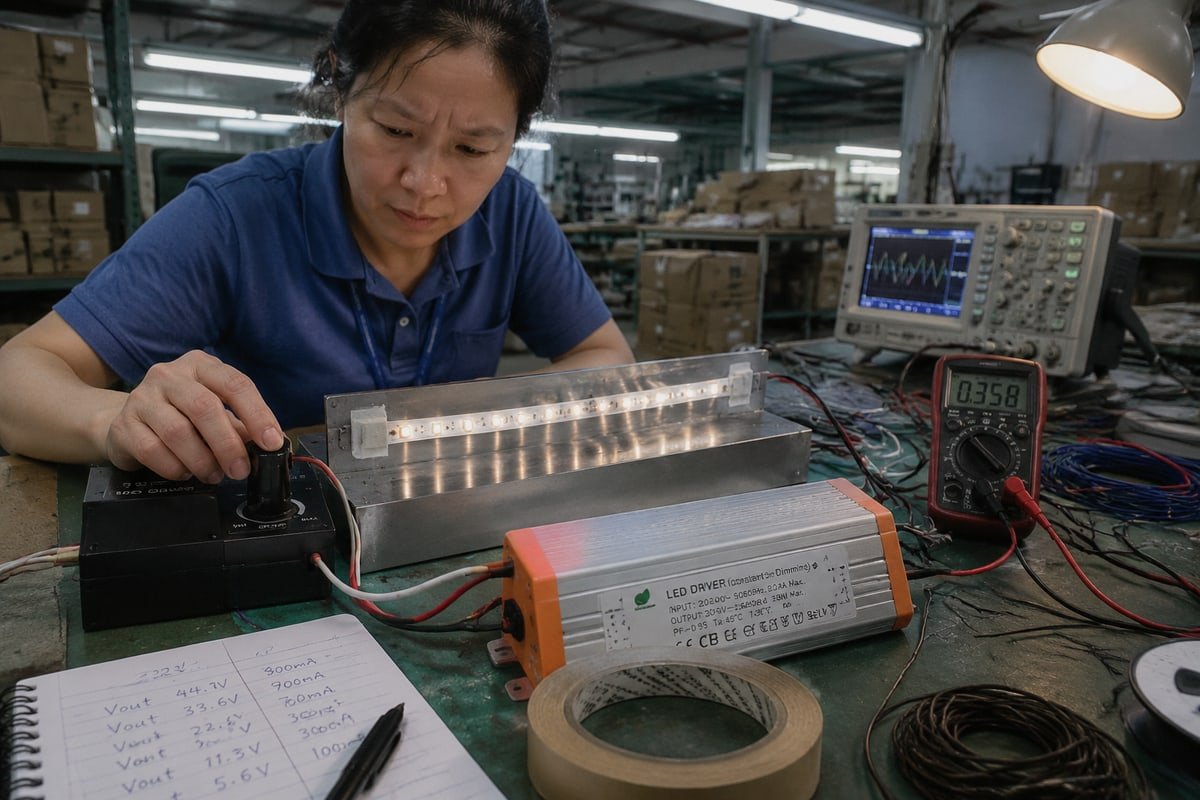
As fitas de LED piscam com drivers TRIAC CV com mais frequência do que qualquer outra reclamação que registramos em nossa fábrica de drivers. Isso frustra instaladores, prejudica a confiança no projeto e atrasa pedidos repetidos.
As fitas de LED piscam com drivers TRIAC CV quando o dimmer, o circuito de entrada do driver e a carga de LED não estão devidamente combinados. O TRIAC corta a forma de onda CA, e um driver incompatível não consegue manter uma regulação de CC estável—especialmente em níveis de dimerização baixos, cargas baixas ou com a combinação errada de borda de subida/borda de descida.
Essa resposta parece simples. Mas os detalhes importam. Abaixo, eu detalho as causas reais, as correções que funcionam e como qualificar produtos antes de comprar em grandes quantidades.
O que causa o flicker nas minhas fitas de LED quando eu uso drivers CV TRIAC?
No ano passado, nossa equipe de controle de qualidade rastreou a reclamação de flicker de um cliente de Singapura até uma causa raiz: o estágio de entrada 1 do driver não conseguia manter o TRIAC em condução. Esse caso moldou toda esta seção.
O flicker acontece quando a forma de onda com corte de fase, o estágio de entrada do driver, seu loop de regulação de CC e a carga de LED ficam fora de sincronia. Gatilhos comuns incluem queda de corrente de manutenção, capacitância de entrada excessiva, incompatibilidade de borda de subida/borda de descida, ciclagem de proteção hiccup e cargas abaixo do requisito mínimo de carga do driver.
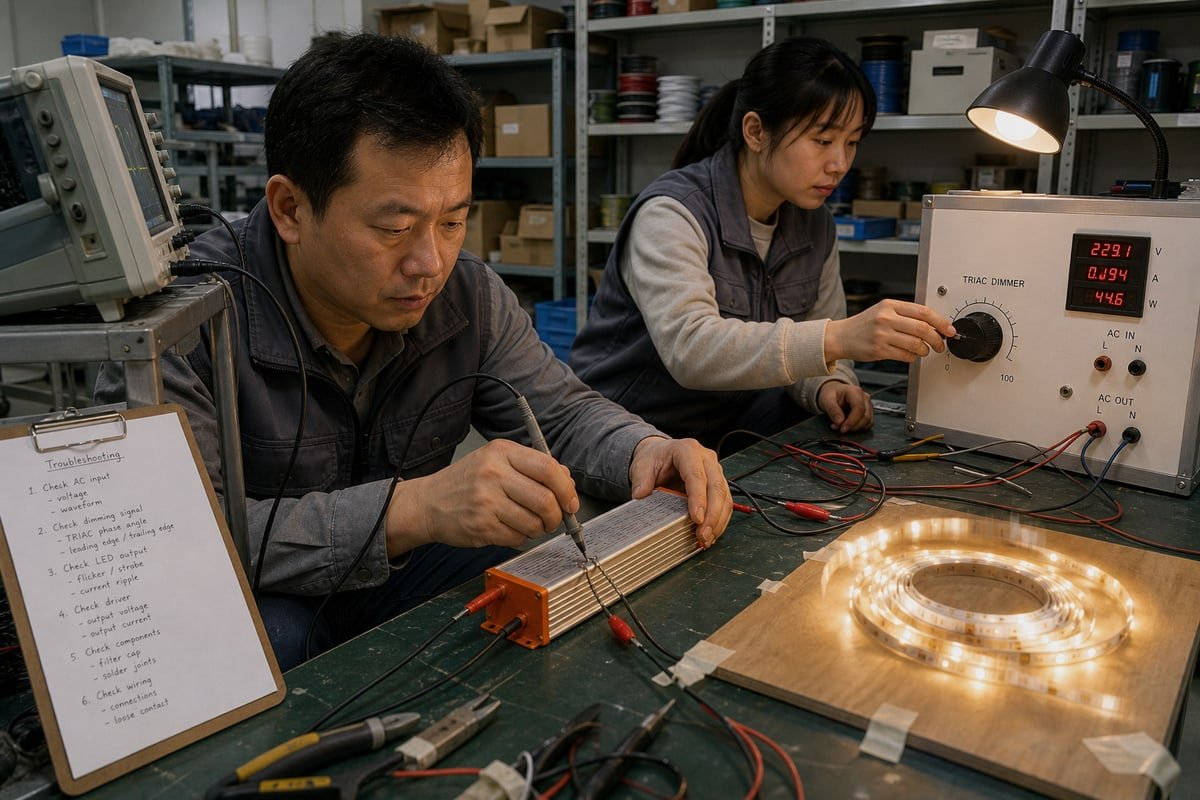
A maioria das pessoas enquadra isso como “incompatibilidade TRIAC”. Esse enquadramento é vago demais para corrigir qualquer coisa. A cadeia real é esta: forma de onda com corte de fase → estágio de entrada do driver → regulação de CC e loop de controle → carga de LED. O flicker aparece quando qualquer elo dessa cadeia se rompe.
A causa mais negligenciada: corrente de manutenção
Um TRIAC precisa de corrente suficiente fluindo através dele para permanecer em condução durante cada meio ciclo da CA. Um driver com corrente de entrada pequena ou altamente não linear pode fazer o TRIAC desligar cedo ou disparar de forma inconsistente. Isso piora perto do fundo da faixa de dimerização, porque a janela de condução 2 já é curta. É por isso que o flicker muitas vezes aparece apenas abaixo de aproximadamente 20% de brilho. O sistema funciona bem em potência total, depois pisca, estala ou tremula quando você diminui a luz.
A lista completa de mecanismos de flicker
Em nosso laboratório, classificamos as reclamações de flicker nos mecanismos abaixo. Cada um tem uma correção diferente, então identificar o certo economiza semanas.
| Mecanismo | O que realmente acontece | Sintoma típico |
|---|---|---|
| Queda de corrente de manutenção | O driver consome corrente insuficiente para manter o TRIAC em condução | Piscadas ou estalos em níveis de dimerização baixos |
| Incompatibilidade de borda de subida/descida | O driver não consegue decodificar o estilo de corte de fase do dimmer | Flicker em toda a faixa |
| Ressonância de ondulação do filtro EMI | Capacitores de entrada ressoam a cada disparo do TRIAC | Tremulação ou zumbido perto da faixa média |
| Jitter na detecção de cruzamento de zero | O driver lê mal o tempo da forma de onda cortada | Flicker aleatório e irregular |
| Ciclagem de proteção hiccup | A proteção contra sobrecarga reinicia o driver repetidamente | Piscar lento e rítmico de liga-desliga |
| Padrões de batimento entre ondulação e PWM | A ondulação da CA retificada interfere na frequência interna de dimerização PWM | Efeito de rolagem lenta ou estroboscópico |
| Deriva térmica | Limiares de condução mudam conforme os componentes aquecem | Flicker que começa após o aquecimento |
| Poluição harmônica | Outras cargas não lineares criam entalhes na forma de onda CA no ramo | Flicker apenas quando outros equipamentos estão em operação |
| Queda de tensão em trechos de CC | Fio subdimensionado ou trechos longos causam oscilações de queda | Flicker na extremidade distante da fita |
| Incompatibilidade de impedância refletida | A indutância parasita da fita perturba o loop de regulação de saída | Instabilidade com fitas muito longas |
Observe que apenas alguns desses são problemas de dimmer. Vários são problemas de entrega de energia que se tornam visíveis quando a dimerização remove a margem do sistema.
Como posso corrigir a oscilação nos meus projetos de iluminação com fita de LED dimerizável por TRIAC?
Um cliente no Vietnã certa vez devolveu três drivers “defeituosos” à nossa oficina. Todos os três passaram nos nossos testes de bancada. O problema real dele era queda de tensão em um longo trecho de fita no local da obra.
Corrija a cintilação testando em ordem: ignore o dimmer, verifique se a tensão e a potência do driver correspondem à fita, confirme se a carga mínima do dimmer é atendida, aperte cada conexão, meça a queda de tensão ao longo do trecho e, por fim, substitua o driver por uma unidade de CV com classificação para corte de fase.
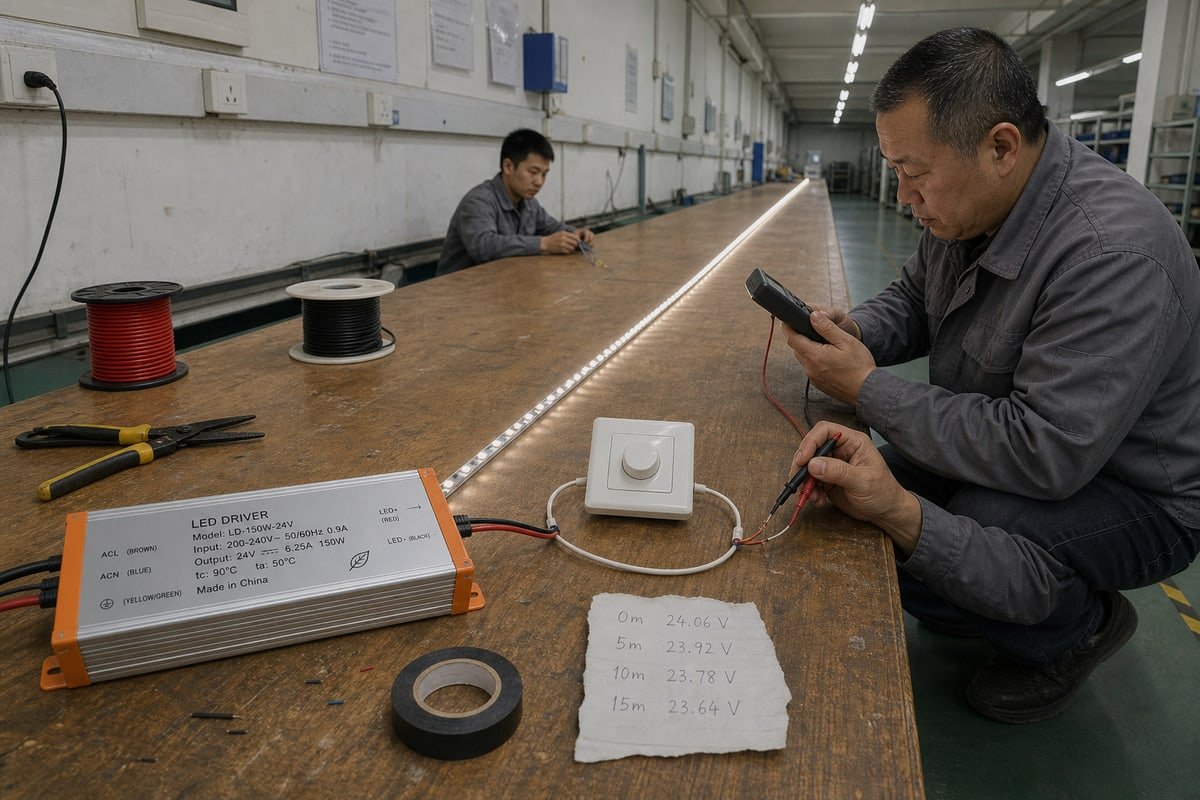
A maneira mais rápida de corrigir a cintilação é parar de adivinhar e começar a eliminar. A distinção principal é entre cintilação induzida pelo dimmer e cintilação por entrega de energia. Elas parecem idênticas aos olhos, mas exigem correções opostas. Aqui está a sequência de eliminação que recomendamos aos nossos clientes de engenharia.
- Ignore o dimmer. Conecte o driver diretamente à rede elétrica. Se a cintilação desaparecer, o problema está na cadeia de dimerização 3. Se persistir, examine a entrega de energia.
- Verifique a correspondência elétrica. Confirme se o transformador de LED de baixa tensão emite os corretos 12V ou 24V e se sua potência cobre a fita com margem. Um driver operando no limite pode entrar em proteção contra picos, o que parece um piscar rítmico.
- Verifique a carga mínima do dimmer. Muitos dimmers de parede precisam de uma potência mínima para operar. Uma fita curta em brilho baixo pode ficar abaixo desse piso, então o dimmer liga e desliga em ciclos.
- Inspecione cada conexão. Terminais soltos, emendas corroídas e conectores de clipe baratos criam contato intermitente que imita perfeitamente problemas de dimmer.
- Meça a tensão em ambas as extremidades da fita. Se você vir mais de cerca de 0,5V de queda do início ao fim, a queda está contribuindo para a cintilação. Encurte o trecho, aumente a bitola do fio ou alimente a energia de ambas as extremidades.
- Troque o driver por último. Se os passos um a cinco passarem e a cintilação permanecer, substitua o driver por uma unidade explicitamente classificada para dimerização por corte de fase e confirmada em relação ao seu modelo de dimmer.
Seguir essa ordem importa. Em nossos registros de pós-venda, uma grande parcela de “falhas de driver” acaba sendo problemas de fiação, dimensionamento de carga ou carga mínima do dimmer, que um driver novo nunca teria corrigido.
Quais interruptores dimmer TRIAC são verdadeiramente compatíveis com meus drivers de LED CV?
Escolher entre um dimmer de fase direta e um modelo de borda de descida é uma troca que nossos engenheiros ponderam constantemente: confiabilidade bruta de travamento versus desempenho suave em baixo nível.
Dimmers TRIAC compatíveis correspondem ao método de dimerização declarado do driver—borda de subida, borda de descida ou ambos—atendem ao perfil de corrente de entrada do driver e possuem uma classificação de carga mínima que a fita conectada pode satisfazer. Sempre confirme o pareamento com a lista de compatibilidade de dimmers testados do fabricante do driver.
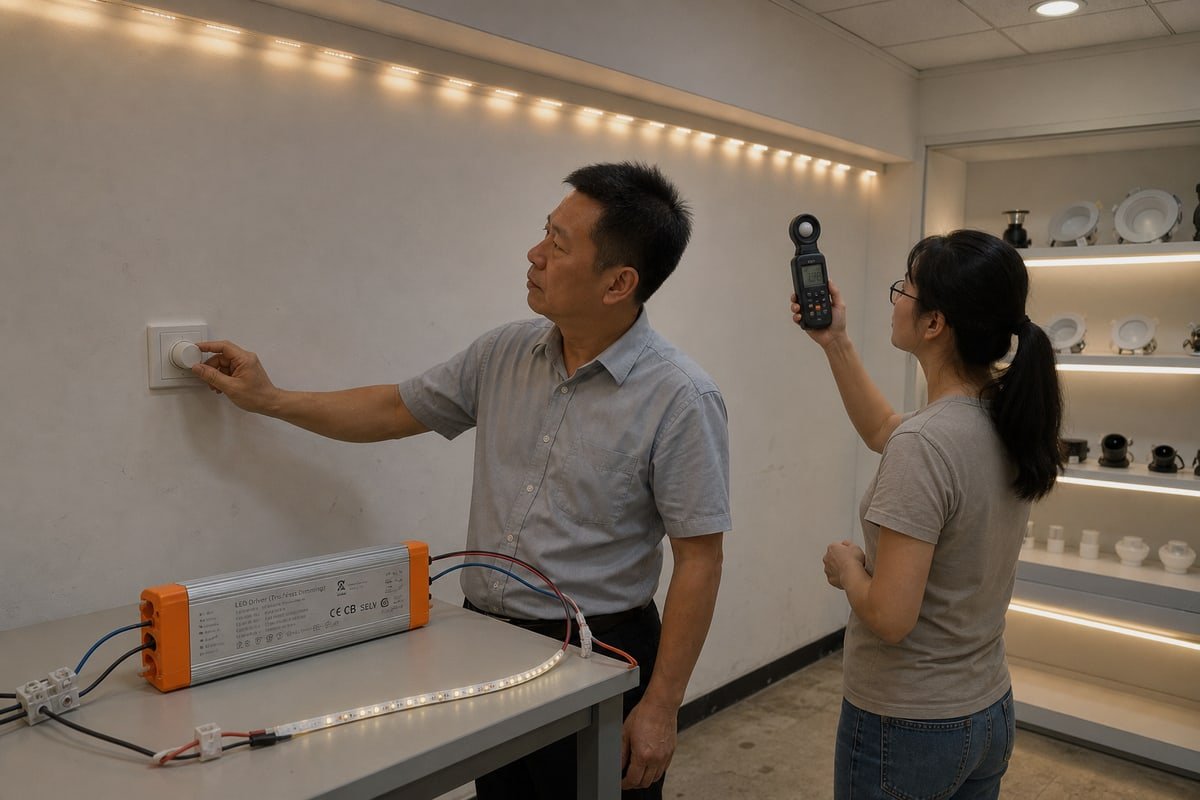
A compatibilidade do interruptor dimmer é onde a maioria dos projetos dá errado, então comece com a comparação entre borda de subida e borda de descida. As duas tecnologias cortam a forma de onda CA de maneiras diferentes, e um driver projetado para uma pode se comportar mal na outra.
| Fator | Borda de subida (fase direta) | Borda de descida (tipo ELV) |
|---|---|---|
| Como corta a forma de onda | Corta a frente de cada meio ciclo | Corta o final de cada meio ciclo |
| Alvo de design original | Cargas incandescentes e magnéticas | Cargas eletrônicas de baixa tensão |
| Sensibilidade à corrente de sustentação | Alta—precisa de corrente estável para permanecer travado | Baixa—usa transistores, não um TRIAC de travamento |
| Requisito de carga mínima | Frequentemente 25W ou mais | Geralmente muito menor |
| Comportamento de dimerização em baixo nível | Propenso a queda e flash | Tipicamente mais suave e silencioso |
| Melhor pareamento | Drivers explicitamente classificados para borda de subida | Designs de driver dimerizáveis ELV |
Agora deixe-me abordar uma objeção comum de compradores. Alguns engenheiros me dizem que a dimerização TRIAC é inerentemente errada para fitas de LED, e que apenas uma solução MOSFET ou de borda de descida pode ser livre de cintilação. Entendo de onde vem essa visão—dimmers incandescentes legados em uma fonte de alimentação de tensão constante 4 unidades piscam muito. Mas a conclusão está desatualizada. Um driver cujo estágio de entrada é projetado para decodificar entrada phase-cut, apresentar corrente estável ao TRIAC e regular de forma limpa em níveis de dimerização profunda pode ter um desempenho muito bom em hardware de ponta 5. O espectro real vai de “configurações genéricas antigas que piscam” a “sistemas compatíveis com TRIAC projetados que não piscam.”
A regra prática que damos aos distribuidores: nunca qualifique um dimmer sozinho. Qualifique o dimmer, o driver e a fita como um sistema único, e peça ao seu fornecedor a lista de compatibilidade testada antes de especificar qualquer coisa.
Como escolho um driver TRIAC de CV confiável para evitar cintilação em pedidos em massa?
Uma lição de anos exportando drivers para a Europa e o Sudeste Asiático se destaca para mim: uma linha de datasheet dizendo 24V de tensão constante não diz nada sobre dimerização.
Escolha um driver explicitamente rotulado como 24V de tensão constante, dimerizável por TRIAC/phase-cut—não apenas tensão constante. Verifique suporte a borda de subida e borda de descida, carga mínima e máxima, estabilidade de dimerização no extremo baixo, comportamento da corrente de entrada, marcas de segurança como CE, CB e SELV, e então teste uma amostra da combinação completa dimmer-driver-fita antes de se comprometer.
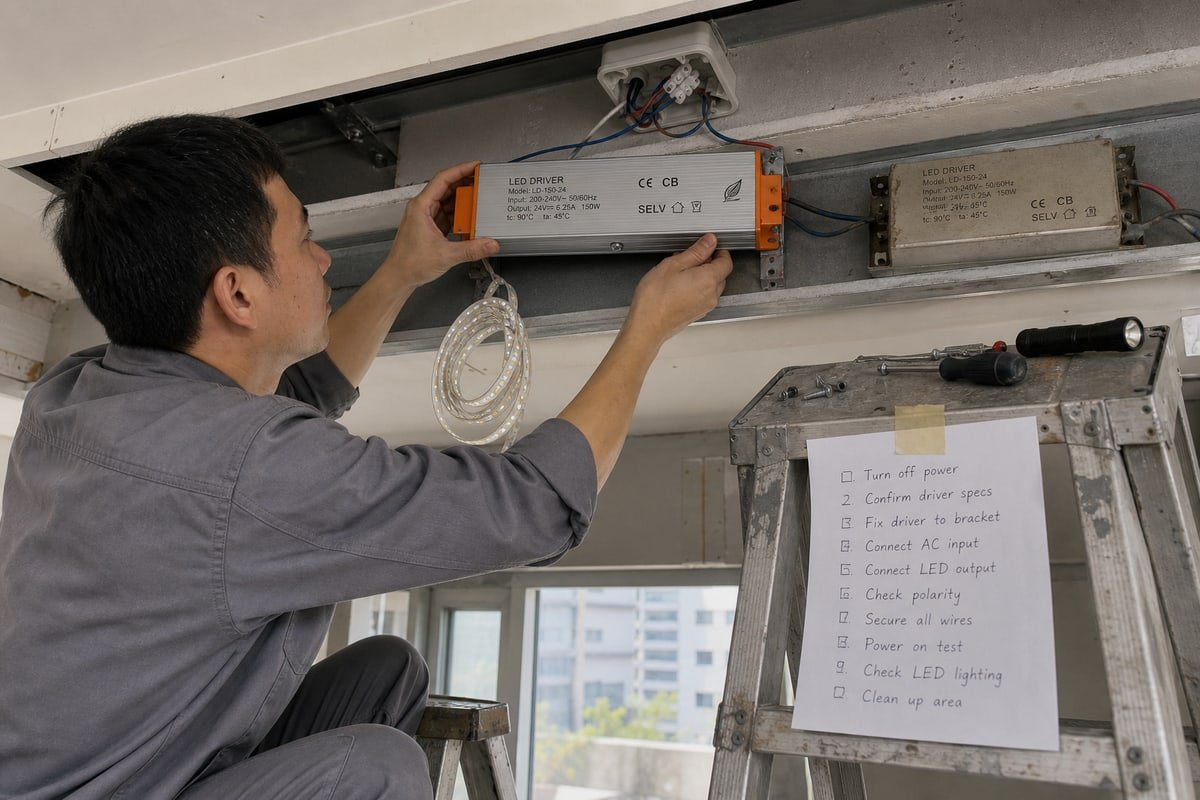
Aqui está o problema oculto que custa mais dinheiro aos compradores. Uma fita de LED de 24V pode ser perfeitamente compatível eletricamente com um driver CV de 24V e ainda assim piscar quando dimerizada. Compatibilidade de tensão e compatibilidade de dimerização são duas coisas diferentes. Uma fonte de alimentação de tensão constante convencional pode produzir excelente 24V DC em operação normal, mas seu circuito de entrada pode ser completamente inadequado para uma forma de onda phase-cut. Conectá-la atrás de um dimmer TRIAC não a torna magicamente um driver dimerizável por TRIAC. A especificação deve dizer algo como “24V de tensão constante, dimerizável por TRIAC/phase-cut”—não simplesmente “fonte de alimentação de 24V de tensão constante.”
As seis perguntas a fazer a cada fornecedor
Antes de qualquer pedido em massa, dizemos aos compradores para irem além de “é dimerizável por TRIAC?” e fazerem estas seis perguntas:
- É projetado para borda de subida, borda de descida ou ambos?
- Qual é a carga mínima e máxima do driver?
- Qual é a forma de onda da corrente de entrada do driver?
- Ele mantém regulação estável no seu nível mínimo de dimerização pretendido?
- A fita de LED está realmente consumindo energia suficiente para a faixa operacional do driver?
- O dimmer tem um requisito de carga mínima próprio?
A lista de verificação de qualificação para pedidos em massa
| Ponto de controlo | O que verificar | Bandeira vermelha |
|---|---|---|
| Rótulo de dimerização | Declara explicitamente dimerizável por TRIAC/phase-cut | Apenas diz tensão constante |
| Marcas de segurança | CE, CB e SELV impressos no invólucro | Certificados ausentes ou não verificáveis |
| Design térmico | Invólucro de alumínio com ranhuras de dissipação de calor | Plástico selado sem caminho térmico |
| Alegações de sem pisca-pisca | Pergunte se a dimerização de 0–100% se aplica ao seu dimmer e carga | Alegação dada sem lista de dimmers testados |
| Teste de extremo baixo | Amostra testada no seu brilho mínimo real | Apenas testado na saída total |
| Termos de garantia | Garantia por escrito honrada em falhas de dimerização | Garantia exclui comportamento de dimerização |
No lado do hardware, a qualidade física de construção diz muito. Nossas próprias unidades usam um invólucro de alumínio escovado com ranhuras de dissipação de calor, porque a deriva térmica em um driver quente pode mudar o comportamento de condução e criar pisca-pisca que só aparece após o aquecimento. Também trate o marketing de “0–100% sem pisca-pisca” como uma alegação de compatibilidade, não uma garantia universal—ela só se mantém com dimmers testados na faixa de carga declarada. Minha principal conclusão B2B: não qualifique um driver CV como dimerizável por TRIAC só porque ele aceita um dimmer TRIAC. O teste real é se a combinação completa de dimmer, driver e fita de LED permanece estável em toda a sua faixa de dimerização necessária.
Conclusão
Pisca-pisca é uma incompatibilidade de sistema, não um mistério. Combine o dimmer, o driver e a fita; teste a cadeia completa; e compre apenas de fornecedores que qualifiquem combinações completas.
Notas de rodapé
- Explica a função do estágio de entrada no controle de energia baseado em TRIAC. ↩︎
- Explicação técnica do controle de disparo de fase e do tempo de condução. ↩︎
- O URL original do Departamento de Energia está 404; esta é a página autoritativa atualizada que explica os fundamentos de pisca-pisca de LED e os componentes do sistema. ↩︎
- Normas da Diretiva de Baixa Tensão da UE para equipamentos elétricos de tensão constante. ↩︎
- Norma NEMA sobre compatibilidade de dimerização para iluminação de estado sólido. ↩︎