Ga naar de inhoud









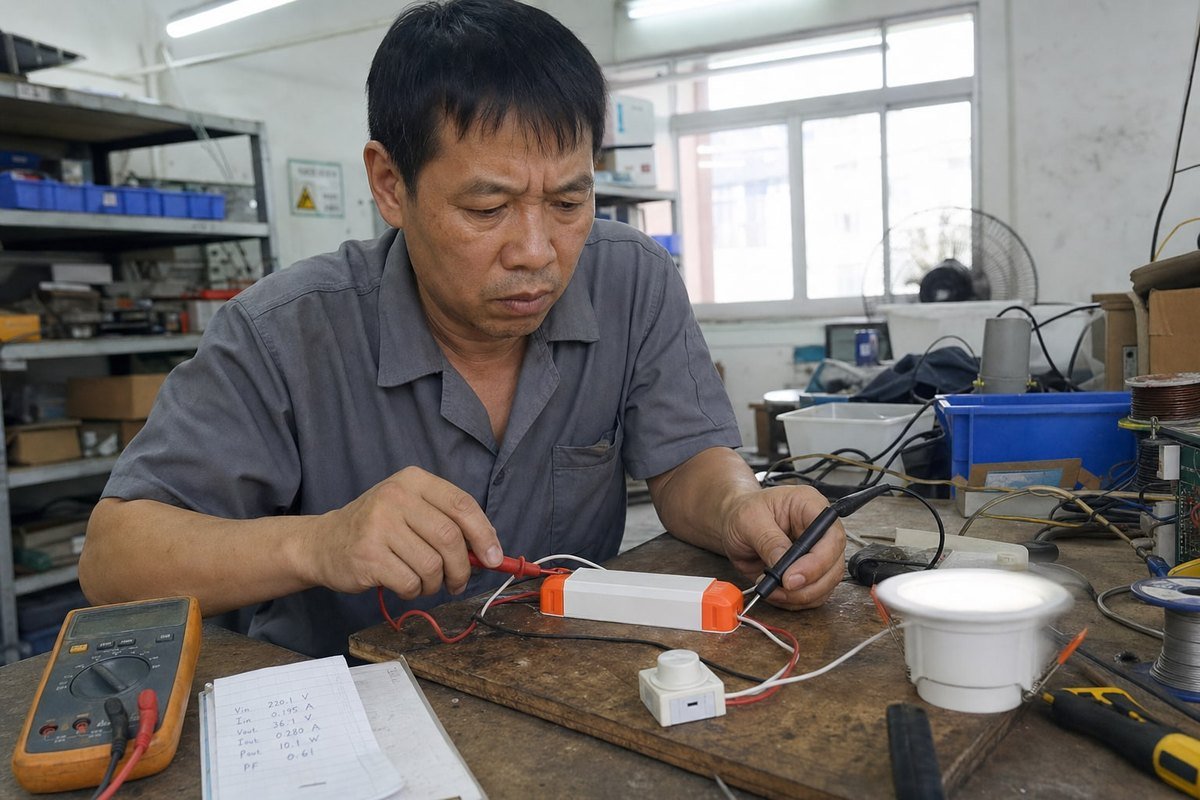
Flickerklachten kunnen een verlichtingsproject snel doen zinken. LED-lampen die flikkeren met CC TRIAC-drivers zijn de meest voorkomende retourreden die wij onderzoeken. Het frustrerende deel? De driver test vaak prima op onze testbank, maar flikkert hevig op de dimmer van de klant. Die mismatch is precies wat ik hier wil ontrafelen, zodat je het probleem kunt stoppen voordat het jouw klanten bereikt.
LED-lampen flikkeren met CC TRIAC-drivers omdat fase-aangesneden dimmers zijn ontworpen voor resistieve gloeilampbelastingen. De lage LED-stroom zakt onder de houdstroom van de TRIAC, de ingangscondensator laadt in bursts op, en EMI-filterringing verstoort het opnieuw triggeren—waardoor de TRIAC ontkoppelt en de driver zichtbaar opnieuw start.
Dat is het korte antwoord. Maar als je professioneel LED-drivers inkoopt of ontwerpt, heb je meer nodig dan een samenvatting. Laat me je meenemen door de oorzaken, de oplossingen, en de tests die wij draaien voordat een driver onze fabriek verlaat.
Wat veroorzaakt flikkering wanneer ik CC-drivers koppel met TRIAC-dimmers?
Een paar jaar geleden stuurde een van onze Franse kopers me een video van een downlight die stroboscoopte op 20% helderheid. Het armatuur was prima. De driver was prima. De combinatie was het probleem, en dat verhaal herhaalt zich wekelijks in onze support-inbox.
Flikkeren ontstaat omdat de TRIAC-dimmer continue latch- en houdstroom nodig heeft om geleidend te blijven, terwijl een constante-stroomdriver gepulste, capacitieve stroom trekt. Wanneer de stroomopname van de driver onder de houddrempel zakt, ontkoppelt de TRIAC midden in de cyclus, verliest de driver vermogen, start opnieuw, en de LED flitst zichtbaar.
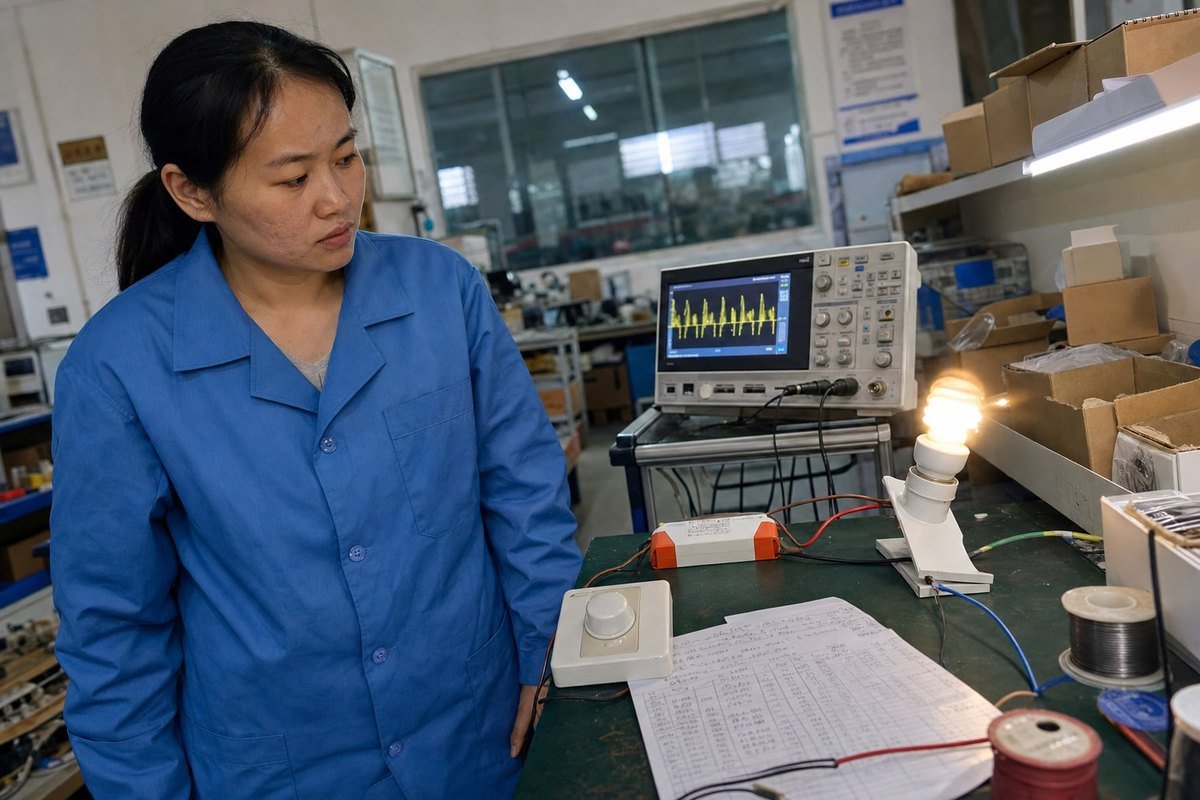
De kern van het probleem is een communicatiefout tussen twee apparaten die op verschillende aannames zijn gebouwd. Een TRIAC-dimmer voert fase-aansnijding uit: het kapt een deel van elke AC-halve cyclus af en levert de rest aan de belasting. Een gloeidraad is puur resistief, dus trekt het gelijkmatige stroom op het moment dat de TRIAC vuurt. De TRIAC latchet, blijft boven zijn houdstroom 1, en alles werkt.
Een constante-stroom LED-driver gedraagt zich totaal niet als een gloeidraad. Het gelijkricht de aangesneden AC, laadt een ingangscondensator 2 in scherpe bursts, en regelt vervolgens een vaste stroom naar de LED-string. Tussen die laadbursts kan de stroom die de dimmer ziet instorten tot bijna niets.
Het stapsgewijze flikker-mechanisme
- De dimmer kapt de golfvorm en vuurt de TRIAC.
- De ingangscondensator van de driver trekt een scherpe inschakelpiek.
- De stroom zakt vervolgens onder de houdstroom van de TRIAC.
- De TRIAC ontkoppelt vroeg of triggert onregelmatig opnieuw binnen dezelfde halve cyclus.
- De interne voedingsrail van de driver zakt, de regel-IC reset, en de uitgangsstroom daalt.
- De LED flitst of pulseert—vaak als een zichtbaar stroboscopisch effect.
Secundaire bijdragers die wij in het lab zien
Naast de kernmismatch van de houdstroom, traceren onze engineers flikkeren regelmatig naar deze secundaire oorzaken:
| Oorzaak | Wat er gebeurt | Waar het zich voordoet |
|---|---|---|
| EMI-filterringing | Steile TRIAC-spanningsstijging exciteert het ingangsfilter; oscillatie verstoort de dimdetectie | Willekeurig flikkeren bij middendim |
| Zwakke bleeder-schakeling | Onvoldoende stroom tijdens de uit-tijd om de TRIAC gelatcht te houden | Flikkeren bij lage dimniveaus |
| Voedingstekort van de regel-IC | Korte geleidingshoeken verhongeren de IC-voeding; driver gaat in hiccup-modus | Knipperen nabij minimale helderheid |
| Net-DC-offset | Asymmetrisch vuren tussen halve cycli | Zichtbare 50/60 Hz-modulatie |
| Lange uitgangskabels | Parasitaire capaciteit destabiliseert de stroomlus bij lage duty-cycli | Flonkeren tijdens diep dimmen |
Moderne TRIAC-dimbare constante-stroomdrivers—inclusief de compacte units die wij bouwen—pakken deze problemen aan met actieve bleeder-schakelingen, gedempte EMI-filtering 3, en fase-detectielogica afgestemd op aangesneden golfvormen. Maar zelfs de beste driver kan niet elke dimmer repareren, wat ons bij compatibiliteit brengt.
Hoe kan ik compatibele TRIAC-dimmers kiezen om flikkering in mijn CC LED-driverontwerpen te voorkomen?
Compatibiliteitsvragen domineren de technische gesprekken die ik met kopers voer. Wanneer wij drivers naar Europa verzenden, vragen we altijd welke dimmermerken het project specificeert—omdat dimmerschakelaar-compatibiliteit meer succes bepaalt dan welke enkele driver-specificatie ook.
Kies dimmers uit de geteste compatibiliteitslijst van je driverfabrikant, match leading edge vs trailing edge-topologie met het driverontwerp, controleer dat de dimmer geschikt is voor LED-belastingen, en bevestig dat het aangesloten LED-wattage comfortabel binnen het minimale en maximale belastingsvenster van de dimmer valt.
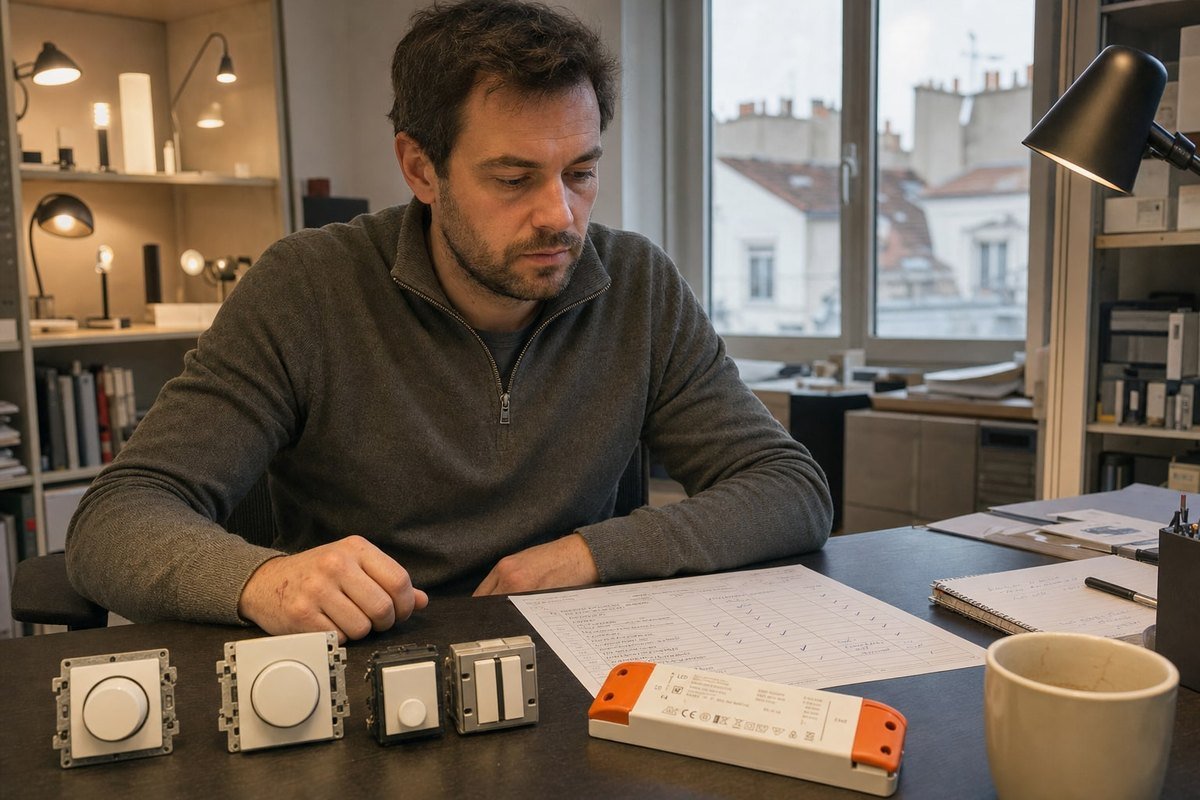
Niet alle fase-aangesneden dimmers gedragen zich hetzelfde, en de eerste splitsing die je moet begrijpen is leading edge vs trailing edge.
Forward phase vs reverse phase: ken je topologie
Voorwaartse fase-dimmers (leading-edge, TRIAC-gebaseerd) snijden het begin van elke halve cyclus af. De spanning schakelt abrupt in, wat zorgt voor inschakelpieken 4 en kan EMI-filterringing opwekken. Omgekeerde fase-dimmers (trailing-edge, MOSFET-gebaseerd) snijden het einde van de halve cyclus af. De spanning stijgt geleidelijk, wat vriendelijker is voor capacitieve driver-ingangen—maar een driver die is afgestemd op voorwaartse fasedetectie kan een omgekeerd fasesignaal volledig verkeerd interpreteren.
| Kenmerk | Voorwaartse fase (leading edge) | Omgekeerde fase (trailing edge) |
|---|---|---|
| Schakelcomponent | TRIAC | MOSFET/IGBT |
| Spanningsstijging | Abrupte, steile dV/dt | Geleidelijk, zacht |
| Houdstroom nodig | Ja, cruciaal | Nee |
| Minimale belastingsvereiste | Vaak 25–60W | Meestal veel lager |
| Best gecombineerd met | Drivers met sterke bleeder-circuits | Capacitieve LED-driver-ingangen |
| Typische faalmodus | Flikkering, uitval bij laag dimniveau | Verkeerde detectie als driver leading edge verwacht |
Een praktische selectiechecklist
Op basis van onze exportervaring is dit de volgorde die ik kopers zoals u aanraad:
- Begin met de compatibiliteitslijst. We testen onze drivers tegen populaire dimmermodellen en publiceren de resultaten. Een getest paar haalt het meeste giswerk weg.
- Controleer het LED-vermogen van de dimmer. Oudere gloeilampdimmers vermelden vaak een minimale belasting van 25W–60W. Drie LED-armaturen van 8W voldoen daar mogelijk niet aan.
- Derate de dimmer voor LED-belastingen. Een gloeilampdimmer van 400W verwerkt vaak slechts ongeveer 10% daarvan in LED-wattage vanwege inschakelpieken.
- Stem de topologie af. Bevestig of uw driver voorwaartse fase of omgekeerde fasesignalen verwacht 5 voordat u de wandbediening specificeert.
- Vraag naar de dimcurve. Een driver en dimmer met niet-overeenkomende curven flikkeren misschien niet, maar ze dimmen slecht—dode slag bovenaan, plotselinge afsnijding onderaan.
Nog een tip van onze fabrieksvloer: als een project armatuurtypes op één dimmercircuit combineert, test dan de volledige gemengde belasting, niet één armatuur tegelijk. Interacties tussen drivers op dezelfde fase-aangesneden lijn veroorzaken flikkering die tests met één eenheid nooit onthullen.

Welke minimale belasting- of houdstroomproblemen moet ik controleren om flikkeren te voorkomen?
Er is een afweging die we in elk driverontwerp maken: hoeveel bleederstroom we verbranden. Te weinig, en de TRIAC valt uit bij laag dimniveau. Te veel, en de efficiëntie lijdt eronder en de driver wordt heet. Deze balans goed krijgen is waar CC TRIAC-driverontwerp echt moeilijk wordt.
Controleer of de totale LED-belasting voldoet aan de minimale belastingsvereiste van de dimmer, of de ingangsstroom van de driver bij alle geleidingshoeken boven de houdstroom van de TRIAC blijft, en of het bleeder-circuit de latchingstroom handhaaft tijdens de kritieke milliseconden nadat de TRIAC is ontstoken.
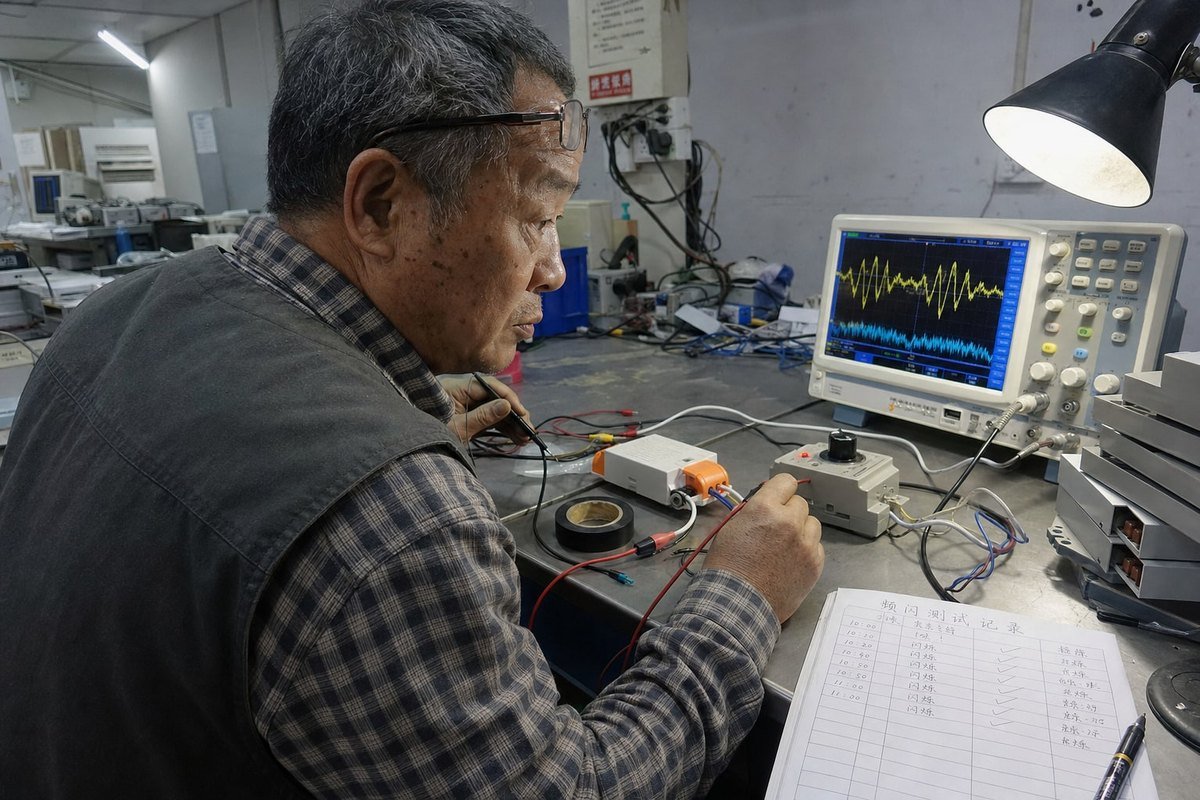
Twee verwante maar verschillende stroomdrempels bepalen het gedrag van de TRIAC, en ze verwarren veroorzaakt ontwerpfouten.
Latchingstroom vs. houdstroom
Latchingstroom is wat de TRIAC onmiddellijk na triggering nodig heeft om aan te blijven nadat de gate-puls eindigt. Houdstroom is de kleinere waarde die nodig is tijdens geleiding om aan te blijven. Specificaties voor latching- en houdstroom variëren per TRIAC-model 6, maar typische waarden lopen van een paar milliampère tot meer dan 50 mA. Een gloeilamp gaat direct ruim over beide heen. Een gedimde LED-driver kan op een van beide falen—latchingfalen veroorzaakt misfires direct na triggering, terwijl houdstroomfalen vroegtijdige uitval later in de halve cyclus veroorzaakt.
De wiskunde die ertoe doet bij laag dimniveau
Flikkering wordt erger bij diep dimmen om een simpele energiereden. Bij een korte geleidingshoek ontvangt de driver slechts een dun plakje van elke halve cyclus. Minder energie per cyclus betekent een lagere gemiddelde ingangsstroom, en dat is precies wanneer de TRIAC het meest waarschijnlijk zijn houdstroom verliest. Daarom is het kenmerkende symptoom van een mismatch instabiliteit onder ongeveer 20% helderheid, terwijl volledige helderheid perfect lijkt.
| Controlepunt | Wat te verifiëren | Waarschuwingssignaal |
|---|---|---|
| Minimale belasting van de dimmer | Totaal LED-wattage vs. dimmerspecificatie | Belasting onder het opgegeven minimum |
| TRIAC-houdstroom | Driver-ingangsstroom bij minimale dimstand | Stroom zakt onder ~10–50 mA |
| Type bleedercircuit | Actief (geschakeld) vs passief (resistief) | Passieve bleeder plus specificatie voor diep dimmen |
| Thermisch gedrag | Bleedertiming bij bedrijfstemperatuur | Flikkering die pas na opwarmen verschijnt |
| Lekstroompad | Herstartcycli van de driver met dimmer op minimum | Langzaam aan-uit knipperen wanneer bijna uit |
Waarom actieve bleeders het spel veranderden
Oudere ontwerpen gebruikten een vaste resistieve bleeder die bij elk dimniveau stroom verspilde. Onze huidige ontwerpen gebruiken actieve bleedercircuits die alleen tijdens het kwetsbare venster na TRIAC-ontsteking en bij lage geleidingshoeken aanvullende stroom trekken. Een les die we op de harde manier hebben geleerd: bleedertiming drift met temperatuur. Een driver die een koude banktest doorstaat, kan na dertig minuten in een warm plafondarmatuur gaan flikkeren. We voeren nu soak-tests uit met drivers bij verhoogde temperatuur voordat we een dimontwerp goedkeuren, omdat thermische drift in de bleeder een van de verraderlijkste flikkerbronnen in het veld is.
Hoe test en los ik flikkerproblemen op voordat ik in massaproductie ga?
Een koper vroeg me ooit waarom we aandringen op een volledige dimmer-sweeptest wanneer het sample “al werkte” in zijn kantoor. Twee maanden later kwam zijn productiebatch op locatie een ander dimmermerk tegen—en onze sweepgegevens redden het project. Testen vóór massaproductie is goedkope verzekering.
Test elk driver-dimmer paar over het volledige dimbereik met een oscilloscoop op ingangsstroom en een flickermeter op lichtoutput. Verifieer stabiel inschakelen op minimaal dimniveau, controleer opwarmgedrag, test meerdere dimmermerken en bevestig dat er geen hiccup-herstarten optreden bij elke geleidingshoek.
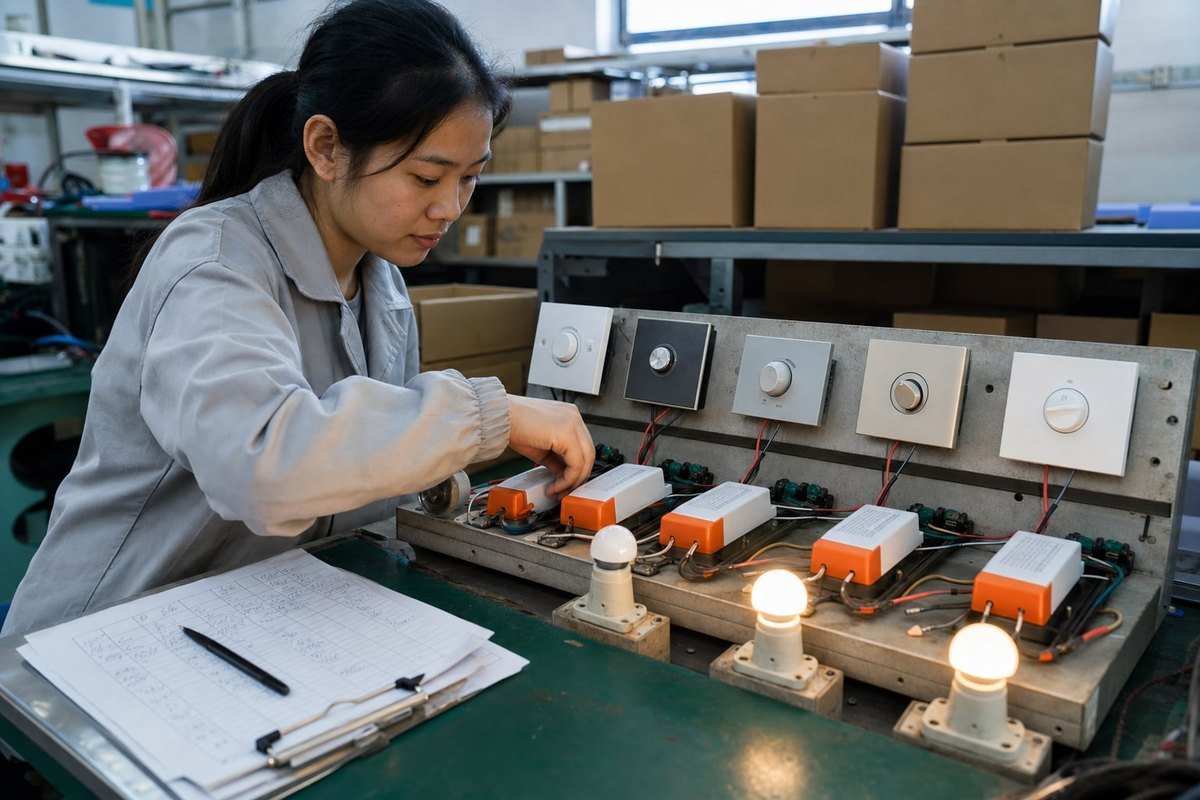
Laat me de workflow delen die we in ons QC-lab volgen, aangepast zodat u deze kunt uitvoeren voordat u een productiebatch goedkeurt.
Een zevenstappen-testprotocol vóór productie
- Test de exacte combinatie op de bank. Test het specifieke dimmermodel, drivermodel en de LED-belasting die het project zal gebruiken. Vervangingen verbergen problemen.
- Doorloop het volledige dimbereik langzaam. Ga in 30 seconden van 100% naar minimum. Let op glinsteren, flitsen of dode zones—vooral in het onderste kwart van het bereik.
- Meet de ingangsstroom met een scope. Plaats een stroomprobe 7 op de AC-ingang. Let op vroege TRIAC-drop-out (stroom die midden in de halve cyclus instort) en op dubbele triggering veroorzaakt door ringing van EMI-filtering.
- Meet lichtflikkering direct. Gebruik een flikkermeter of een camera met hoge framesnelheid om procentuele flikkering en flikkerindex 8 bij meerdere dimniveaus te kwantificeren. Het stroboscopische effect kan onzichtbaar zijn voor het blote oog, maar duidelijk voor een camera of voor gevoelige bewoners.
- Voer een thermische soak uit. Laat minstens een uur op minimale dimstand werken in een behuizing bij realistische omgevingstemperatuur. Controleer de stabiliteit opnieuw wanneer warm.
- Test minimum- en maximumaantallen armaturen. Eén driver op een dimmer gedraagt zich anders dan tien. Test beide uitersten van het geplande circuit.
- Controleer de uit-stand. Bevestig met de dimmer volledig uit dat de LED donker blijft. Ghosting of periodiek knipperen wijst op lekstroom die de condensator van de driver langzaam oplaadt en herstartcycli activeert.
De symptomen lezen
Verschillende flikkersignaturen wijzen op verschillende oorzaken. Flikkering alleen nabij minimale helderheid betekent meestal een mismatch in houdstroom of dimbereik—niet de bedrading. Flikkering op alle niveaus suggereert een topologiemismatch of filteroscillatie. Knipperen met de dimmer uit betekent lekstroom. Flikkering na opwarmen wijst op thermische drift. En vergeet het balancerende perspectief niet: sommige flikkering in het veld komt door spanningsschommelingen, losse nuldraad of gedeelde circuits met AFCI/GFCI-onderbrekers die reageren op harmonische ruis. Sluit die eerst uit voordat u het driver-dimmerpaar de schuld geeft.
Conclusie
Flikkering bij CC TRIAC-drivers is zelden een LED-defect. Het is een dimmer-driver-mismatch die u kunt voorkomen met topologiematching, bleederbewust ontwerp en gedisciplineerd testen vóór productie. Als u hulp wilt bij het combineren van drivers en dimmers voor uw volgende project, deelt ons team bij boqi graag onze compatibiliteitsgegevens.
Voetnoten
- Beschrijft de minimale stroom die nodig is om een TRIAC in geleidende toestand te houden. ↩︎
- Technische documentatie over condensatorcomponenten die verantwoordelijk zijn voor gepulseerde stroomopname in LED-drivers. ↩︎
- Gezaghebbende Wikipedia-pagina die elektromagnetische interferentie en onderdrukkingstechnieken uitlegt. ↩︎
- Betrouwbare Wikipedia-bron die inschakelstroom en de impact ervan op elektrische componenten definieert. ↩︎
- Technisch overzicht van trailing-edge-dimtechnologie voor capacitieve LED-belastingen. ↩︎
- Legt de fundamentele halfgeleidercomponent uit die wordt gebruikt in fase-aansnijdingsdimcircuits. ↩︎
- Gids van een industriekoploper over tools voor het meten van ingangsstroomgolfvormen bij probleemoplossing. ↩︎
- Overheidsbron die metrieken definieert voor het meten en kwantificeren van lichtflikkering in LED-systemen. ↩︎