Aller au contenu











Choisir entre des drivers LED 0–10V à courant constant et à tension constante déroute même les acheteurs expérimentés. J'ai vu de mauvais choix sur notre ligne de production provoquer du scintillement, une surchauffe et une défaillance prématurée des LED. Un driver mal assorti peut ruiner tout un lot de luminaires — et les frais de retour à eux seuls peuvent effacer votre marge sur le projet. La bonne nouvelle ? La décision devient simple une fois que vous séparez le signal de gradation du type de régulation de sortie.
Choisissez un driver LED 0–10V à courant constant lorsque votre LED spécifie un courant de pilotage tel que 350mA, 700mA ou 1A. Choisissez un driver 0–10V à tension constante lorsque votre produit LED nécessite une alimentation fixe en 12V ou 24V DC, comme les bandeaux LED avec limitation de courant intégrée.
C'est la réponse courte. Mais il y a plus à dire. Le signal 0–10V indique seulement au driver à quel point il doit atténuer. Il ne détermine pas si le driver est CC ou CV. Laissez-moi vous expliquer les détails pour que vous n'achetiez plus jamais la mauvaise unité.
Quelles sont les principales différences entre les drivers LED 0–10V à courant constant et à tension constante ?
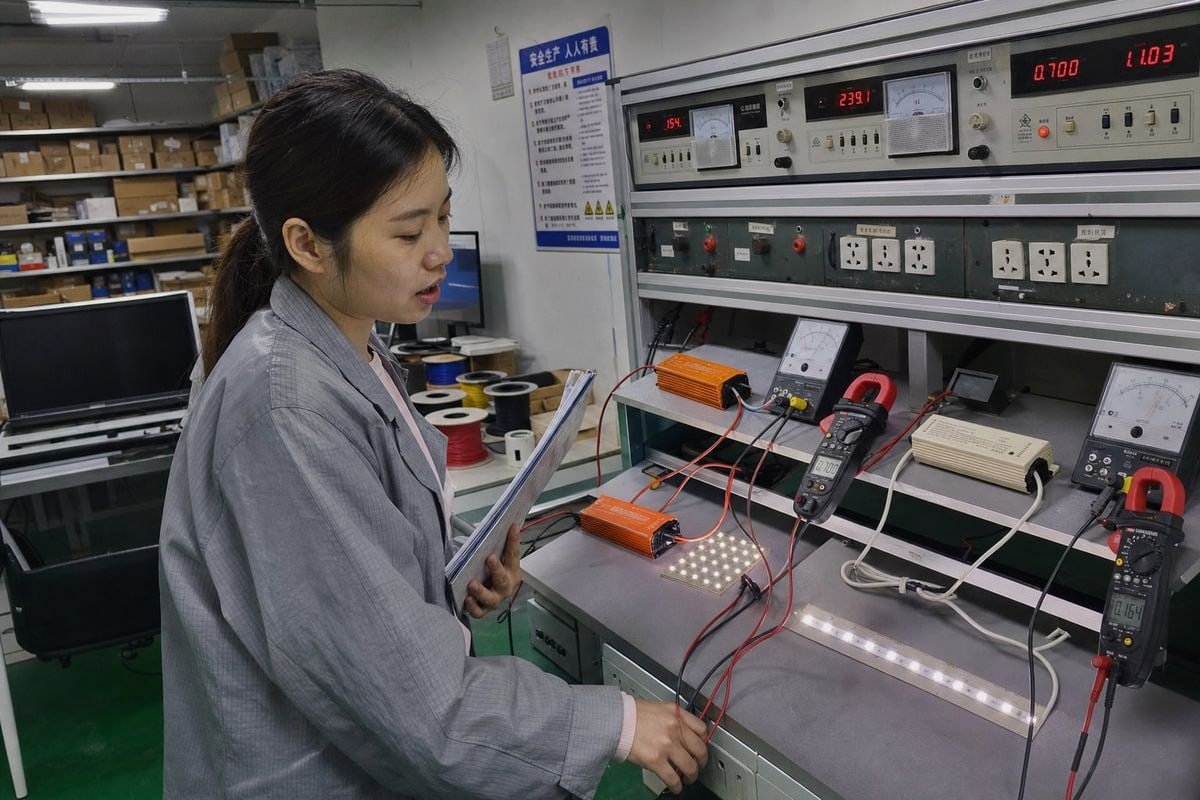
Lorsque nous calibrons des drivers 0–10V dans notre usine, la première chose que notre banc de test vérifie est le mode de sortie. Une unité CC et une unité CV se comportent complètement différemment sous charge, même si toutes deux acceptent le même signal de gradation analogique.
Un driver 0–10V à courant constant maintient le courant de sortie fixe tandis que la tension varie dans une plage de tension directe. Un driver 0–10V à tension constante maintient la tension de sortie fixe, généralement 12V ou 24V DC, tandis que le courant varie avec la charge. L'entrée 0–10V contrôle uniquement le niveau de gradation.
Voici la comparaison essentielle en un coup d'œil :
| Fonctionnalité | Courant constant (CC) | Tension constante (CV) |
|---|---|---|
| Sortie régulée | Courant (par ex., 350mA, 700mA, 1A) | Tension (par ex., 12V, 24V DC) |
| L'étiquette indique | Courant fixe + plage de tension | Tension fixe + courant maximal |
| Câblage typique | Série | Parallèle |
| Charges les mieux adaptées | Modules LED COB, luminaires haute puissance | Bandeaux LED, modules de signalétique |
| Limitation de courant | Gérée par le driver | Doit être intégrée au produit LED |
| Méthode de gradation | Réduction du courant constant (CCR) | Souvent modulation par largeur d'impulsion 1 (PWM) |
CC contrôle le courant, CV maintient la tension
La différence est simple à retenir : CC contrôle le courant LED ; CV maintient la tension LED. Un driver CC ajuste sa tension de sortie à la hausse ou à la baisse dans une plage de conformité afin que le courant reste exactement à la valeur nominale. Cela protège les puces LED contre les surintensités et l'emballement thermique 2. Un driver CV fait l'inverse. Il verrouille la tension à 12V ou 24V et laisse la charge connectée tirer le courant dont elle a besoin, jusqu'à un maximum.
Où le signal 0–10V s'intègre
La nature L'interface 0–10V est un signal de gradation analogique, pas un type de sortie de puissance. C'est une norme de contrôle basse tension : 10V commande la pleine luminosité, 0V commande la sortie minimale ou l'extinction, selon que le driver offre la fonction d'extinction complète. Les drivers CC et CV peuvent tous deux accepter ce signal. Le driver agit comme traducteur. Dans un système CC, le driver réduit le courant en réponse au signal. Dans un système CV, le driver module généralement la sortie en utilisant le PWM. Lorsque nous concevons nos circuits de gradation, nous vérifions également le comportement de courant de sortie ou d'entrée côté contrôle, car une inadéquation là provoque des lignes de gradation mortes même lorsque le câblage d'alimentation est parfait.
Comment puis-je déterminer quel type de driver LED correspond à mes exigences de production ?
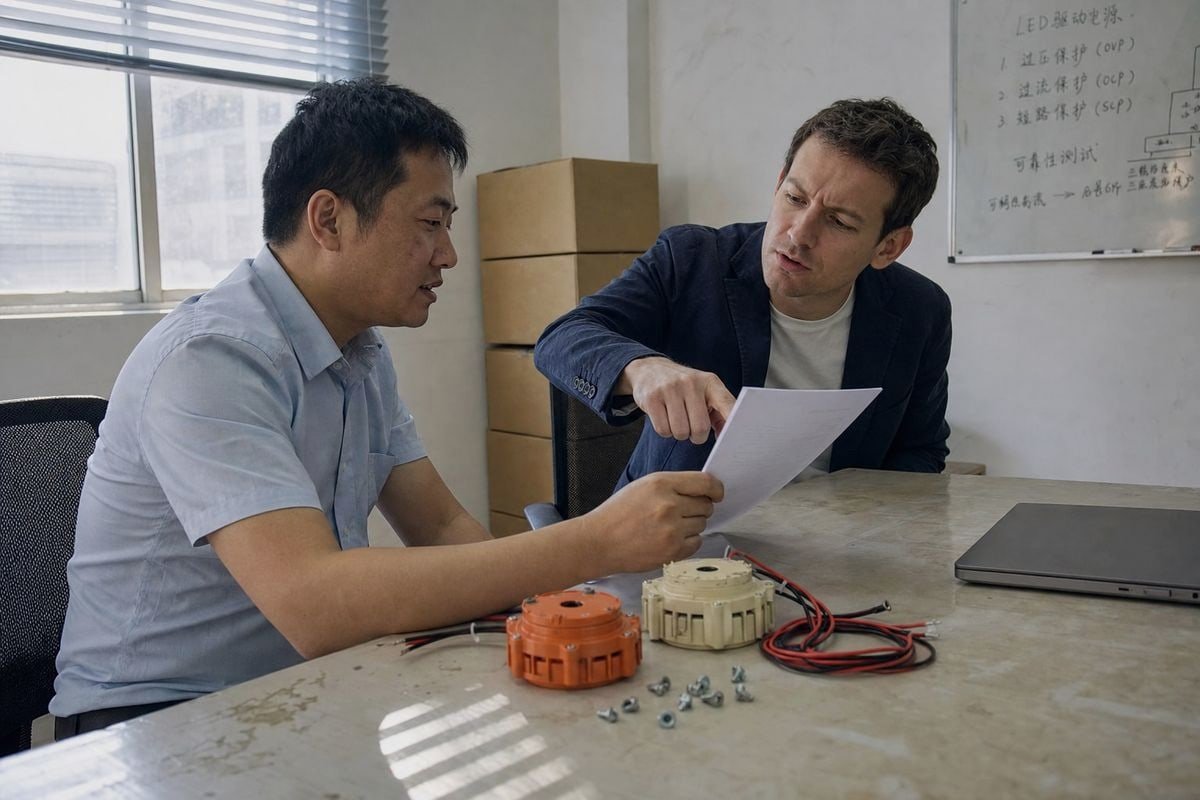
Un acheteur de France nous a un jour envoyé une spécification de luminaire indiquant uniquement la puissance — ni courant, ni tension. Nous avons dû la renvoyer avec une question : que dit la fiche technique de la LED ? Ce seul document décide de tout.
Lisez d'abord la fiche technique de la LED. Si elle spécifie un courant de commande en mA ou A, sélectionnez un driver à courant constant correspondant exactement à cette valeur. Si elle spécifie une tension de fonctionnement en VDC, comme 12V ou 24V, sélectionnez un driver à tension constante avec une marge de puissance suffisante.
Suivez ce processus de décision simple avant chaque bon de commande :
- Vérifiez la fiche technique de la LED. Le courant en mA signifie CC. La tension en VDC signifie CV. La puissance seule n'est jamais suffisante pour trancher.
- Vérifiez la topologie de câblage. Le câblage en série ou en parallèle compte. Les chaînes en série de puces ou de modules LED COB nécessitent du CC. Les modules et bandeaux connectés en parallèle nécessitent du CV.
- Vérifiez la plage de tension directe. Pour les drivers CC, la tension directe totale de votre chaîne LED doit se situer dans la fenêtre de tension de sortie du driver.
- Vérifiez l'interface de gradation. Confirmez que le driver est spécifiquement un modèle CC dimmable 0–10V ou CV dimmable 0–10V. Le protocole de gradation ne détermine jamais le type de sortie.
- Vérifiez les exigences de classe de sécurité. Pour de nombreuses installations basse tension, une alimentation de classe 2 3 simplifie la conformité du câblage et l'inspection.
Pourquoi le câblage en série ou en parallèle est important
Les systèmes à courant constant (CC) sont généralement basés sur une configuration en série. Chaque LED de la chaîne voit un courant identique, donc la luminosité reste uniforme sur toute la chaîne. Les systèmes à tension constante (CV) sont généralement basés sur une configuration en parallèle. Chaque module ou segment de bande utilise la même ligne de tension, ce qui facilite l'ajout ou le retrait de luminaires lors des modifications de disposition. D'après notre expérience d'exportation de drivers vers des clients européens, le mélange de ces topologies est la première cause de défaillances sur le terrain. Une charge en parallèle sur un driver CC force un partage de courant inégal. Une longue chaîne en série sur un driver CV ne s'allumera tout simplement pas correctement.
Correspondance au-delà de la puissance
Pour la sélection CC, faites correspondre exactement la valeur en milliampères — 350 mA, 700 mA ou 1 A sont les valeurs les plus courantes que nous expédions. Pour la sélection CV, assurez-vous que la capacité de puissance totale du driver dépasse la somme de toutes les charges connectées, idéalement avec une marge de 20 %. Remplacer des drivers CC et CV simplement parce que la puissance correspond est une erreur que nous voyons régulièrement, et cela se termine généralement par des luminaires morts ou scintillants.
Quels facteurs de coût dois-je prendre en compte lors de la sélection d'un driver LED 0–10 V pour une fabrication à grande échelle ?
Il y a un compromis que je pèse à chaque devis à grand volume que nous préparons : le prix unitaire par rapport au coût total du système. Le driver le moins cher sur la facture est rarement le moins cher dans le produit fini.
Pour la fabrication à grande échelle, évaluez le coût total du système, et non le prix unitaire du driver. Les drivers CV coûtent moins cher par unité et simplifient les configurations en parallèle, mais les drivers CC réduisent les taux de défaillance, les réclamations sous garantie et les pertes de câblage. Tenez compte du câblage, de la hauteur sous plafond, de la qualité de gradation et des exigences de certification.

Voici comment les facteurs de coût se décomposent généralement lorsque nous aidons des clients à budgétiser un projet :
| Facteur de coût | Impact du courant constant | Impact de la tension constante |
|---|---|---|
| Prix unitaire du driver | Plus élevé par unité | Plus bas par unité |
| Câblage et raccordement | Insensible à la chute de tension sur de longues distances | La chute de tension impose des câbles plus épais ou des distances plus courtes |
| Évolutivité | Un driver par luminaire ou par chaîne | Un grand driver peut alimenter de nombreux modules en parallèle |
| Risque de défaillance et de garantie | Plus faible ; le courant est régulé | Plus élevé si la limitation de courant côté LED est faible |
| Coût de la qualité de gradation | CCR fluide, sans pièces supplémentaires | La PWM peut nécessiter une atténuation du scintillement pour les projets haut de gamme |
Le coût caché de la chute de tension
Les drivers CC augmentent automatiquement leur tension de sortie pour surmonter la résistance du câble. Cela les rend intrinsèquement insensibles à la chute de tension sur de longues distances. Les systèmes CV n'ont pas ce luxe. Sur une installation de bande 12 V, un long câble d'alimentation peut visiblement atténuer l'extrémité de la bande. Corriger cela signifie du cuivre plus épais, des segments plus courts ou des points d'injection supplémentaires — tout cela représente de l'argent réel à l'échelle de la production. Lorsque nous chiffrons de grands projets de signalétique, la section du câble est souvent le poste qui surprend le plus les acheteurs.
Modularité contre protection
Certains clients insistent en affirmant que le CC est toujours le meilleur investissement car il protège les LED et améliore l'efficacité. D'autres insistent sur le fait que le CV gagne car il est moins cher et plus facile à reconfigurer. Les deux points de vue sont à moitié justes. Le CC est techniquement préférable pour les émetteurs nus et les luminaires à haute puissance. Le CV est réellement plus économique pour les produits basse tension préconçus où la limitation de courant se trouve déjà à l'intérieur du module. Certains de nos clients spécifient également des drivers hybrides CV+CC, qui fonctionnent en mode tension constante sous des charges normales mais passent en mode courant constant lors d'événements de surintensité. Cette protection hybride coûte un peu plus cher au départ mais évite une défaillance catastrophique du système — un argument solide dans les installations commerciales sans surveillance.
Quelles applications fonctionnent le mieux avec les systèmes de gradation 0–10 V à courant constant par rapport à tension constante ?
Au début de ma carrière dans une usine d'éclairage LED, j'ai vu une commande d'éclairage de studio être rejetée parce que les bandes scintillaient à la caméra. Les luminaires semblaient parfaits à l'œil nu. Le capteur de la caméra n'était pas d'accord.
Les drivers 0–10 V à courant constant fonctionnent le mieux pour les downlights, les panneaux lumineux, les luminaires haute baie et les luminaires à base de COB nécessitant une luminosité uniforme. Les systèmes 0–10 V à tension constante conviennent aux bandes LED, à la signalétique, à l'éclairage en corniche et aux applications d'accentuation construites à partir de modules câblés en parallèle.
Faites correspondre l'application au type de driver à l'aide de cette référence :
| Application | Type recommandé | Pourquoi |
|---|---|---|
| Downlights encastrés et spots | CC | Les puces câblées en série nécessitent un courant exact pour une sortie uniforme |
| Luminaires haute baie et industriels | CC | Les émetteurs à haute puissance exigent une protection contre les surintensités |
| Éclairage de film et de diffusion | CC avec CCR haute fréquence | Élimine les bandes capturées par les capteurs de caméra à haute vitesse |
| Bandes LED et rubans lumineux | CV | Les bandes ont des résistances intégrées et nécessitent un 12 V/24 V stable |
| Enseignes et lettres de canal | CV | Les modules parallèles sont faciles à ajouter, à retirer et à remplacer |
| Éclairage en corniche et d’accentuation | CV | Longueurs flexibles et reconfiguration simple des champs |
Comportement de gradation dans les luminaires réels
La qualité de gradation est là où les applications divergent vraiment. Les drivers CC gradent généralement par réduction de courant constant, qui abaisse le courant analogique en douceur. Cela convient à l'éclairage général, et les systèmes 0–10V bien conçus peuvent gradateur en douceur jusqu'à 10%, 1%, et même 0,1% dans certaines configurations. Les systèmes CV reposent plus souvent sur la modulation de largeur d'impulsion, qui cycle rapidement la sortie. La PWM est parfaitement acceptable pour la plupart des travaux décoratifs, mais une PWM à basse fréquence peut produire un scintillement visible 4 ou un banding caméra. Pour les environnements vidéo, une CCR haute fréquence sur un driver CC est la spécification plus sûre.
Courbes de gradation et perception humaine
Un autre détail que nos ingénieurs signalent pour les projets premium : la forme de la courbe de gradation. La plupart des contrôleurs 0–10V émettent un signal linéaire, mais l'œil humain perçoit la lumière de manière non linéaire. Les drivers CC haut de gamme peuvent être programmés avec des courbes de gradation logarithmiques afin que la gradation perçue semble naturelle sur toute la plage. Si votre projet nécessite une capacité d'extinction complète, confirmez que le driver la prend en charge explicitement — de nombreux drivers 0–10V standard ne gradateur que jusqu'à un niveau minimum et ne s'éteignent jamais complètement sans un relais séparé.

Conclusion
Faites correspondre la charge d'abord, puis la méthode de gradation. Si votre LED spécifie le courant, choisissez CC. Si elle spécifie la tension, choisissez CV. Traitez le 0–10V purement comme l'interface de gradation — et vérifiez la compatibilité avant de commander à grande échelle.
Notes de bas de page
- Explique la méthode de gradation technique que les drivers CV utilisent couramment pour contrôler la luminosité. ↩︎
- Contexte sur le mode de défaillance par surchauffe que la régulation à courant constant prévient dans les LED. ↩︎
- L'IEEE couvre les classifications de sécurité électrique pertinentes pour la conception d'alimentations basse tension. ↩︎
- ENERGY STAR fournit des directives faisant autorité sur les normes de performance de scintillement dans les produits d'éclairage à LED. ↩︎