Przejdź do treści









Lighting controls can be confusing, especially when you’re trying to balance performance, cost, and compatibility.
A 0–10V dimmer adjusts brightness by sending a low-voltage DC signal to the LED driver, making it ideal for smooth, flicker-free dimming in commercial lighting projects.
This guide will help you fully understand how 0–10V dimming works, where it fits best, and what to watch out for. Whether you’re new to lighting or managing large-scale installations, you’re in the right place.
Understanding the Basics: What Does 0–10V Mean?
Lighting specs are full of jargon. If you don’t know what “0–10V” stands for, it’s hard to compare dimming systems confidently.
The term “0–10V” refers to a low-voltage analog signal that controls the brightness level of a light, ranging from completely off (0V) to full brightness (10V).
What is an analog control signal?
- Unlike digital protocols, 0–10V uses a simple analog method to communicate brightness.
- The dimmer sends out a voltage between 0 and 10 volts DC.
- The LED driver receives the signal and adjusts current to the LED accordingly.
| Voltage Level | Light Output |
|---|---|
| 10V | 100% brightness |
| 5V | 50% brightness |
| 1V | ~10% brightness |
| 0V | Off or lowest (depends on driver) |
This straightforward signal is why 0–10V dimming is often used in commercial or industrial spaces—it’s reliable and easy to implement.
How a 0–10V Dimmer Works: The Core Principle
Most people think dimmers cut power to reduce brightness. But 0–10V works in a completely different way.
A 0–10V dimmer doesn’t change the power going to the light—it adjusts a separate low-voltage signal to tell the driver how bright the LEDs should be.

Signal path and control logic
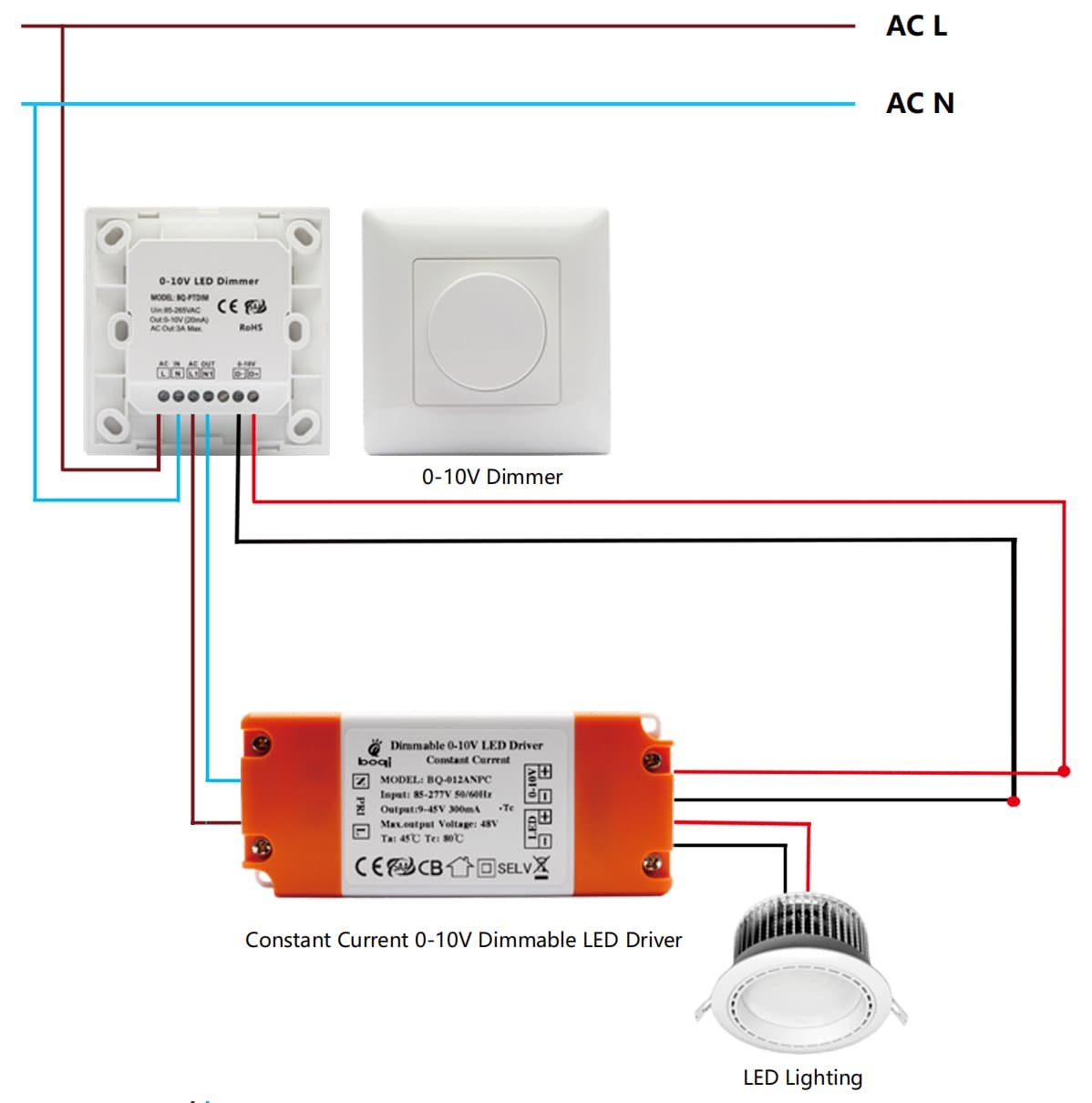
0–10V dimming involves a parallel low-voltage signal wire that talks to the driver.
- The wall-mounted 0–10V dimmer varies the control voltage.
- The driver reads this voltage and adjusts its output current.
- The current determines how bright the LED appears.
Sink vs. Source control
There are two types of 0–10V dimming control:
- Current sinking (most common): The dimmer pulls voltage down from the driver.
- Current sourcing: The dimmer sends voltage to the driver.
Always check which one your driver supports. Mixing them up can result in no dimming response.
Key Components of a 0–10V Dimming System
Just buying a 0–10V dimmer isn’t enough. You need the right setup to make it all work smoothly.
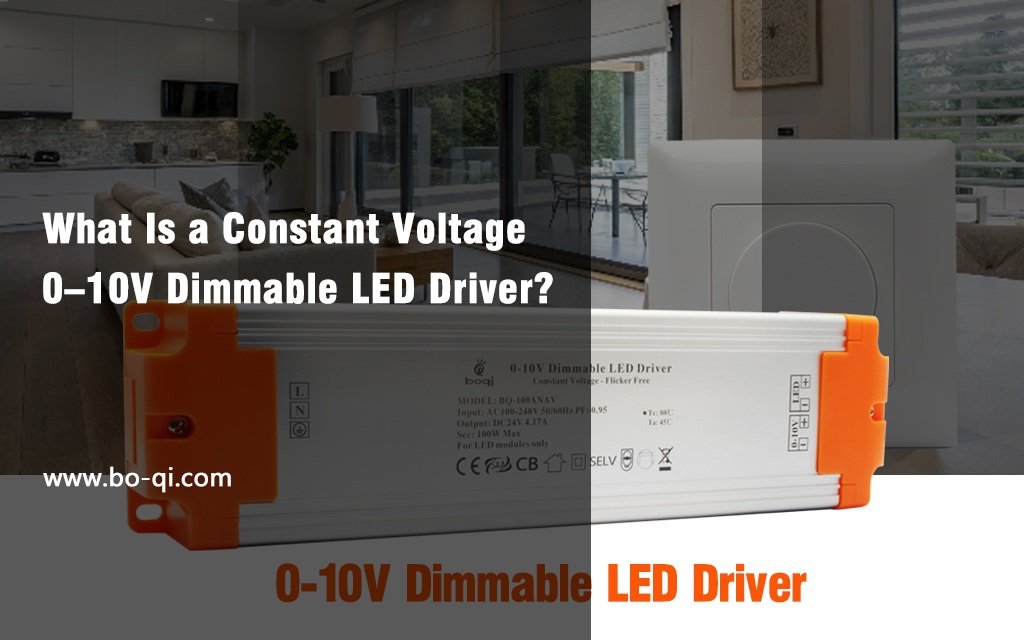
A 0–10V dimming system typically includes a compatible LED driver, a 0–10V dimmer, and low-voltage control wiring.
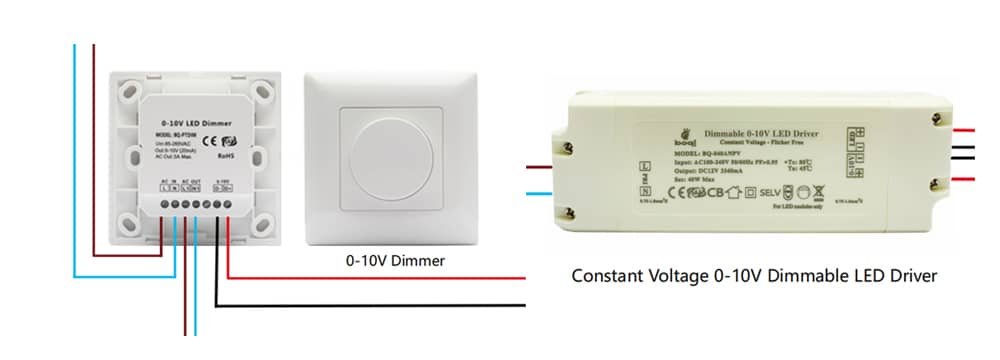
Breaking down the system
Sterownik LED 0-10 V
- Receives AC input and converts it to DC for the LED.
- Must support 0–10V dimming input.
- Some support “dim-to-off” at 0V.
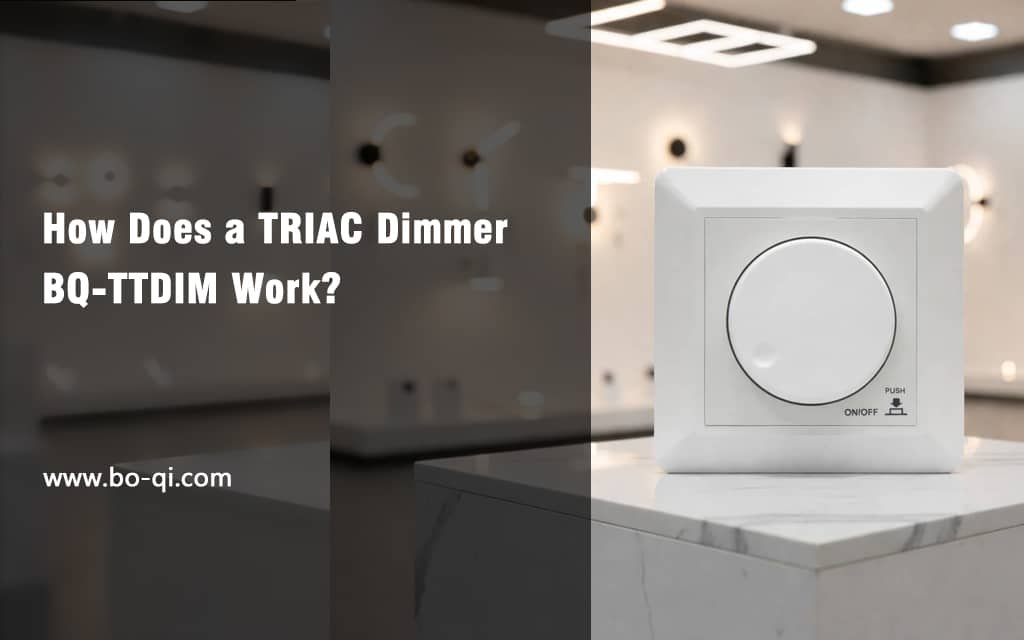
0–10V Dimmer
- Usually a wall-mounted rotary knob or slider.
- Adjusts voltage between 0 and 10V.
- Some advanced models include scene memory or remote control.
Control Wiring
- Two additional wires (typically purple and gray).
- Run separately from the AC power line.
- Must be properly shielded in noisy electrical environments.
| Komponent | Function |
|---|---|
| LED Driver | Controls LED current based on 0–10V input |
| Dimmer | Sends adjustable voltage signal |
| Signal Wires | Transmit 0–10V control signal |
0–10V vs. Other Dimming Technologies (TRIAC, DALI, PWM)
Choosing a dimming method isn’t just about brightness—it affects compatibility, flicker, and even energy savings.
0–10V dimming offers reliable analog control but lacks the advanced features and precision of digital dimming systems like DALI or PWM.

Pros and cons of other systems
TRIAC Dimming (Leading Edge)
- Uses AC phase-cut to dim.
- Simple, cheap, but can flicker.
- Mostly used in residential.
DALI (Digital Addressable Lighting Interface)
- Sends digital commands.
- Supports grouping, scenes, diagnostics.
- Complex and costly.
PWM (Pulse-Width Modulation)
- Adjusts light by switching current on/off rapidly.
- Very smooth and precise.
- Used in high-end applications.
| Typ ściemniania | Signal Type | Precyzja | Common Use Case |
|---|---|---|---|
| 0–10V | Analog | Średni | Commercial/industrial |
| TRIAC | AC phase-cut | Niski | Residential |
| DALI | Digital | Wysoki | Office/Smart control |
| PWM | Digital | Very High | Studio/Medical |
Applications: Where 0–10V Dimmers Are Commonly Used
You won’t find 0–10V dimming in every building. But for certain use cases, it’s the top choice.
0–10V dimmers are widely used in commercial buildings, warehouses, retail stores, hospitals, and classrooms due to their simplicity and smooth control.

Why it’s ideal for commercial settings
- Compatible with large-area lighting setups
- Supports multiple fixtures on one controller
- Complies with many energy codes
- Easily integrated into lighting control systems
Typical installations:
- Office ceiling panels
- Linear industrial high bays
- Downlights in retail spaces
- Architectural accent lighting
Advantages of Using 0–10V Dimmers
If you’re unsure whether 0–10V is worth it, think about long-term control and comfort.
0–10V dimmers are known for smooth dimming, easy installation, and broad compatibility with many LED drivers.
Why professionals trust it
Simple to Design and Maintain
- Fewer components compared to digital systems
- Easy to troubleshoot
Flicker-Free Operation
- Especially at mid-to-high brightness levels
Oszczędność energii
- Supports daylight harvesting and occupancy-based dimming
- Some drivers go down to 0.1% output or turn off completely
Broad Availability
- Many major LED driver brands support 0–10V as a default
Limitations You Should Know About
Every system has trade-offs. Ignoring 0–10V’s limitations can lead to costly mistakes.
0–10V systems are prone to signal voltage drop over long distances and cannot report fixture status like digital protocols can.
Common issues to watch for
No Feedback or Communication
- Unlike DALI, 0–10V can’t report errors or dimming levels back to a controller.
Voltage Drop
- Over long wire runs, the signal can degrade, leading to uneven dimming.
Electrical Noise
- In some environments, nearby AC wires may interfere with the signal.
Installation Tips for Beginners
Proper setup is the key to reliable dimming. Many problems stem from basic installation mistakes.
To install a 0–10V dimmer correctly, you must run two extra control wires, ensure correct polarity, and keep signal wires away from AC power lines.

Step-by-step tips
- Identify purple (+) and gray (–) wires on your driver.
- Run shielded low-voltage cable for signal wiring.
- Avoid running signal wires parallel to high-voltage wires.
- Confirm driver supports dim-to-off if needed.
- Use wire nuts or push-in connectors rated for low-voltage control.
Troubleshooting Common 0–10V Dimming Issues
Sometimes dimming doesn’t work as expected. Often, the fix is simple once you know where to look.
If your 0–10V dimmer doesn’t respond, check the wiring, polarity, dimmer type, and driver compatibility first.
Most frequent problems
| Problem | Likely Cause |
|---|---|
| Light not dimming | Signal wires not connected |
| Only dims partially | Driver not supporting full range |
| Flickering at low dim level | Signal interference or bad driver |
| No dimming at all | Wrong dimmer type (source/sink) |
Always double-check if your dimmer and driver use the same control type. Mixing sourcing and sinking can cause total failure.
How to Choose the Right 0–10V Dimmer for Your Project
Not all dimmers are created equal. Choosing the wrong one wastes time and money.
The right 0–10V dimmer matches your driver type, control range, dim-to-off capability, and application environment.

What to look for
- Control Type: Confirm sink or source type.
- Zakres ściemniania: Make sure it supports deep dimming if needed.
- Environment: Some models are rated for damp or outdoor use.
- Extra Features: Scene control, remote access, or timers.
- Compliance: Check for CE emc LVD RoHS certifications.
boqi’s 0–10V Dimming Solutions: Reliable, Customizable, Certified
A great dimmer is only as good as the company that backs it.
At boqi, we offer certified, customizable 0–10V dimmers and drivers that ensure smooth performance, energy savings, and long-term reliability.

Own Private Mode Design 0-10V rotary panel dimmer
- Napięcie wejściowe: AC 85–265V
- Output Signal: 0-10V(20mA)
- Prąd wyjściowy: Max 3.0A(AC)
- Sygnał wejściowy: Rotary Knob
- Zakres ściemniania: 0–100%
- IP Rating: IP20 (Indoor use)
- Operating Temp: -30°C to +55°C
- Certyfikaty: CE, EMC, LVD, RoHS
- Gwarancja: 5 lat
- Support 15 units 0-10V LED drivers
boqi 0–10V dimmers BQ-PTDIM
We’ve helped clients around the world build lighting systems that are efficient, easy to install, and built to last. Our solutions include:
- 0–10V LED drivers with dim-to-off support
- Wall-mounted dimmers with modern design
- OEM/ODM customization for your specific projects
- Certifications for Europe
FAQs About 0–10V Dimmers
Can 0–10V dimming go completely dark?
Only if your driver supports “dim-to-off.” Otherwise, 0V still leaves a small glow.
Do I need special wires?
Yes, use low-voltage rated wires, ideally twisted-pair, to reduce interference.
Can I use a regular wall dimmer for 0–10V?
No. 0–10V dimmers are separate from AC phase-cut types like TRIAC.
How many fixtures can one dimmer control?
It depends on driver input current draw, but typically dozens of fixtures are possible.
Wniosek
0–10V dimming is a simple, reliable way to control commercial LED lighting smoothly and efficiently. With the right setup and components, it’s easy to get great results.