تخطى الى المحتوى










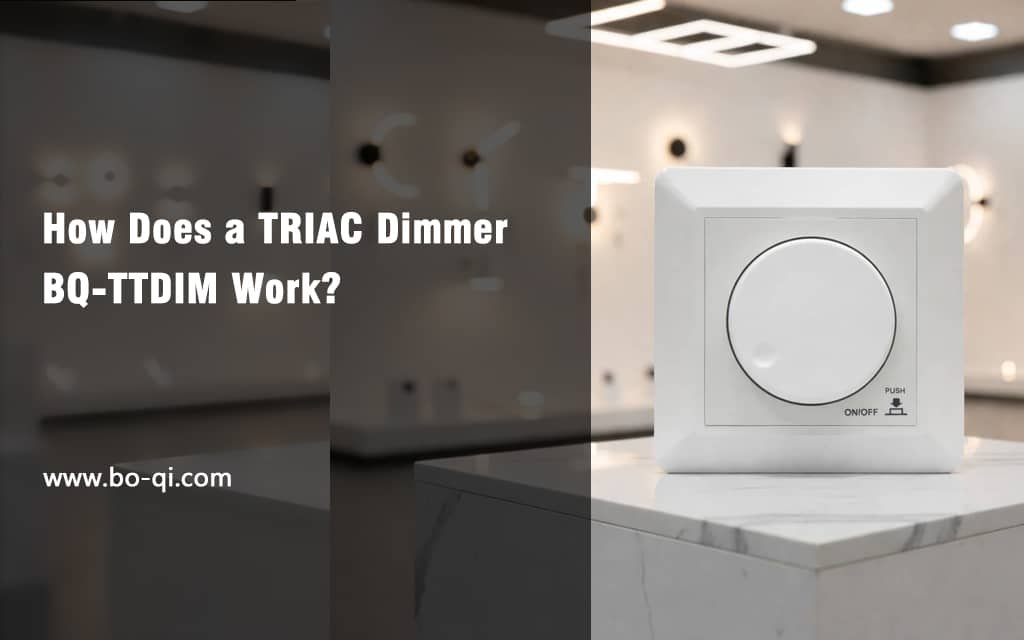
Every month, buyers ask me why TRIAC drivers still fill our production schedule TRIAC wall dimmers 1. They worry about picking outdated technology. On our factory floor at boqi, the answer is clear: TRIAC still wins.
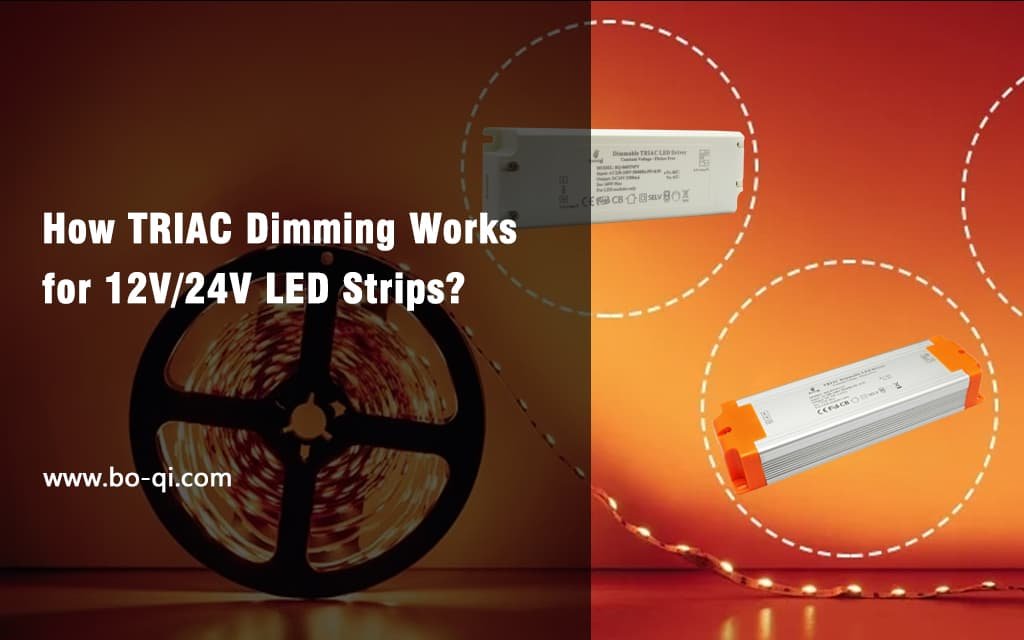
TRIAC drivers remain popular in 2026 because they work seamlessly with over a billion installed wall dimmers, require no new wiring, and cut retrofit costs dramatically. Modern designs also deliver flicker-free performance, wide dimming ranges, and improved power factor correction, keeping TRIAC the practical choice.
Let me break this down properly. In the sections below, I will cover cost, compatibility, technical improvements, and how TRIAC compares with newer digital protocols.
Why do TRIAC drivers remain so cost-effective for my large-scale LED production in 2026?
A French buyer once told me his renovation quotes doubled when the spec called for a digital control bus. When we re-quoted the same project with our TRIAC dimmable drivers, the total dropped sharply.
TRIAC drivers stay cost-effective because they use existing AC mains dimming infrastructure, need only two wires, and require no gateways, control cables, or commissioning software. Hardware is standardized, the supply chain is mature, and installation labor drops significantly compared to digital dimming systems.

The economics here are simple, and they compound at scale. When you produce or install thousands of fixtures, every extra wire, connector, and configuration step multiplies into real money. TRIAC phase-cut dimming rides on the mains line itself. There is no separate control signal. That means no signal cable, no bus topology planning, and no commissioning engineer on site.
Where the savings actually come from
In my experience shipping drivers to European and North American distributors, the cost advantage splits into three buckets:
| Cost Factor | ترياك يعتم | Digital Protocols (DALI, etc.) |
|---|---|---|
| Control wiring | None needed, uses legacy wiring infrastructure | Dedicated bus cable required |
| Wall controls | Existing dimmer switches reused | New control panels or gateways |
| Commissioning | Plug and play | Addressing and programming needed |
| Component supply | Mature, standardized, widely stocked | Fewer suppliers, higher IC costs |
| Installer skill | Any licensed electrician | Trained integrator often required |
Market data supports what we see in orders. Industry figures suggest roughly 68% of residential retrofit projects in North America and the EU choose TRIAC dimming, cutting renovation costs by over 40%. Forecasts also value the global TRIAC dimming driver market at around USD 116 million in 2026, growing steadily through 2036. That growth tells us the value proposition is holding, not fading.
The volume effect
For large-scale LED production, thyristor-based control also simplifies your bill of materials. One driver SKU can serve dozens of fixture models. Below-300W drivers dominate the segment, and dimmable LED lamps 2 remain the leading application. Standardization means fewer purchasing headaches and better negotiating leverage on components.
How can I ensure TRIAC drivers stay compatible with existing wall dimmers and wiring in my projects?
Compatibility testing is where we spend the most lab hours. Our engineers keep a shelf of over a hundred legacy wall dimmers, because a driver that fails on a twenty-year-old switch fails the customer.
Ensure compatibility by matching leading edge or trailing edge dimmer types, verifying the driver meets holding current requirements, confirming minimum load compatibility, and requesting tested dimmer lists from your supplier. Always pilot-test drivers with the actual dimmers installed on site.

The installed base is the whole game here. Estimates put more than 1.5 billion TRIAC wall dimmers 3 in service globally. Your project almost certainly touches some of them. So compatibility is not a nice-to-have; it is the product.
Understand leading edge vs trailing edge
Phase-cut dimming comes in two flavors. Leading edge dimmers, the classic TRIAC type, chop the front of each AC half-cycle. Trailing edge dimmers, common in newer European homes, chop the back. A driver optimized for one can misbehave on the other. When Jacky-type buyers send me project specs from France, the first thing I ask is which dimmer style dominates the site.
Follow a practical compatibility checklist
- Identify the dimmer type on site: leading edge, trailing edge, or universal.
- Check the driver datasheet for holding current requirements. Old TRIAC dimmers need a minimum current flowing to stay latched. If the LED load is too small, the dimmer flickers or drops out.
- Verify minimum load compatibility. Some legacy dimmers specify a 25W or 40W minimum designed for incandescent lamps.
- Confirm the driver includes a bleeder or damping circuit for low-load stability.
- Request the manufacturer's tested dimmer compatibility list. We publish ours for every model, because guessing wastes everyone's time.
- Run a pilot install with real fixtures on real wiring before committing volumes.
Legacy wiring infrastructure matters too. Two-wire circuits without a neutral at the switch box are common in older buildings. TRIAC handles this natively, which is exactly why it survives. Digital protocols usually cannot, at least not without rewiring.
What technical improvements make modern TRIAC drivers more reliable than earlier versions I used before?
Early in my career at an LED factory, I handled returns caused by buzzing dimmers and visible shimmer at low output. Those complaints shaped how our current driver generation is designed.
Modern TRIAC drivers are more reliable thanks to smarter driver ICs with real-time waveform detection, active power factor correction, adaptive bleeder circuits, flicker-free constant-current regulation, and compact high-efficiency designs. These upgrades eliminate the buzzing, shimmer, and dead-travel issues of earlier generations.

The TRIAC concept did not change. The engineering around it changed enormously. Let me walk through the biggest upgrades we have implemented and observed across the industry.
Smarter detection and control
Older drivers guessed at the dimmer's conduction angle and often guessed wrong. Modern driver ICs sample the chopped waveform every cycle and adapt in real time. Some newer designs even apply edge-level intelligent waveform analysis to synchronize with unusual or aging dimmers. The result is smooth dimming from 100% down to 1% or lower, with no sudden jumps or dead zones at the ends of dimmer travel.
Better power quality and quieter operation
Active power factor correction is now standard on quality TRIAC drivers, not a premium extra. It reduces harmonic distortion 4 pushed back into the mains and keeps power factor high even while the waveform is being chopped. Adaptive bleeder circuits inject just enough current to satisfy holding current needs, then back off to save energy. That kills the audible buzz that plagued earlier products.
| Problem in Older TRIAC Drivers | Modern Solution | Result |
|---|---|---|
| Visible flicker at low dim levels | High-frequency constant-current regulation | Flicker-free performance across the range |
| أزيز مسموع | Adaptive bleeder and damping circuits | Silent operation |
| Poor power factor | Active power factor correction | Cleaner AC mains behavior |
| Bulky enclosures | High-efficiency topologies, GaN-ready designs | Compact drivers that fit slim fixtures |
| Dimmer dropout at low load | Precise holding current management | Stable output down to deep dimming |
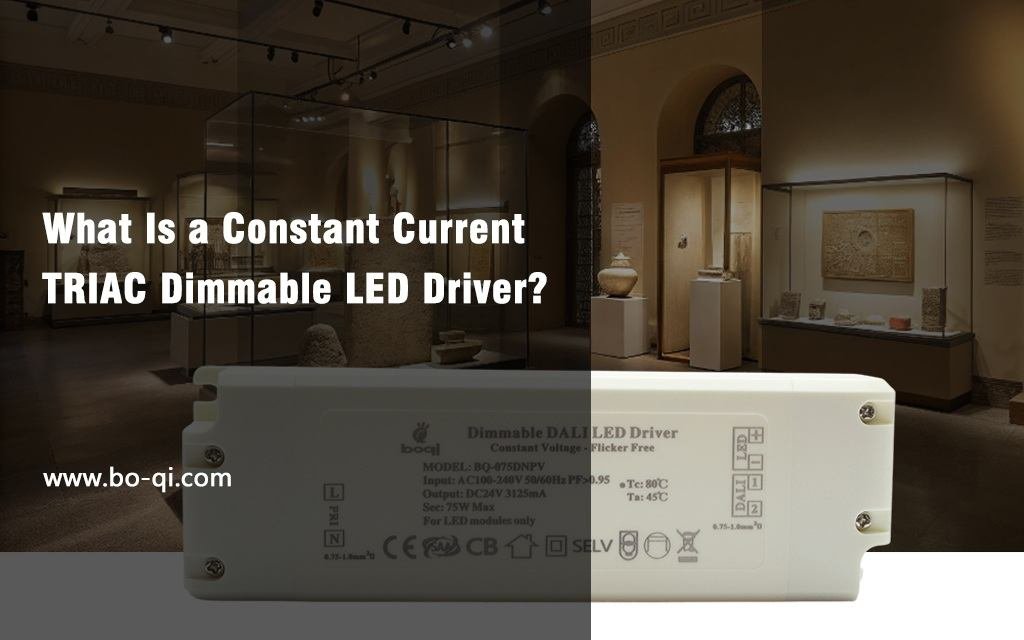
Component-level progress helps as well. Gallium Nitride semiconductors are entering driver designs, raising power density and shrinking footprints. In our own lineup, the compact inline format you see on our units, with SELV output and CE and CB compliance marks printed right on the case, reflects how far thermal and efficiency design has come.
Should I still choose TRIAC dimming over newer digital protocols for my upcoming LED driver designs?
Trade-offs drive this decision, and I weigh them with buyers weekly. One client planning a new office tower went with DALI. The same client chose TRIAC for his hotel renovation. Both choices were right.
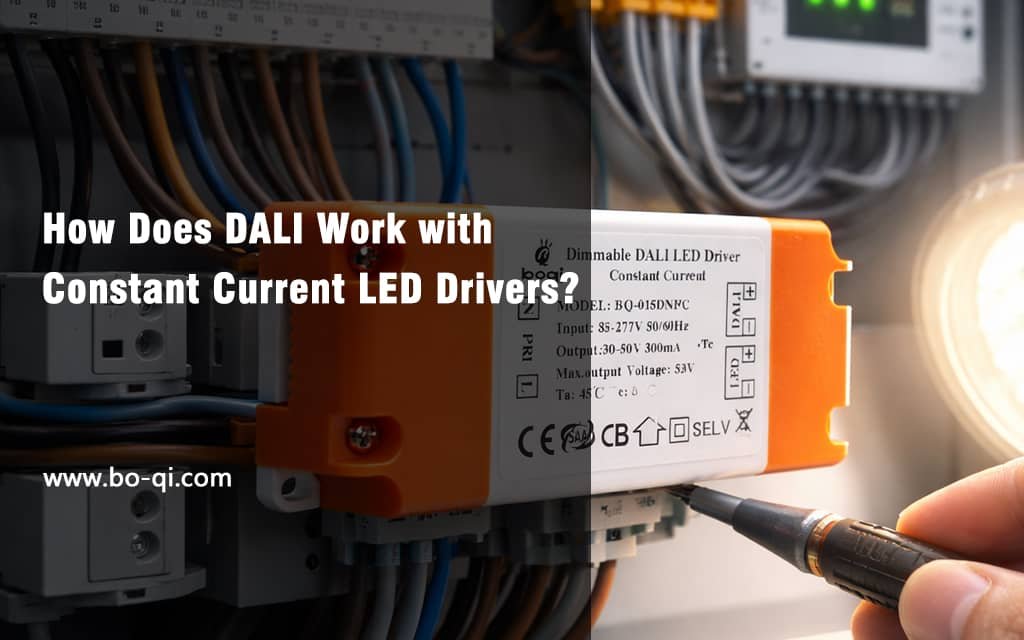
Choose TRIAC for retrofit projects, residential dimming systems, and hospitality upgrades where existing dimmers and wiring must be reused. Choose 0-10V or DALI for new commercial builds needing precise multi-zone control, addressing, or energy reporting. Match the protocol to the infrastructure.

Here is the honest comparison I share with buyers before any spec is locked:
| Criteria | ترياك | 0-10 فولت | دالي |
|---|---|---|---|
| Best use case | Retrofit LED lighting, homes, hotels | Commercial offices, warehouses | New builds, smart buildings |
| Wiring needed | Existing two-wire mains only | Two extra low-voltage wires | Dedicated bus cable |
| Individual addressing | لا يوجد | لا يوجد | Yes, per fixture |
| Commissioning | None | Minimal | Software configuration |
| Cost per point | Lowest | معتدل | Highest |
| Dimming precision | Good, improving | Good | ممتاز |
| Smart home integration | Via hybrid bridge drivers | Via controllers | Native in many systems |
Where TRIAC wins
TRIAC is the pragmatic answer whenever legacy infrastructure exists. Residential dimming systems dominate demand because homeowners want dimmable LEDs behind the switches they already own. Hotels and restaurants follow the same logic. Commercial retrofits accounted for a large share of TRIAC dimmable driver installations recently, driven by green building upgrades that keep existing wiring.
Where TRIAC loses
For a new commercial building with hundreds of addressable zones, daylight harvesting 5, and energy reporting, DALI is simply better. TRIAC cannot address individual fixtures, and waveform chopping brings inherent trade-offs in harmonics compared to a clean digital signal.
The hybrid middle path
The line is also blurring. Hybrid drivers now pair TRIAC input with Matter-compatible smart modules 6, letting a legacy analog dimmer join a modern smart home ecosystem. In our development roadmap, this hybrid category is growing fastest, because it protects the customer's installed hardware while adding digital features.
My rule of thumb: if the walls are already wired and the switches already exist, TRIAC. If you are pulling fresh cable anyway, consider digital.
خاتمة
Choosing a dimming architecture feels risky when protocols multiply yearly. Pick wrong, and costs balloon. TRIAC drivers endure in 2026 because compatibility, simplicity, and retrofit economics still beat technical elegance.
Footnotes
1. Background reference explaining TRIAC technology behind the widely installed wall dimmers mentioned. ↩︎
2. Energy Star guide explaining compatibility and performance standards for dimmable LED bulbs. ↩︎
3. Technical overview of TRIAC components and their role in phase-cut dimming systems. ↩︎
4. Scientific explanation of total harmonic distortion and its impact on electrical power systems. ↩︎
5. Authoritative resource on daylighting strategies and harvesting controls for building efficiency. ↩︎
6. Official Matter protocol documentation clarifies the smart home standard referenced in hybrid drivers. ↩︎