Loncat ke konten








When your LED lights flicker or dim unevenly, the problem often starts with the driver. Choosing the wrong type can ruin your lighting setup.
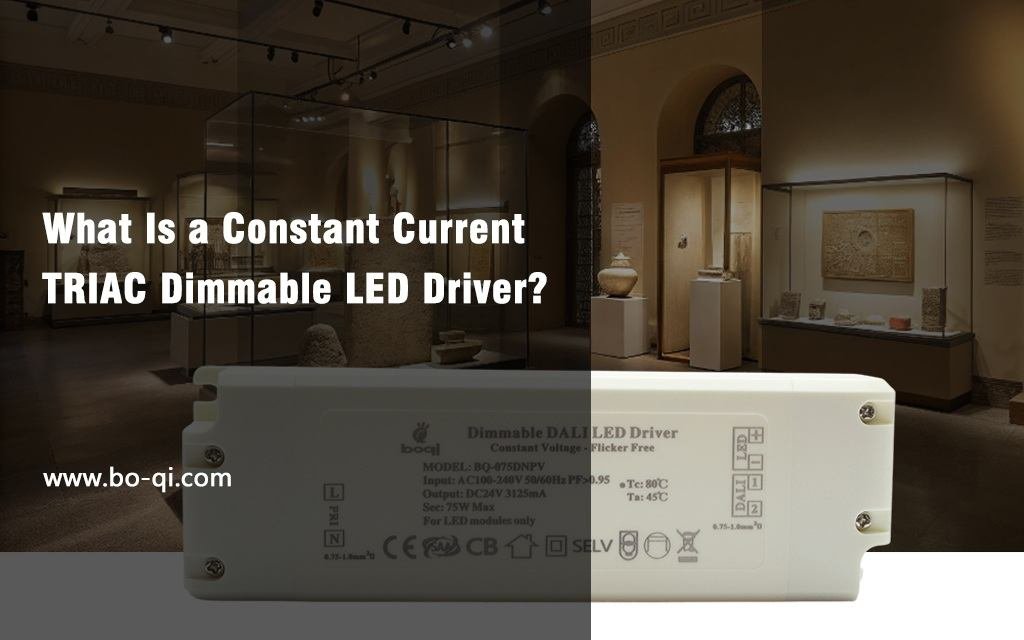
A constant current TRIAC dimmable LED driver delivers a fixed current to LEDs while allowing dimming via standard wall dimmers using phase-cut technology.
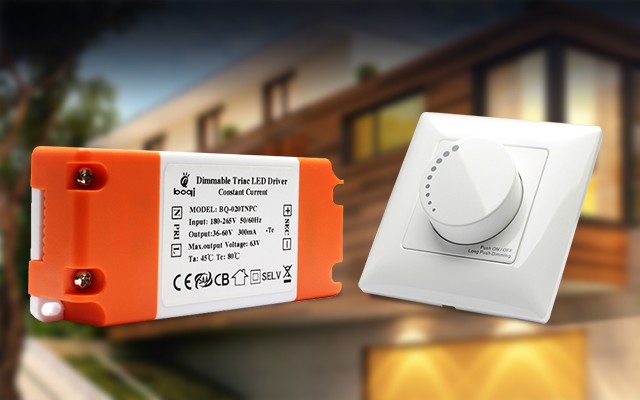
Let me walk you through how these drivers work, why they matter, and how to choose the right one for your lighting project.
What Is a Constant Current LED Driver?
Many people confuse constant current dengan constant voltage. The difference can make or break your LED performance.
A constant current LED driver outputs a fixed current—measured in milliamps (mA)—and adjusts voltage to match the LED’s forward voltage needs.

Constant current drivers are essential when you want to protect LEDs from thermal runaway and current surges.
| Fitur | Driver Arus Konstan | Constant Voltage Driver |
|---|---|---|
| Output Type | Current (fixed mA) | Voltage (fixed V) |
| Aplikasi | COB, High-power LEDs | LED Strips, Arrays |
| Voltage Flexibility | Wide | Limited |
| Kompatibilitas Peredupan | Needs current dimming | Easier with PWM |
Forward Voltage Range
Each LED has a forward voltage range. The driver must adapt to this range while holding current steady. For example, a 350mA driver may support 9–36V, automatically adjusting voltage to keep the current fixed.
TRIAC Dimming Explained: Leading Edge Phase-Cut Technology
TRIAC dimming sounds complicated, but it’s actually based on a simple principle: cutting parts of the AC wave.
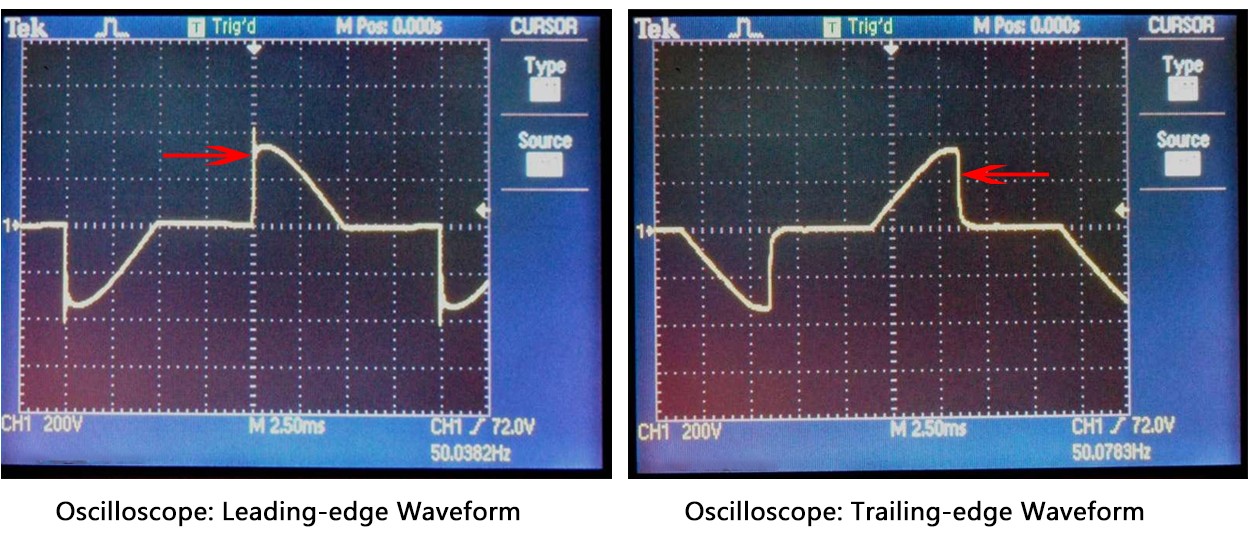
TRIAC dimming works by chopping the voltage waveform, controlling how much power reaches the LED. It’s called “leading-edge” or “phase-cut” dimming.
Understanding Phase-Cut Control
TRIACs (Triode for Alternating Current) cut the voltage at the beginning of each AC half-cycle. This changes the power sent to the driver, which in turn adjusts the light output.
Benefits of TRIAC:
- Widely used in residential wall dimmers
- Low cost and easy availability
- Works with legacy wiring systems
But it’s not always smooth. If the driver isn’t designed properly, the result is visible flicker or buzzing.
How a Constant Current TRIAC Dimmable Driver Works
Combining constant current output with phase-cut dimming is an engineering challenge. Let’s look under the hood.
A constant current TRIAC dimmable driver converts AC to DC, maintains a fixed current, and interprets chopped AC input from a TRIAC dimmer to adjust LED brightness.
Step-by-Step Operation
- Input Stage: Accepts AC power, including the chopped waveform from the dimmer.
- Rectifier and Filtering: Converts AC to high-voltage DC and smooths it.
- Dimming Decoder Circuit: Detects the phase angle of the dimmer’s cut waveform.
- Control Loop: Adjusts the output current accordingly, maintaining constant current.
- Output Stage: Sends a fixed current to LEDs while adjusting voltage based on total load.
This requires precise design. If the control loop lags or misreads the dimmer signal, the output can flicker or buzz.
Key Electrical Characteristics You Should Know
When selecting a TRIAC dimmable driver, a few key specs can save you from big headaches later.
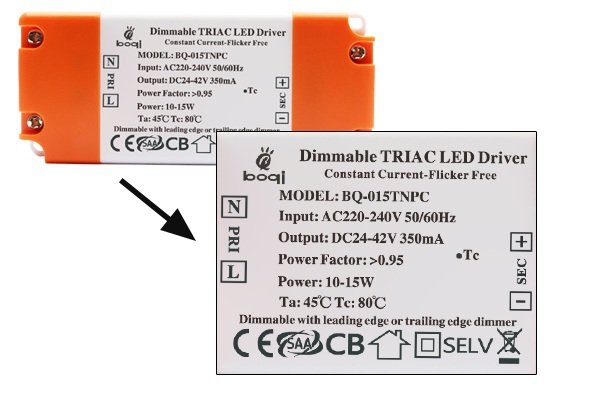
Important parameters include current rating, voltage range, PF (Power Factor), THD (Total Harmonic Distortion), efficiency, and dimming range.
What to Look For
| Parameter | What It Means | Why It Matters |
|---|---|---|
| Output Current | Fixed mA value | Must match LED specs |
| Output Voltage | Range (e.g., 9–36V) | Must cover total LED forward voltage |
| Power Factor (PF) | Should be >0.9 | More efficient, meets commercial standards |
| THD | Should be <20% | Reduces interference |
| Efisiensi | Typically 85–92% | Affects heat and energy usage |
| Rentang Peredupan | Usually 0–100% | Lower range allows softer dimming |
Application Scenarios: Where This Driver Type Performs Best
This driver isn’t for every project. But when it’s the right fit, it’s hard to beat.
TRIAC constant current drivers are ideal for residential lighting, retrofit projects, and any setup using standard wall dimmers.

Kasus Penggunaan Terbaik
- Downlights and recessed fixtures in homes
- LED retrofit bulbs replacing halogen/MR16
- Track lights and wall sconces
- Hotel rooms where dimmers are pre-installed
- Restaurants and retail lighting needing ambiance control
These setups often already use TRIAC wall dimmers. Upgrading to LED while keeping the same dimming hardware makes TRIAC dimmable drivers the go-to.
Compatibility with LEDs, Dimmers, and Fixtures
Not all TRIAC dimmable drivers play nice with all LEDs. Matching is crucial.
To avoid flicker or dimming dead zones, the driver must be compatible with the dimmer, fixture, and LED load.
Matching Rules
- Check Load Requirements: The total LED forward voltage must fall within the driver’s range.
- Check Current Rating: Match the constant current output (e.g., 350mA, 700mA).
- Jenis Peredup: Use a leading-edge dimmer. Avoid trailing-edge unless tested.
- Minimum Load: Many TRIAC dimmers need a minimum load (e.g., 20W) to function well.
- Driver Dimming Curve: Check if it has a linear or logarithmic dimming response.
Testing is key. I always test drivers with real fixtures and dimmers before bulk purchasing.
Benefits of Using Constant Current TRIAC Dimmable Drivers
Why go through all this effort? Because the results are worth it.
These drivers offer cost-effective dimming, wide compatibility, and an easy upgrade path for halogen systems.
Summary of Benefits
- Compatible with existing wiring
- Works with standard dimmers
- No need for complex control systems
- Lower cost than 0-10V or DALI setups
- Smooth, flicker-free dimming (when designed right)
- Available in a wide range of wattages and currents
Potential Challenges: Flicker, Load Matching, and Solutions
Of course, it’s not always smooth sailing. Let’s look at common pitfalls and how to avoid them.
Flicker, improper dimmer compatibility, or load mismatch can cause performance issues in TRIAC dimmable drivers.

Common Problems and Fixes
| Masalah | Karena | Solusi |
|---|---|---|
| Berkedip-kedip | Dimmer-driver mismatch | Use dimmer from driver’s tested list |
| Buzzing noise | EMI or driver layout issue | Choose certified driver with EMI compliance |
| Dimming dead zone | Minimum load not met | Add dummy load or more LEDs |
| Inconsistent dimming | Bad waveform recognition | Use driver with smart phase-cut detection |
I’ve learned the hard way—always test combinations under real-world conditions.
Installation Tips and Wiring Guide
Even the best driver fails if wired wrong. Here’s how I install them right.
Proper wiring, grounding, and fixture matching are critical to get flicker-free dimming from TRIAC drivers.

Key Installation Tips
- Line → L / Neutral → N: Confirm polarity.
- Use Proper Gauge Wire: Follow local codes for current capacity.
- Isolate Input/Output Wires: Avoid interference.
- Secure Connections: Use terminal blocks or solder properly.
- Test with Dimmer: Adjust dimmer slowly during testing phase.
- Grounding: Ensure driver case is grounded if metal.
I always label everything during install—it saves time later when troubleshooting.
How to Select the Right Driver for Your Project
There’s no one-size-fits-all driver. Your choice must match project needs.
Choose based on current output, voltage range, dimmer compatibility, efficiency, and safety certifications.
My Checklist
- Current: Match LED’s spec (e.g., 350mA)
- Voltage: Total LED Vf must be inside range (e.g., 9–36V)
- Wattage: Always leave 10–20% headroom
- Dimmer: Check compatibility list
- Environment: Waterproof (IP65) or indoor use?
- Certs: UL, CE, FCC depending on region
I never finalize a purchase without double-checking datasheets.
boqi Solutions: Reliable, Customizable, and Certified Drivers
Now let’s talk about what we offer at boqi.
At boqi, we design and supply constant current TRIAC dimmable drivers that are flicker-free, customizable, and certified to global standards.

Why Choose boqi
- Custom output current options
- Wide voltage ranges (24-42V, 50–72V, etc.)
- Flicker-free dimming with low-end depth
- Compatibility with major dimmer brands
- CE, CB, SAA, RoHS certifications
- Technical support and OEM service
I built BOQI based on years of solving real-world problems like yours.
Frequently Asked Questions About TRIAC Constant Current Drivers
Q1: Can I use these drivers with LED strips?
No, most LED strips require constant voltage drivers.
Q2: Why do my lights flicker when dimming?
Likely due to dimmer-driver mismatch or insufficient load.
Q3: What’s the typical dimming range?
Usually from 5–100%, depending on the driver and dimmer.
Q4: Is this suitable for commercial lighting?
Yes, for retrofit projects. But 0-10V or DALI may be better for complex systems.
Q5: Do I need a neutral wire at the dimmer?
Many TRIAC dimmers don’t require neutral, making wiring simpler.
Kesimpulan
Constant current TRIAC dimmable LED drivers offer a practical, cost-effective dimming solution—when selected and installed correctly.