コンテンツにスキップ












Many LED strip projects fail during dimming. Lights flicker, buzz, or refuse to dim smoothly. Many engineers blame the LED strips, but the real problem often hides in the dimming method.
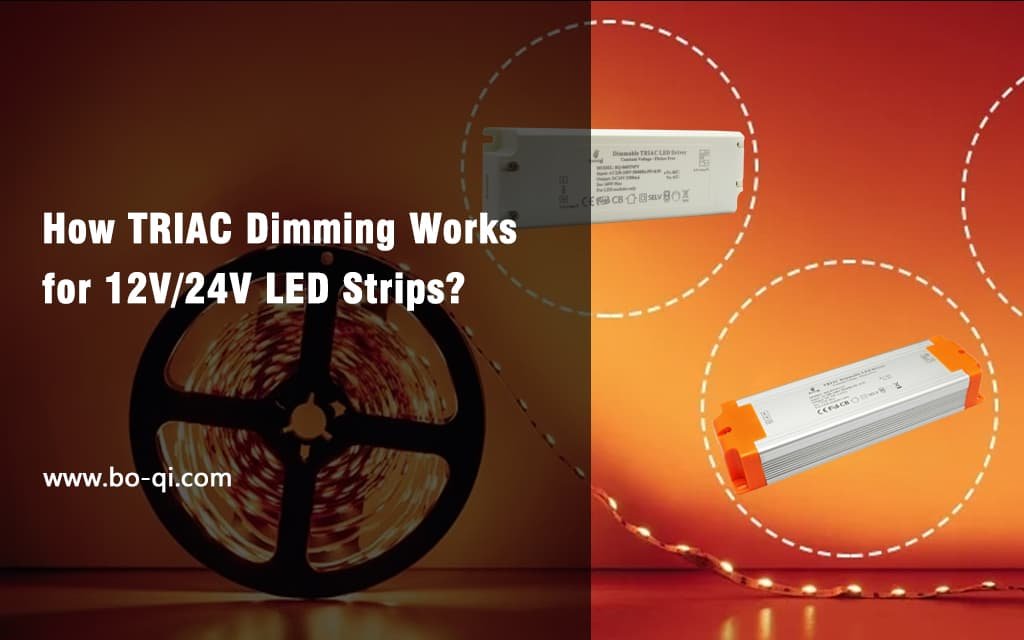
TRIAC dimming controls brightness by cutting part of the AC waveform. For 12V or 24V LED strips, a TRIAC-compatible LED driver converts the chopped AC signal into stable DC output and translates the phase-cut signal into smooth LED brightness control.

TRIAC dimming is one of the oldest lighting control technologies. Yet it still appears in modern LED strip systems. I often see buyers and engineers confused about how it actually works with low-voltage LED strips. In this guide, I will explain the full system structure, the technology behind phase-cut dimming, and how to choose the right TRIAC dimmable LED driver.
What Is TRIAC Dimming and Why It Is Still Widely Used in LED Projects?
Many lighting projects want simple dimming. However, installing new control systems can increase cost and complexity.
TRIAC dimming is a phase-cut dimming method widely used in residential and commercial lighting because it works with traditional wall dimmers and standard AC wiring without needing extra control lines.

I have worked with many lighting manufacturers and contractors. One thing I notice often is that TRIAC dimming appears in many renovation projects. The reason is simple. Buildings already have wall dimmers installed.
Why TRIAC dimming became a standard
TRIAC dimmers originally controlled incandescent lamps. These lamps respond directly to voltage changes. When the dimmer cuts part of the AC waveform, the lamp simply becomes dimmer.
LED lighting is different. LEDs need stable DC power. They cannot connect directly to AC dimmers.
Yet TRIAC dimmers remain common because they offer several advantages.
| 特徴 | 説明 |
|---|---|
| Simple wiring | Uses standard AC power lines |
| Low installation cost | No extra control cables |
| Widely available | Many brands produce TRIAC dimmers |
| Familiar interface | Traditional wall dimmer switches |
Why projects still choose TRIAC dimming
I often see three situations where TRIAC dimming remains popular.
1. Residential lighting
Homes usually already use wall dimmers. Replacing the entire system with smart controls would cost more.
2. Renovation projects
In old buildings, rewiring control systems is difficult. TRIAC dimming works with existing electrical infrastructure.
3. Small commercial spaces
Restaurants, retail shops, and hotels often want simple lighting control without complex automation systems.
Limitations engineers should understand
Even though TRIAC dimming is simple, LED lighting requires careful system design.
Problems appear when people use incompatible drivers.
| Common Issue | Root Cause |
|---|---|
| LED flicker | Driver cannot interpret phase-cut signal |
| Noise from driver | Poor compatibility with dimmer |
| Limited dimming range | Driver design limitation |
| Lights stay slightly on | Leakage current in dimmer |
This is why selecting the right TRIAC dimmable LED driver is critical.
How TRIAC Phase-Cut Dimming Works in LED Lighting Systems?
Many engineers hear the term “phase-cut dimming” but do not fully understand how the waveform changes.
TRIAC dimming reduces LED brightness by cutting part of the AC sine wave. The remaining portion of the waveform delivers less power to the driver, which then adjusts the LED output.


To understand TRIAC dimming, we must first look at the AC waveform.
AC power follows a sine wave pattern. A TRIAC dimmer interrupts this wave at certain points.
Two main phase-cut methods
TRIAC dimming normally uses two different techniques.
Leading-edge dimming
Leading-edge dimming cuts the beginning part of each AC half cycle.
| 特徴 | 説明 |
|---|---|
| Cut location | Beginning of waveform |
| Typical device | TRIAC dimmer |
| Common use | Older dimmer designs |
| コスト | より低い |
This method produces a sudden voltage rise. That sharp transition can create electrical noise.
Many early LED drivers struggled with this waveform.
Trailing-edge dimming
Trailing-edge dimming cuts the end of the waveform.
| 特徴 | 説明 |
|---|---|
| Cut location | End of waveform |
| Typical device | MOSFET dimmer |
| Smoothness | Better |
| LED compatibility | より高い |
Trailing-edge dimming produces smoother electrical behavior. Many modern LED drivers prefer this method.
How the LED driver interprets the signal
The TRIAC dimmable LED driver performs several tasks.
First, it detects the phase-cut angle.
Second, it calculates the intended brightness level.
Third, it adjusts the output accordingly.
| Phase Angle | Driver Interpretation |
|---|---|
| Small cut | High brightness |
| Medium cut | Medium brightness |
| Large cut | Low brightness |
Inside the driver, control circuits convert this information into stable LED power.
Without this interpretation process, LEDs would flicker or shut down.
This is why a standard power supply cannot replace a TRIAC dimmable LED driver.
Typical System Structure for TRIAC Dimming 12V/24V LED Strips?
Many buyers misunderstand the dimming system architecture. They think the dimmer directly controls the LED strip.
That assumption is incorrect.
A complete TRIAC dimming LED strip system includes three core components: a TRIAC wall dimmer, a TRIAC dimmable LED driver, and 12V or 24V constant voltage LED strips.
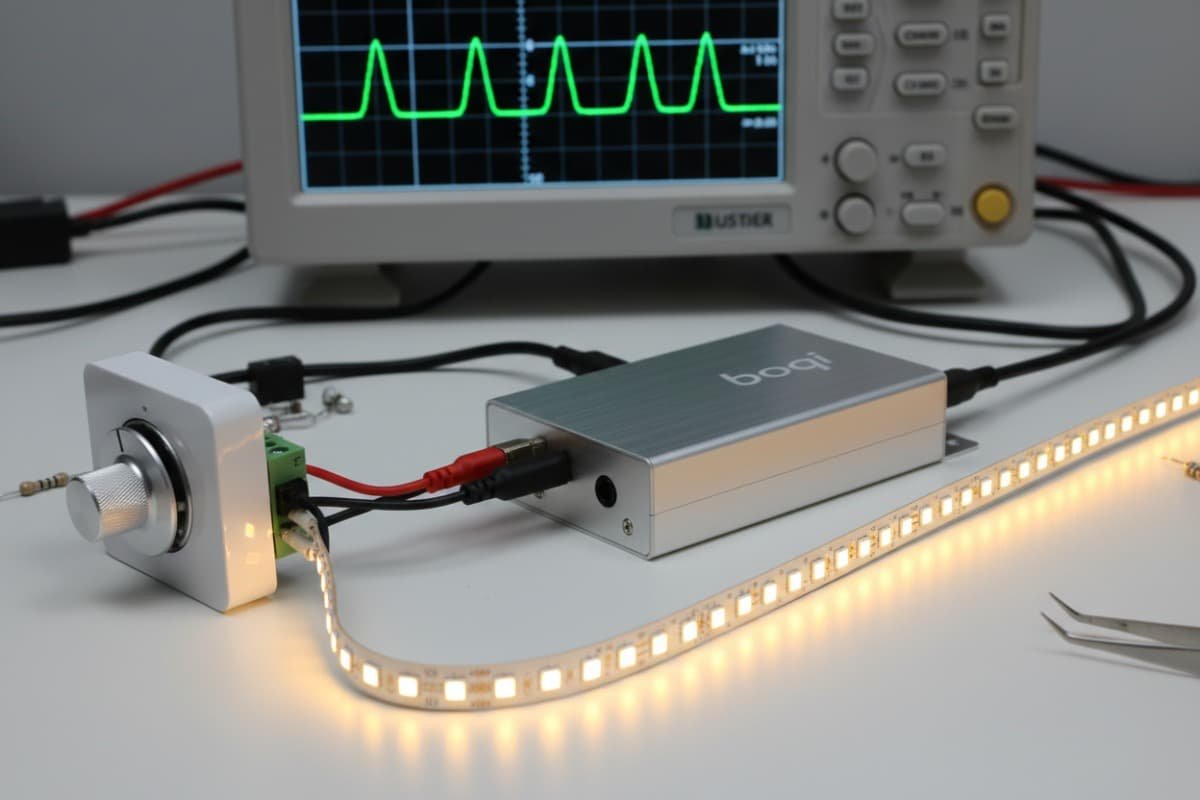
Understanding this structure helps engineers design reliable lighting systems.
Basic system architecture
The signal flow is straightforward.
AC Power
↓
TRIAC Wall Dimmer
↓
TRIAC調光LEDドライバ
↓
12V / 24V LED Strip
Each component has a specific role.
Component functions
| コンポーネント | Function |
|---|---|
| TRIAC wall dimmer | Cuts AC waveform |
| LEDドライバ | Converts AC to DC and interprets dimming |
| LED strip | Produces light |
The dimmer never connects directly to the LED strip.
Why constant voltage drivers are used
Most LED strips operate with constant voltage.
Common voltages include:
- 12V
- 24V
Constant voltage drivers maintain stable output voltage. The LED strip contains resistors or control circuits that regulate current.
Example system specification
Here is a typical LED strip dimming system.
| Item | Example Spec |
|---|---|
| Input voltage | 120V AC |
| Driver output | 24V DC |
| Driver power | 150W |
| LED strip voltage | 24V |
| Dimming method | トライアック |
This architecture ensures stable operation.
When engineers understand this system structure, troubleshooting becomes much easier.
Why 12V/24V LED Strips Require a TRIAC Dimmable LED Driver?
Many new buyers ask a simple question.
Why can’t we connect a LED strip directly to a wall dimmer?
12V or 24V LED strips require a TRIAC dimmable LED driver because the dimmer only modifies AC power, while LED strips need stable low-voltage DC power to operate correctly.

The LED driver performs several critical functions.
AC to DC conversion
First, the driver converts AC power to DC.
LED strips require constant voltage DC output.
| Input | Output |
|---|---|
| 120V / 230V AC | 12V / 24V DC |
Without this conversion, the LEDs would be destroyed.
Dimming signal detection
Second, the driver detects the phase-cut waveform.
The control circuit analyzes the waveform timing.
| Phase Cut Angle | Interpreted Brightness |
|---|---|
| Small | Bright |
| ミディアム | ミディアム |
| Large | Dim |
This detection circuit is what separates a TRIAC dimmable driver from a standard power supply.
Stable PWM output
Finally, the driver adjusts LED brightness.
Most modern drivers use PWM control.
PWM stands for pulse width modulation.
| PWM Duty Cycle | LED Brightness |
|---|---|
| 100% | Full brightness |
| 50% | Half brightness |
| 10% | Low brightness |
The driver converts the phase-cut signal into PWM output.
This method ensures smooth dimming without affecting LED color.
Why standard drivers fail
Standard LED drivers do not recognize phase-cut signals.
This leads to several issues.
| 問題点 | 原因 |
|---|---|
| 明滅 | Driver misreads waveform |
| Buzzing | Electrical instability |
| Limited dimming | Control circuit missing |
| Driver shutdown | Protection triggered |
This is why professional LED strip systems always require TRIAC dimmable LED drivers.
Key Technical Parameters Buyers Should Check When Selecting TRIAC Drivers?
Many buyers focus only on price when choosing LED drivers.
However, poor driver performance often causes expensive project failures.
When selecting a TRIAC dimmable LED driver, buyers should evaluate electrical specifications, dimming performance, load capacity, efficiency, and safety certifications.

I always recommend checking several key parameters before purchasing.
Input voltage range
The driver must match the AC power supply.
| Region | Typical Voltage |
|---|---|
| North America | 120V |
| Europe | 220-240V |
| Global projects | 100-277V |
Wide input voltage improves flexibility.
Output voltage
LED strips require constant voltage.
| LED Strip Type | Driver Output |
|---|---|
| 12V LED strip | 12V driver |
| 24V LED strip | 24V driver |
Mismatch can damage the lighting system.
Maximum load capacity
The driver must support the total LED power.
I usually recommend keeping load at 80-90% of rated power.
| Driver Power | Recommended Load |
|---|---|
| 100W | 80-90W |
| 150W | 120-135W |
This improves reliability and lifespan.
調光範囲
A good driver should support full dimming range.
| Driver Quality | 調光範囲 |
|---|---|
| Basic | 30-100% |
| Good | 10-100% |
| High-end | 0-100% |
Smooth dimming is important for professional lighting projects.
Flicker performance
Poor drivers cause visible flicker.
High-quality drivers maintain stable output.
Power factor and efficiency
These parameters affect energy usage.
| Parameter | Good Value |
|---|---|
| Power factor | >0.9 |
| 効率 | >85% |
Certifications
Professional projects require safety certifications.
| Certification | Region |
|---|---|
| CE | Europe |
| RoHS | Environmental compliance |
| UL | North America |
These parameters help buyers select reliable LED drivers.
Compatibility Between TRIAC Dimmers and LED Drivers?
Many engineers believe that any TRIAC dimmer works with any LED driver.
That assumption often leads to problems.
TRIAC dimmer compatibility depends on dimmer type, load requirements, and driver design, which is why not all dimmers work properly with every LED driver.

Leading vs trailing edge compatibility
Some drivers support both types.
Others only support one.
| 調光タイプ | 互換性 |
|---|---|
| Leading edge | Most common |
| Trailing edge | Better performance |
High-quality drivers usually support both.
Minimum load requirement
TRIAC dimmers were designed for incandescent lamps.
These lamps draw large current.
LED drivers consume less power.
If the load is too small, dimmers behave unpredictably.
| Issue | 原因 |
|---|---|
| 明滅 | Load too low |
| Dimmer not working | Minimum load not met |
Dimmer brand compatibility
Not all dimmers perform the same.
Different brands use different circuits.
Driver manufacturers usually test compatibility with popular brands.
| Dimmer Brand | Market |
|---|---|
| Lutron | North America |
| レビトン | North America |
| Schneider | Europe |
Before large projects, I recommend compatibility testing.
Common TRIAC Dimming Problems in LED Strip Projects?
Even with good components, dimming problems sometimes appear.
Understanding the root cause helps engineers solve issues quickly.
The most common TRIAC dimming problems include LED flickering, buzzing noise, limited dimming range, and lights that cannot fully turn off.

LED flickering
Flicker usually appears at low brightness.
Possible causes include:
| 原因 | 説明 |
|---|---|
| Poor driver design | Cannot interpret phase-cut signal |
| Incompatible dimmer | Waveform instability |
| Low load | Dimmer malfunction |
Buzzing noise
Buzzing often comes from the driver.
| Source | Reason |
|---|---|
| Magnetic components | Vibration |
| High ripple current | Electrical noise |
Good driver design minimizes this issue.
Limited dimming range
Sometimes lights dim only between 30% and 100%.
Possible causes:
| 原因 | Reason |
|---|---|
| Driver limitation | Poor dimming circuit |
| Dimmer mismatch | Incorrect waveform detection |
Lights not turning off
Some LED strips glow faintly even when dimmer is off.
| 原因 | 説明 |
|---|---|
| Leakage current | Dimmer electronics |
| Driver sensitivity | Circuit design |
Better drivers include anti-ghosting circuits.
Installation Best Practices for TRIAC Dimming LED Strip Systems?
Even high-quality components can fail with poor installation.
Proper design practices improve system stability.
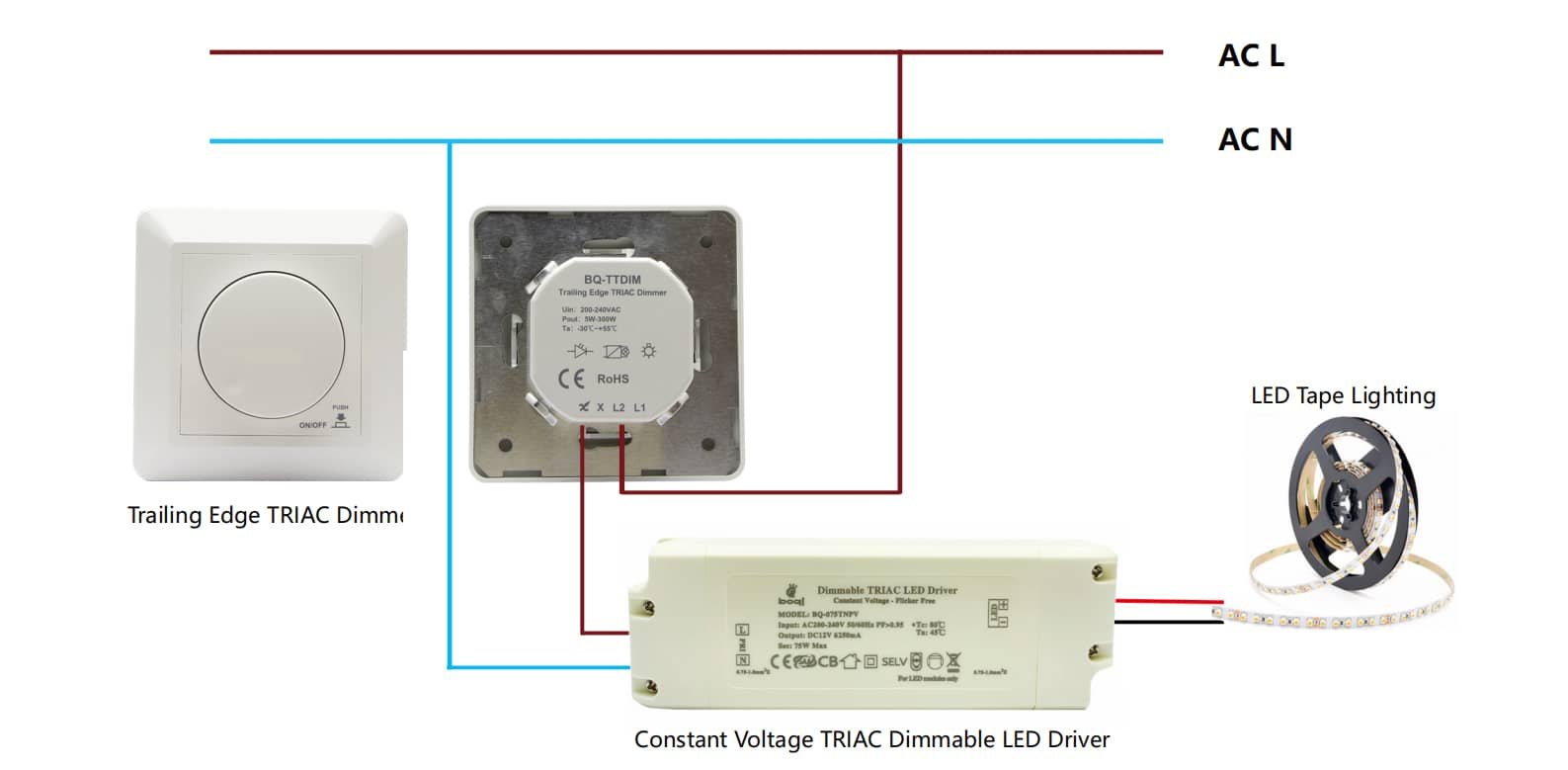
Correct driver sizing, proper wiring, and dimmer compatibility testing are essential for stable TRIAC dimming LED strip systems.
Driver load recommendation
Never run drivers at full capacity.
| Driver Rating | Recommended Load |
|---|---|
| 100W | 80-90W |
| 200W | 160-180W |
This prevents overheating.
Correct wiring
Incorrect wiring causes dimming instability.
| Connection | Rule |
|---|---|
| AC input | Connect through dimmer |
| DC output | Connect to LED strip |
Dimmer-driver matching
Testing dimmer compatibility before installation is important.
Avoiding overload
Overload leads to driver shutdown.
Always calculate total LED power.
TRIAC vs 0-10V vs DALI: Which Dimming Method Is Better for LED Strips?
Lighting designers often choose between several dimming methods.
Each method serves different applications.
TRIAC dimming works best for residential lighting, while 0-10V そして DALI systems are more suitable for commercial and smart building projects.
TRIAC dimming
| 特徴 | 説明 |
|---|---|
| 配線 | Standard AC |
| Control | Wall dimmer |
| 申し込み | Homes |
0-10V調光
| 特徴 | 説明 |
|---|---|
| Control signal | Analog voltage |
| Stability | Good |
| 申し込み | Commercial lighting |
DALI dimming
| 特徴 | 説明 |
|---|---|
| Control system | Digital |
| 特徴 | Smart control |
| 申し込み | Smart buildings |
Each system has different complexity levels.
How to Choose a Reliable TRIAC Dimmable LED Driver Supplier?
Many LED strip failures originate from poor driver quality.
Choosing the right supplier reduces risk.
A reliable TRIAC dimmable LED driver supplier should offer stable dimming performance, wide dimmer compatibility, customization options, and strong technical support for lighting projects.

Stable dimming performance
The most important feature is dimming stability.
Good drivers maintain smooth brightness control.
Wide dimmer compatibility
A strong supplier tests drivers with many dimmer brands.
| 特徴 | 重要性 |
|---|---|
| Compatibility list | Reduces risk |
| Lab testing | Improves reliability |
Customization options
Large projects often require customization.
Examples include:
- Custom power ratings
- Special housing design
- Regional certification
Technical support
Engineering support helps solve system problems quickly.
A good supplier provides:
| Service | ベネフィット |
|---|---|
| Compatibility testing | Prevents dimming issues |
| Technical consultation | Supports system design |
| Project customization | Meets unique requirements |
From my experience in the LED driver industry, reliable suppliers make a huge difference in project success.
Reliable TRIAC Dimming Solutions from boqi
ボクキ is a trusted Chinese manufacturer specializing in high-performance LED調光器 そして 調光LEDドライバー. Our TRIAC dimmable drivers are designed specifically for 12V and 24V LED strip lighting, delivering smooth, flicker-free dimming and stable output.
All boqi products comply with CE and RoHS certifications, ensuring safety and international quality standards. With fast lead times, customization services, and a 5-year warranty, we provide scalable lighting control solutions for residential, commercial, and architectural lighting projects worldwide.
Looking for a dependable supplier of TRIAC dimming solutions for LED strips?
Choose boqi — where quality meets innovation.
結論
TRIAC dimming remains a practical solution for many LED strip projects. With the right TRIAC dimmable LED driver and proper system design, it can deliver stable and smooth brightness control.